
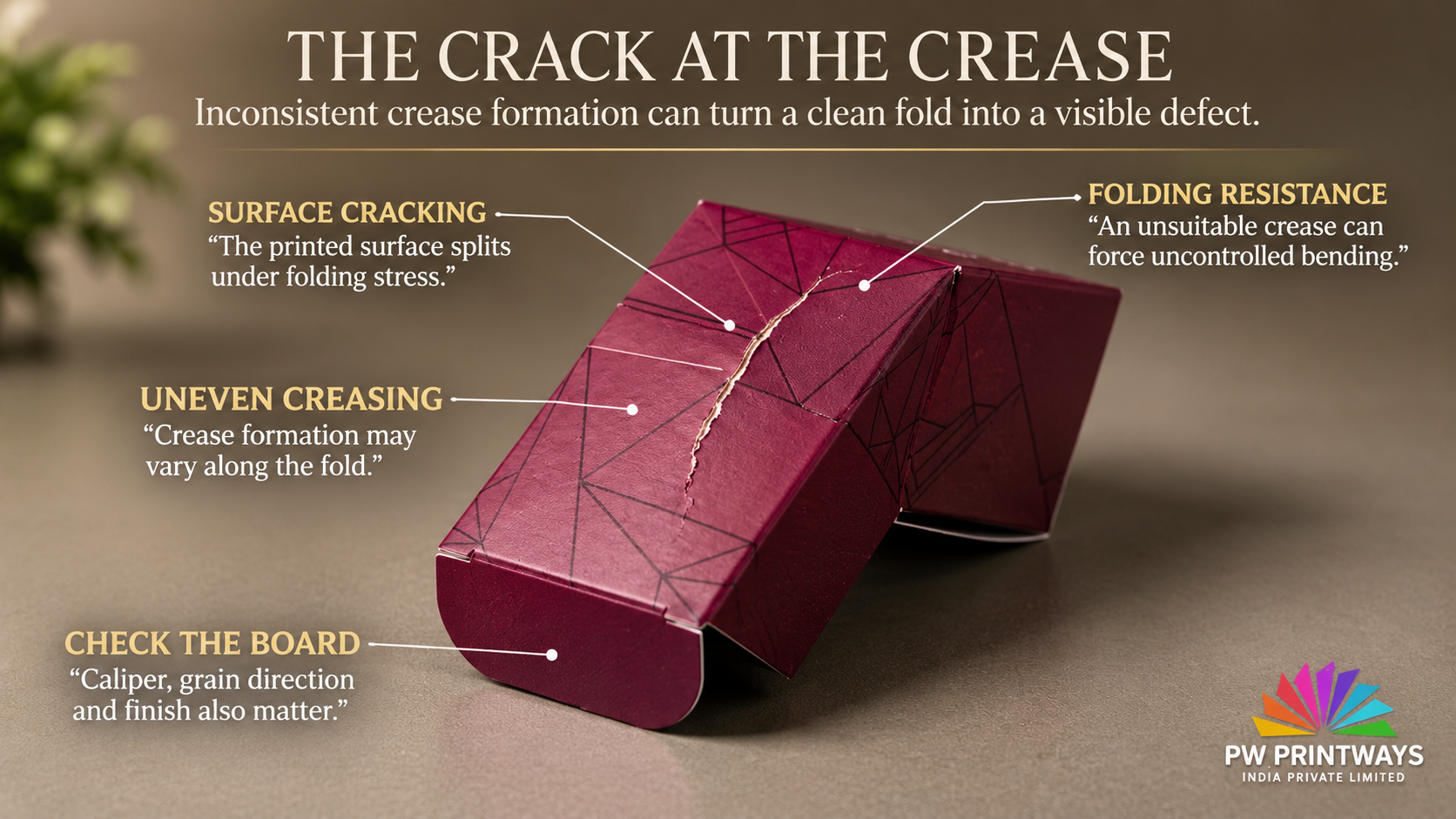
Why Do Cartons Crack When Folded?
Understanding Inconsistent Crease Depth Before Upgrading to Mono Cartons
A carton may look clean as a flat printed sheet and still split along a fold during erection.
The cause is not always the paperboard alone: crease geometry, board characteristics,
grain direction, finishing and the folding sequence all need to work together.
Paperboard conversion · Crease rule and matrix · Folding performance · Mono-carton production
The short answer
Inconsistent crease formation can concentrate folding stress and make the board surface crack.
A crease is intended to create a controlled folding zone in paperboard. If the crease is
too shallow, too aggressive, misaligned or inconsistent across the sheet, the carton may
resist folding or develop a visible fracture along the fold. The result depends on the
relationship between board caliper and construction, creasing rule, matrix channel,
grain direction, moisture condition, surface finish and folding method.
There is no single crease-depth number that suits every paperboard grade and carton design.
The correct setup should be developed for the actual board and finished construction,
then checked on representative folded cartons before bulk production.
Important distinction
Crease depth is not simply a matter of increasing machine pressure.
In production conversations, “crease depth” is often used as shorthand for how strongly
and consistently the folding channel is formed. The working result is influenced by the
creasing rule profile and height, matrix-channel width and depth, board thickness and
compressibility, make-ready, alignment and machine setup. Too little deformation may leave
a weakly defined fold; excessive or poorly supported deformation can crush or damage
the board structure.
The objective is a controlled hinge—not the deepest possible impression. A board-specific
trial is more reliable than making an unverified pressure adjustment.
In this guide
- What a crease does
- Why cartons crack
- Signs of inconsistent creasing
- Under-creased, controlled and over-creased folds
- Grain direction and board condition
- A production troubleshooting sequence
- Upgrading to mono cartons
- Buyer and pre-production checklist
- How PW Printways fits into the workflow
- Frequently asked questions
01 / Understand the process
What Does Creasing Do in a Folding Carton?
A mono carton begins as a flat paperboard blank. After printing and any specified surface
finishing, the sheet is die-cut and creased so that its panels, flaps and closure areas can
fold at the intended positions. The crease establishes a controlled hinge line and helps
the flat blank become a consistent three-dimensional carton.
Without a suitable crease, the board has to bend across a broader and less controlled area.
That can increase folding resistance, make the fold position less predictable and place
unwanted strain on the printed or coated surface. A properly developed crease helps the
board fold where the dieline intends it to fold.
01 / Creasing
Create the folding zone
The rule and matrix work together to compress and deform the board in a planned line,
creating a controlled area for folding.
02 / Folding
Form the carton panels
The blank bends around the crease. The board layers on the outside and inside of the
fold experience different stresses.
03 / Inspection
Check the finished fold
The carton is reviewed for line definition, cracking, panel alignment, closure behaviour
and consistency with the approved sample.
For further reading, see the
Iggesund Paperboard Graphics Handbook: Creasing and Folding
,
which explains why paperboard should be creased before folding and how crease design
affects fold definition.
02 / Root-cause analysis
Why Can Inconsistent Crease Depth Cause Cartons to Crack?
Cracking usually points to a mismatch somewhere in the board–crease–fold system.
The crease may not be controlling the fold adequately, or the board and surface layers
may be unable to accommodate the strain created during folding. These are the production
factors worth checking first.
CAUSE 01
Crease rule and matrix mismatch
A rule and channel combination that is unsuitable for the board caliper or construction
can create a fold that is too tight, too broad or insufficiently defined. The actual
rule and matrix specification should be selected for the board and job.
CAUSE 02
Uneven pressure or make-ready
Variation in platen pressure, packing, make-ready or support can produce a crease that
changes from one area of the sheet to another. A line that is not formed consistently
may fold differently across the same carton blank.
CAUSE 03
Board caliper and construction variation
GSM alone does not describe the full board. Caliper, fibre composition, ply construction,
stiffness and compressibility affect how the sheet responds to a creasing operation.
A change of board grade can require a new crease trial.
CAUSE 04
Grain direction and fold layout
Paperboard behaves differently in its principal material directions. A fold across the
grain may be more prone to surface cracking than a comparable fold with the grain,
depending on the board and design. Review grain direction with the dieline rather than
treating it as an afterthought.
CAUSE 05
Board moisture or storage condition
Paperboard is moisture-sensitive. A board that has been stored or conditioned differently
may not fold like the material used for the approved trial. Compare the board condition
and production environment when defects appear between batches.
CAUSE 06
Coating, ink coverage or lamination
Printed coatings, heavy ink coverage, varnish or film lamination can change the behaviour
of the outside surface at a fold. If the carton is laminated, the crease must be developed
for the finished construction—not assumed to be identical to the unlaminated board.
CAUSE 07
Folding direction or aggressive erection
Folding against the intended crease bead, using an unsuitable pre-break sequence or
applying excessive force during erection can increase stress at the fold. The folding
method should be checked alongside the die-cutting and creasing setup.
The AIMS Group’s
Creasing, Folding & Storage Guidelines
emphasise that crease construction is critical, that grain direction should be considered,
and that board-specific trials are needed rather than relying on one universal
rule-and-matrix combination.
03 / Recognise the defect
What Are the Visible Signs of Inconsistent Creasing?
A crack is not always the same type of failure. Before changing the machine setting,
identify what has actually broken and whether the defect occurs consistently along the
crease, only at selected positions, or only after a finishing operation.
| Visible symptom | Possible explanation | What to inspect |
|---|---|---|
| White line along the fold | Surface coating, ink layer or exposed paperboard may be showing through. | Inspect under magnification and identify whether the board, print, coating or film is affected. |
| Cracking on only some blanks | Crease formation, sheet support, board variation or make-ready may be inconsistent. | Compare position on the sheet, board caliper, grain direction and die-cutting setup. |
| Board fibres split at the crease | The board may be under excessive strain or the crease geometry may be unsuitable. | Review board grade, grain, condition, rule and matrix, and fold direction. |
| Fold line looks crushed or weak | The board may have been compressed too aggressively or the crease may be poorly supported. | Check the crease impression, matrix condition, rule alignment and carton strength at the fold. |
| Cracking appears after lamination | The added film and adhesive may have changed the finished sheet construction and fold behaviour. | Compare unlaminated and laminated samples and review the crease for the finished caliper. |
| Cracking appears during machine erection | Pre-breaking, folding sequence, speed or guide settings may be contributing to stress. | Observe the actual packing or folder-gluer sequence and compare it with a controlled hand-folded sample. |
A white fold line does not automatically prove that the laminate film has split.
Identify the failed layer before deciding on a corrective action.
For a more specific diagnosis of film-related failures, read
Laminate Cracking Along the Score Line During Folding: Causes, Diagnosis & Prevention
.
That article focuses on laminated cartons; this guide concentrates on crease formation
and folding consistency more broadly.
04 / Crease quality
Under-Creased, Controlled and Over-Aggressive Folds: What Is the Difference?
The production target is a crease that makes the carton fold predictably without causing
unnecessary damage to the board. The labels below describe general symptoms; they are not
machine-setting instructions or universal depth measurements.
| Crease condition | Typical behaviour | Potential risk | Production response |
|---|---|---|---|
| Under-formed crease | Fold line may be vague and the blank may resist bending at the intended position. | Folding stress can spread beyond the crease and affect the surface or panel alignment. | Review rule-and-matrix suitability, support, alignment and board specification. |
| Controlled crease | Fold forms consistently along the intended line and the panels align as designed. | Still requires checking on the finished board, surface treatment and intended folding method. | Record the approved job setup and retain a representative folded sample. |
| Over-aggressive or damaged crease | Board may appear crushed, excessively weakened or visibly damaged along the line. | Loss of board integrity, poor appearance or failure during handling and erection. | Review geometry and make-ready. Do not assume more pressure or a deeper impression is the answer. |
Production principle
Do not correct a cracking carton by changing pressure alone.
First confirm the board grade and caliper, crease rule and matrix, grain direction,
surface finish and folding sequence. Change one controlled variable at a time and
compare representative folded samples under the same conditions.
05 / Paperboard behaviour
Why Do Grain Direction and Board Condition Matter?
Paperboard is a fibre-based material, not a uniform plastic sheet. Its stiffness and folding
response vary with fibre orientation, construction, thickness and moisture condition.
The relationship between the main crease lines and the grain direction should therefore
be reviewed when the dieline is prepared.
AIMS Group advises that, wherever possible, creases should be made parallel to the grain
because creases across the grain can be more prone to surface cracking. It also recommends
folding into the bead formed by pre-creasing. These are useful principles, but the final
layout must still respect carton geometry, board characteristics and the product’s
structural requirements.
BOARD SPECIFICATION
Check more than GSM
Record the board grade and grammage, but also review caliper, stiffness, construction
and the relevant supplier data. Two boards with the same GSM may not crease or fold
in the same way.
GRAIN & DIELINE
Review the fold layout early
Consider the main panel folds, grain direction, sheet layout and carton structure
before artwork and production are finalised. A late layout change can affect crease
behaviour and sheet utilisation.
STORAGE & CONDITION
Keep the board consistent
Compare stock condition when the same job behaves differently between trials or
production batches. Store and condition paperboard in line with the material
supplier’s recommendations.
Technical references:
AIMS Group: Creasing, Folding & Storage Guidelines
and
Iggesund: Creasing and Folding
.
06 / Production troubleshooting
A Practical Sequence for Diagnosing Carton Cracking
When a carton cracks during folding, a repeatable inspection sequence is more useful than
changing several machine settings at once. The following checks can help a buyer, converter
and production team narrow down the likely cause.
STEP 01
Identify the affected layer
Check whether the fracture is in the paperboard surface, printed ink, coating,
laminate film or adhesive interface. Do not label every visible white line as laminate failure.
STEP 02
Confirm the board specification
Compare the actual board grade, GSM, caliper and batch with the approved job requirement.
Note any material or supplier change.
STEP 03
Review grain and sheet layout
Check the board grain direction against the major fold lines and confirm that the dieline
orientation is the approved one.
STEP 04
Inspect rule and matrix
Review the creasing rule profile, matrix channel, alignment, condition and make-ready.
Confirm that the combination is intended for the actual board.
STEP 05
Compare crease consistency across the sheet
Inspect multiple positions, not only one carton blank. Look for differences across
the sheet, near edges and in areas where the defect repeats.
STEP 06
Reproduce the intended fold
Check fold direction, the crease bead, pre-breaking sequence and the actual erection
method. Compare hand-folded and machine-folded samples where appropriate.
STEP 07
Adjust one variable and re-test
Make a controlled adjustment with the converter or machine supplier’s guidance.
Fold a representative sample and record whether the defect improved or moved.
Record the result
Keep a clear reference for repeat production
Document the board specification, finished surface construction, dieline revision,
rule-and-matrix combination, approved fold sample and any agreed inspection criteria.
A repeat order should be compared against the same approved reference, with changes
reviewed rather than assumed to be interchangeable.
07 / Upgrading to mono cartons
How Should Brands Control Creasing When Upgrading to Mono Cartons?
Moving to a printed mono carton is more than choosing a paperboard sheet and transferring
artwork onto it. The carton is a designed structure with panels, creases, cuts, folds,
closures and a defined route through printing and converting. A fold that looks acceptable
on a screen or flat sample still needs to work when the carton is erected and packed.
Start with dimensions, filled weight, primary-pack shape and the way the product will be inserted.
Select the board specification around stiffness, caliper, print surface, fold performance and end use.
Develop the dieline, closure, panel sizes and crease positions around the product and packing method.
Review coating, varnish or lamination as part of the finished construction, especially at fold lines.
Validate die-cutting, creasing, folding and pasting on representative production material.
Approve the erected carton and retain the agreed sample and specification before repeat production.
A mono carton is commonly used for retail presentation, product information, grouping or
secondary protection. It does not automatically replace a corrugated shipper where stacking,
transit or grouped distribution protection is required. The retail carton and the outer
shipping pack should be designed around the separate jobs they perform.
For carton structure selection, see
Straight-Line Gluer vs Auto-Lock Bottom Mono Cartons
and
Reverse Tuck vs Straight Tuck vs Auto-Lock Bottom
.
08 / Buyer and pre-production checklist
What Should You Check Before Approving a Mono Carton?
Use this checklist to align procurement, artwork, structural development and production
before a new mono-carton job is released.
- Confirm the product dimensions, filled weight, primary-pack shape and loading direction.
- Specify the paperboard grade and grammage; record caliper and other relevant material data where required.
- Review grain direction against the main crease lines and sheet layout.
- Approve the dieline, panels, flaps, closure construction and crease positions.
- Confirm the crease rule and matrix are specified for the actual board and finished construction.
- Identify any coating, varnish, lamination, foil or other finish that may affect folding or glue areas.
- Check that the crease is consistent across representative positions on the sheet.
- Fold and erect a representative carton using the intended folding or packing method.
- Inspect for surface cracks, board splitting, crushed lines, panel misalignment and closure issues.
- Agree the finished-sample approval and inspection criteria before bulk production.
- Retain the approved board, artwork revision, dieline and folded sample as the reference for repeat orders.
09 / Match the carton to the application
Why Crease Consistency Matters Across Different Industries
The required carton structure and folding behaviour depend on the product and packing
operation. The same generic board or crease setup should not be assumed to suit every
carton category.
FMCG
Repeat runs and high-volume packing
Consistent carton formation supports repeatable packing, product identification and
shelf presentation across SKUs and production batches.
Explore FMCG packaging.
PHARMACEUTICALS
Specified structure and version control
Carton dimensions, board, crease lines, closure and leaflet space should work with
the actual primary pack and the customer’s packing process.
Explore pharmaceutical packaging.
COSMETICS
Premium print and surface finish
Dark colours, coated surfaces and decorative finishes can make a small fold defect
more visible. The complete finished construction should be checked.
Explore cosmetics packaging.
Planning to Upgrade to Printed Mono Cartons?
PW Printways India Pvt. Ltd. manufactures custom-printed mono cartons, folding cartons
and printed corrugated packaging at K-30, Sector-5, DSIIDC Bawana Industrial Area,
Delhi-110039, India. The company’s published production workflow connects the client brief,
structure and artwork, proof approval, printing, finishing, die-cutting, folding, pasting,
inspection and dispatch, with coordinated delivery support for businesses across India.
For a useful production discussion, share your product dimensions, filled weight,
existing carton or sample, board preference, artwork or dieline, finishing requirement,
quantity and packing method. These details help align the carton structure and production
specification with the actual job.
Discuss Your Mono-Carton Requirement →
PW Printways India Pvt. Ltd. · K-30, Sector-5, DSIIDC Bawana Industrial Area,
Delhi-110039, India · +91 98993 80302 ·
About PW Printways
Frequently Asked Questions
Why do cartons crack along the crease when folded?
for the board and finished construction. Rule-and-matrix geometry, board caliper and
stiffness, grain direction, moisture condition, coating or lamination and folding method
can all contribute. The failed layer should be identified before changing the production setup.
Does increasing creasing pressure always prevent carton cracking?
supported creasing can crush or weaken the board, while insufficient crease formation
can leave the fold poorly defined. Review the board, rule, matrix, make-ready and fold
method, then conduct a controlled trial with the converter or machine supplier’s guidance.
What is the difference between a creasing rule and a matrix?
the corresponding channel into which the rule presses the board. Their dimensions and
alignment work together with the board caliper and construction to form the crease.
Can paperboard grain direction cause cracking at a fold?
directions. Creases across the grain can be more prone to surface cracking for some
boards. Review grain orientation with the carton layout and material supplier’s guidance;
the final design should be validated on the selected board.
Does higher GSM prevent mono-carton crease cracking?
construction, grain direction or fold performance. A higher grammage is not a universal
solution. Select and test the board for the complete carton design and packing requirement.
Can lamination make cracking at the crease worse?
during folding. If a carton is laminated, the crease should be evaluated for the
completed board-and-film combination. A white line should be inspected to determine
whether the film, ink, coating or paperboard has actually failed.
How can a manufacturer check crease consistency before bulk production?
specification, fold samples using the intended sequence, check surface and board damage,
and confirm carton fit and closure. Record the approved finished sample and production
specification for repeat runs.
What should a brand share when upgrading to mono cartons?
or dieline, artwork, required quantity, board preference if known, finish, packing method
and delivery location. The converter can then review the structure and production
requirements around the actual product.
About This Guide
This guide is prepared for brands, procurement teams and packaging professionals
reviewing folding-carton cracking and mono-carton production. It draws on publicly
available paperboard creasing guidance and PW Printways India Pvt. Ltd.’s published
information about its mono-carton products and manufacturing workflow. The recommended
checks are general production guidance; exact rule-and-matrix dimensions, press settings
and acceptance criteria should be determined for the selected board, tooling, machine
and carton design.
Technical references:
AIMS Group: Creasing, Folding & Storage Guidelines
·
Iggesund Paperboard Graphics Handbook: Creasing and Folding
.
Learn more about
PW Printways India Pvt. Ltd.,
explore
mono-carton packaging
or
contact the team.
