
Packaging Failure Analysis / Lamination / Creasing
Laminate Cracking Along the Score Line During Folding: Causes, Diagnosis & Prevention
The carton can look perfect while flat — and still fail the moment it is folded.
A visible white line, film fracture or surface split along the crease is usually a converting problem that must be diagnosed before simply blaming the lamination.
| Defect | Cracking at Fold / Crease Line |
| Commonly Seen On | Laminated mono cartons & folding cartons |
| Visible Symptom | White line, split film, fractured print or surface separation |
| Critical Stage | Creasing → folding → pasting / carton erection |
Quick Diagnosis
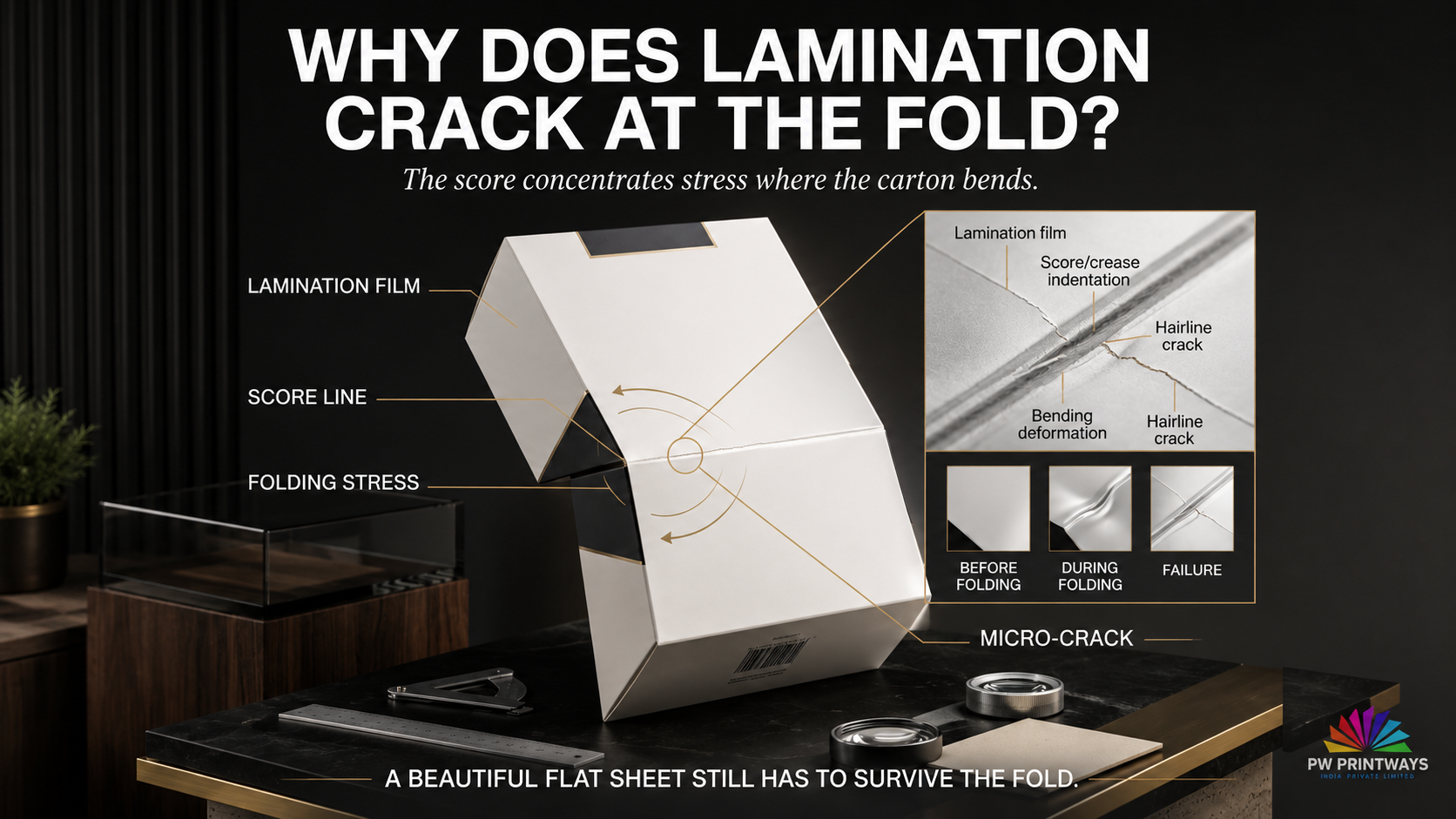
Why Does Lamination Crack at the Fold?
When a laminated paperboard carton is folded, the outer surface of the fold has to travel around a larger radius than the inner surface.
That means the laminate film, ink, coating and outer board layers experience tension while the inner layers are compressed.
If the crease does not create enough controlled flexibility — or if the combined board-and-laminate structure is too stiff or brittle for the fold — the surface may crack instead of bending cleanly.
The important point:
The problem may be the film, the board, the crease geometry, the grain relationship, the folding process — or a combination of them.
Score Line or Crease Line?
In everyday packaging discussions, buyers often call the folding line a score line.
In folding-carton converting, the more accurate term is usually crease line.
A creasing rule presses the paperboard into a corresponding channel or counter, creating a controlled hinge so the board can fold at the intended location.
Failure Mechanics
What Happens to a Laminated Carton During Folding?
01
The board is compressed and deformed along a controlled folding zone.
02
The crease reduces local bending resistance so the carton can form around the intended hinge.
03
Inner material compresses while the outer laminated surface experiences tensile strain.
04
Film, print and paperboard coating must bend without exceeding their practical deformation limits.
Before Fixing It: Identify What Is Actually Cracking
Not every white line at a fold is a laminate-film failure.
| Visible Defect | Possible Failure | What to Inspect |
|---|---|---|
| White hairline | Board coating / print cracking | Check whether film itself remains intact |
| Visible film split | Laminate fracture | Inspect film across full fold length |
| Film lifting from board | Local delamination / bond failure | Check laminate adhesion around crease |
| Paper fibres exposed | Board fracture | Review board, grain, moisture and crease setup |
| Dark solid colour breaks | Surface/ink crack made visually obvious | Inspect magnified fold before blaming film |
Root-Cause Matrix
8 Common Reasons Laminate Cracks Along a Carton Crease
CAUSE 01
Incorrect Crease Geometry
If the crease rule, channel width or crease depth is unsuitable for the combined board-and-laminate thickness, the fold can become too sharp or insufficiently formed. Excessive surface strain may then concentrate directly along the crease.
CAUSE 02
Crease Specification Wasn’t Adjusted After Lamination
Lamination adds another layer to the printed sheet. A crease specification developed for the unlaminated board may not necessarily remain ideal after the laminate film and adhesive are added.
CAUSE 03
Board Is Too Stiff or Brittle for the Fold
Higher-caliper or stiff boards require appropriate crease development. If the surface cannot deform smoothly around the fold radius, the board coating, print or film may show cracking.
CAUSE 04
Grain Direction and Fold Direction Are Poorly Matched
Paperboard behaves differently in the machine and cross directions. The relationship between grain direction, primary carton folds, structural stiffness and production layout should therefore be considered before finalising the dieline.
CAUSE 05
Laminate Film Is Too Rigid for the Application
Film thickness, material characteristics and the complete laminated structure influence flexibility. A film that performs well on a flat panel may behave differently across a tight 180-degree fold.
CAUSE 06
Poor Lamination Bond Near the Crease
If the film is not bonded consistently to the printed substrate, folding stress can expose weak areas and create local lifting, bubbles or separation close to the crease.
CAUSE 07
Board Condition Has Changed
Paperboard responds to moisture and storage conditions. Board that has become excessively dry or otherwise poorly conditioned may fold differently from the material used during initial approval.
CAUSE 08
Folding Stress Is Too Aggressive
Carton erection, pre-breaking, folder-gluer settings or manual folding can introduce excessive stress if the crease has not been properly formed for the required fold angle.
Typical Failure Chain
Board + Lamination
↓
Incorrect / marginal crease
↓
High resistance during folding
↓
Concentrated tensile stress
↓
Film / coating / board fracture
Why Changing the Lamination Film First Can Be the Wrong Fix
When cracking appears on a laminated carton, it is tempting to assume that the film is defective.
But replacing the film may not solve a crease that is fundamentally too narrow, too sharp or otherwise unsuitable for the laminated board.
Likewise, changing the crease alone will not fix weak laminate adhesion or a board that is behaving poorly.
Better troubleshooting principle:
Change one controlled variable at a time and compare folded samples under the same conditions.
Production Troubleshooting
A Practical 7-Step Diagnostic Sequence
- Fold an unlaminated sample.
Does the board itself crack at the same location? - Fold a laminated sample.
Determine whether the visible failure appears only after lamination. - Inspect the crease closely.
Check whether it is clean, centered and consistent along its full length. - Identify the failed layer.
Film, adhesive bond, ink/coating or paperboard? - Review board + laminate thickness.
Confirm whether the crease configuration was developed for the finished structure. - Review grain and carton orientation.
Confirm how major folds relate to board direction and structural needs. - Repeat the fold test after controlled adjustment.
Do not move to mass production until the revised combination performs consistently.
Cause → Check → Corrective Direction
| Possible Cause | Production Check | Corrective Direction |
|---|---|---|
| Crease too aggressive | Rule/channel relationship | Re-evaluate crease geometry |
| Lamination added thickness | Finished laminated caliper | Develop crease for finished structure |
| Board too brittle | Board condition / batch comparison | Review material and conditioning |
| Grain relationship | Dieline orientation on sheet | Review layout with structural requirements |
| Rigid film structure | Film/application comparison | Evaluate appropriate laminate specification |
| Poor adhesion | Film lifting / bond consistency | Review lamination process |
| Aggressive folding | Pre-break / folding operation | Adjust folding sequence/settings |
Why the Problem Looks Worse on Dark Cartons
Crease cracking can be particularly noticeable when a carton uses dark solid colours.
A small fracture that is difficult to notice on a white or light design can expose a lighter substrate beneath a black, navy, burgundy or other deep-colour printed surface.
That means premium cosmetics, wellness and luxury retail cartons can be visually less forgiving even when the physical defect is small.
Premium packaging connection:
For a premium cosmetic or wellness carton, a clean fold is part of the brand presentation. Surface cracking can undermine an otherwise excellent design, print and finish.
Should You Replace Lamination With Aqueous Coating?
Not automatically.
Lamination and aqueous coating are different finishing systems with different appearance, protection and material characteristics.
If lamination is genuinely required for the product or brand presentation, the better solution may be to engineer the board, film, crease and folding process correctly rather than removing the laminate simply to hide a converting problem.
For a broader comparison, see our
Aqueous Coating vs Lamination Film: Cost & Durability Guide →
Pre-Production Control
The Best Time to Find Crease Cracking Is Before the Full Run
A flat printed and laminated sheet may appear completely acceptable.
That is why finishing approval should include the actions the carton will actually experience:
Creasing
Pre-breaking
90° folding
180° folding where relevant
Pasting
Carton erection
Packed-product handling
A carton should therefore be evaluated as a converted structure, not only as a printed sheet.
How to Reduce the Risk of Laminate Cracking
01 — Specify the complete construction.
Board grade, caliper/GSM, print, laminate and required folds should be evaluated together.
02 — Develop the crease for the laminated sheet.
Do not assume an unlaminated setup automatically remains suitable.
03 — Review grain orientation early.
It should be considered during structural and sheet-layout planning rather than after cracking appears.
04 — Check the folded sample, not only the flat sample.
Critical folds should be tested before commercial approval.
05 — Keep production variables consistent.
Material batches, storage, converting conditions and folding setup can influence repeatability.
06 — Investigate the actual layer that failed.
Avoid changing film, board or tooling based only on visual assumption.
Does Cracking Mean Lamination Is Wrong for Mono Cartons?
No.
Lamination can remain suitable for many folding-carton applications where the desired appearance, handling resistance or surface feel justifies its use.
The objective is to ensure that the finished laminated paperboard structure is designed to fold, not merely to look good while flat.
Manufacturer Perspective
How PW Printways Approaches Creasing & Finishing Problems
At PW Printways India Pvt. Ltd., the performance of a mono carton is considered across the complete production sequence rather than treating print, lamination, die-cutting and folding as unrelated operations.
PW Printways’ published production capabilities include structural development, prepress, printing, cutting, creasing, finishing and final quality control.
The company also uses in-house Heidelberg printing and Bobst finishing equipment for the production of mono cartons, folding cartons and other printed packaging.
For a cracking problem, the practical objective is to determine whether the failure originates from the board, print surface, lamination, crease geometry or folding process before production specifications are changed.
Laminated Mono Cartons Are a System, Not Just a Finish
PW Printways manufactures custom mono cartons and folding paperboard packaging for sectors including pharmaceuticals, FMCG, cosmetics, electronics, food and retail.
For laminated cartons, product dimensions, paperboard, carton structure, print coverage, laminate, die-cutting, creasing and pasting should all be evaluated as part of the same production requirement.
Explore PW Printways Mono Cartons & Packaging Products →
Where Crease Quality Matters Most
| Application | Why Fold Quality Matters |
|---|---|
| Cosmetics | Premium visual surfaces make cracking highly noticeable |
| Wellness | Clean presentation can support quality perception |
| Pharmaceutical | Reliable converting and repeat folding are important |
| FMCG | Large production quantities make small defect rates significant |
| Premium Retail | Visible fold defects can reduce presentation quality |
| D2C Packaging | Carton appearance remains part of the unboxing experience |
See more about the
industries served by PW Printways India →
Preventing Defects Also Reduces Avoidable Waste
Crease cracking that is discovered after printing, lamination and die-cutting can create avoidable rejection, rework and material consumption.
That is one reason production-ready testing and correct structural planning are also relevant to material-efficiency goals.
Read our Responsible Packaging & Sustainable Printing Guide →
Packaging Manufacturing in India
Custom Mono & Folding Cartons for Brands Across India
PW Printways India manufactures custom printed packaging from Bawana, Delhi and supports packaging requirements for businesses across India.
Laminated mono-carton requirements can be discussed for businesses across North, West, South, Central, East and North-East India rather than limiting manufacturing support only to Delhi NCR.
Brands in markets such as Mumbai, Pune, Ahmedabad, Surat, Bengaluru, Hyderabad, Chennai, Kolkata, Jaipur, Chandigarh, Lucknow, Indore, Kochi and other locations can discuss specifications according to product, quantity, board, print and finishing requirements.
International & Export-Oriented Packaging Requirements
International brands and sourcing teams can also discuss customised folding-carton requirements with PW Printways India.
For export-oriented packaging, lamination, crease performance and carton structure should be considered alongside product specifications, shipping conditions, commercial quantity and destination requirements.
Buyer Checklist
What to Send Your Packaging Manufacturer When Reporting Cracking
Finished carton sample showing the actual defect
Flat blank before folding
Paperboard grade / GSM / caliper
Lamination type and any relevant specification
Dieline showing the affected crease
Photos of the crack before and after folding
Quantity affected and whether it occurs consistently or intermittently
Related Packaging Insights
Finishing Selection
Aqueous Coating vs Lamination Film →
Premium Packaging
Why Premium Packaging Matters for Brand Success →
Responsible Production
Responsible Packaging & Sustainable Printing →
Product Visibility
Transparent Packaging & Consumer Trust →
Technical Reference Note
Research on laminated paperboard creasing and folding has shown that crease formation changes local bending behaviour and that correct control of this deformation is important for avoiding surface-layer fracture during folding.
Packaging Troubleshooting
Is Your Laminated Carton Cracking at the Fold?
Share your carton sample, product dimensions, paperboard specification, laminate requirement, dieline, quantity and photos of the affected fold with the PW Printways India team.
Frequently Asked Questions
Lamination & Carton Crease FAQs
Why does lamination crack when a carton is folded?
Cracking can occur when the laminated paperboard experiences more strain at the fold than the film, printed surface or board can accommodate. Crease geometry, board stiffness, laminate construction, grain relationship and folding conditions can all contribute.
Is a white line always caused by the laminate film?
No. The visible white line may come from the printed coating or paperboard surface cracking underneath an intact film. The failed layer should be identified before corrective action is selected.
Can an incorrect crease cause laminate cracking?
Yes. A crease that is unsuitable for the finished laminated board can concentrate excessive stress at the fold and contribute to surface cracking.
Does lamination thickness affect folding?
It can. Lamination changes the finished sheet construction and may affect flexibility and the crease specification required for clean folding.
Does board GSM alone decide whether cracking will happen?
No. GSM is only one variable. Board caliper, stiffness, grain orientation, moisture condition, laminate, crease geometry and fold angle also influence performance.
Can grain direction affect crease cracking?
Yes. Paperboard has different stiffness and folding characteristics in its principal material directions. Grain orientation should therefore be reviewed together with major fold lines and structural requirements.
Should lamination be removed if the fold cracks?
Not necessarily. If lamination is appropriate for the packaging requirement, the correct approach is to identify whether the failure comes from lamination, board, creasing or folding and correct the underlying cause.
Does PW Printways manufacture laminated mono cartons in India?
PW Printways India manufactures custom printed mono cartons and folding cartons from its Bawana, Delhi location and supports packaging requirements for businesses across India.
Can international brands discuss laminated carton requirements?
Yes. International and export-oriented packaging requirements can be discussed according to board, carton structure, printing, lamination, finishing, quantity and delivery requirements.
About PW Printways India Pvt. Ltd.
PW Printways India is a custom printed packaging manufacturer specialising in mono cartons, folding cartons and printed corrugated packaging. Its published manufacturing process includes structural development, prepress, printing, cutting, creasing, finishing and final quality inspection.
The company’s in-house Heidelberg printing and Bobst finishing equipment supports controlled production of custom printed packaging.
Manufacturing Location:
K-30, Sector-5, DSIIDC Bawana Industrial Area,
Delhi – 110039, India
Market Reach:
PAN India • International / export-oriented enquiries
About
/
Products
/
Industries
/
Contact
