D2C Packaging · E-Commerce · Mono Cartons
Are D2C Brands in India Losing Customers at the Unboxing Stage? What the Packaging Data Says
A customer may discover your brand through Instagram, purchase through your website and receive the product through a delivery partner. But the first physical interaction happens when the parcel reaches their hands. Explore how branded mono cartons, product fit and better-designed shipping packaging can make the unboxing experience more consistent with the brand promise.
D2C packaging
Unboxing experience
Mono-carton strategy
The Quick Answer
D2C packaging is more than a shipping requirement. It is part of the physical brand experience that customers receive after purchasing online.
Consumer research from India and international markets indicates that packaging can influence brand selection, perception and repeat-purchase behaviour. Custom printed mono cartons give D2C businesses an additional surface for brand identity, product information and organised presentation.
However, a premium carton alone cannot guarantee customer retention. The right approach combines an attractive retail carton, suitable product protection, convenient opening and an appropriate outer shipping package.
01 · The customer journey
Why Does the Unboxing Stage Matter for D2C Brands?
A direct-to-consumer brand invests considerable time and money attracting customers through digital advertising, social media, influencer marketing, product photography and online promotions.
The customer discovers the product online, compares alternatives, reads reviews and finally places an order. But after the purchase, the brand has another important responsibility: delivering a physical product experience that feels consistent with the expectations created during the buying journey.
Unlike traditional retail shopping, where customers can physically examine a product before purchasing, online customers often experience the actual packaging only after delivery.
The journey from digital discovery to physical delivery
01 / DISCOVERY
The brand creates an expectation
Customers discover the product through a website, advertisement, marketplace, social media or online recommendation.
02 / PURCHASE
The customer makes a decision
Product quality, pricing, reviews, visual presentation and perceived value contribute to the purchase decision.
03 / DELIVERY
The physical package arrives
The packaging becomes the first physical representation of the product and the brand after an online purchase.
04 / UNBOXING
The product is revealed
The customer opens the parcel, sees the product carton and interacts with the packaging before using the product.
Now imagine a customer purchasing a premium skincare serum. The website presents elegant product photographs, refined typography and carefully selected brand colours.
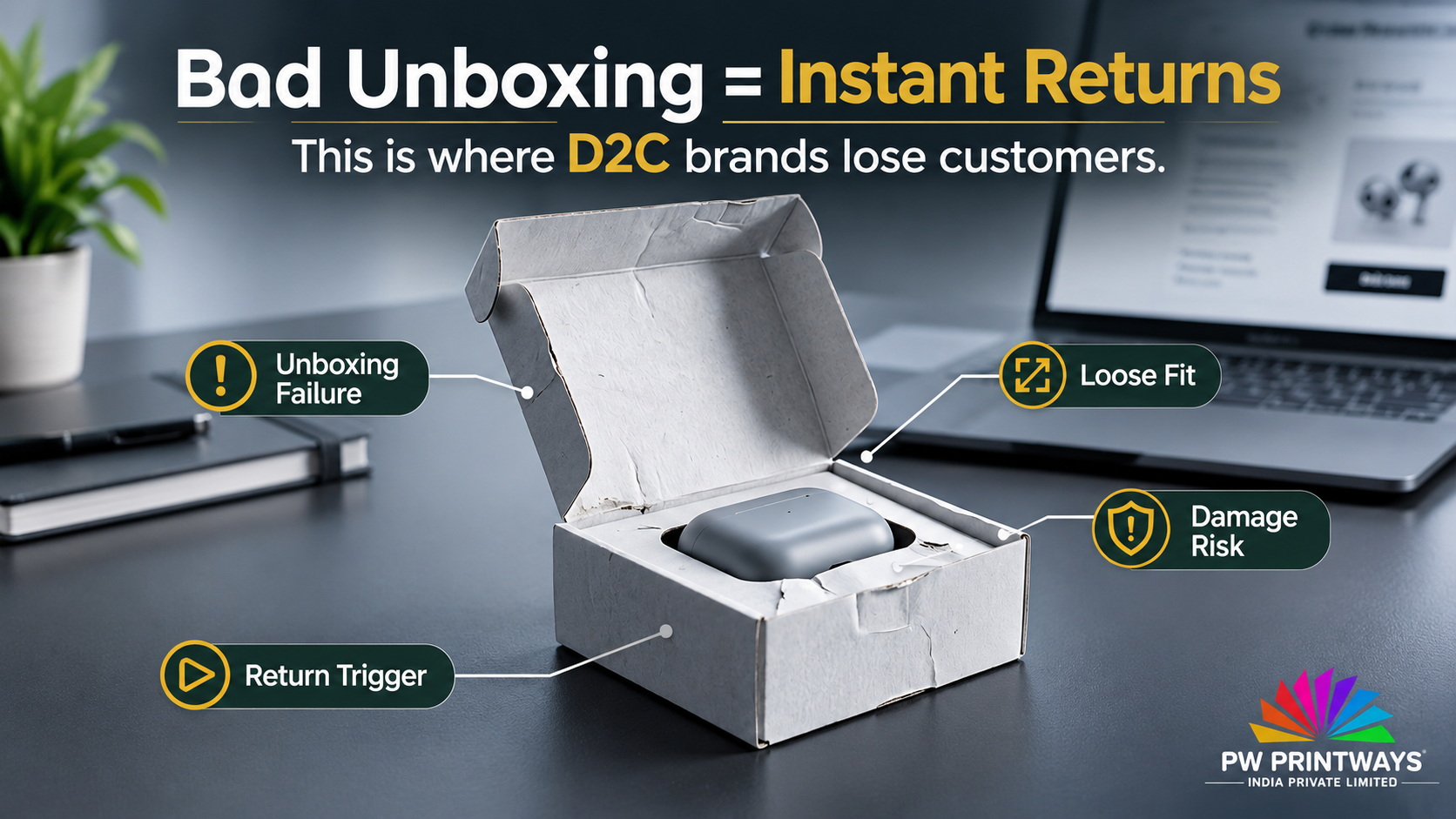
However, the delivered product arrives in an oversized package with excessive empty space, a damaged retail carton or generic product presentation.
The serum may still be perfectly fine, but the physical presentation might not communicate the same level of attention that the digital campaign promised. This is why the unboxing experience deserves attention when planning a D2C packaging system.
02 · Research and consumer behaviour
What Does the Packaging Data Actually Say?
Packaging is sometimes treated as a secondary consideration during product development. However, consumer research indicates that it can contribute to how customers evaluate brands and make purchasing decisions.
Two useful research sources provide a perspective on the relationship between packaging and consumer behaviour: the India D2C Report 2022, prepared by CII and Shiprocket with Praxis Global Alliance as knowledge partner, and Adobe Express’s 2026 global packaging survey.
INDIA / HOUSEHOLD SUPPLIES
53%
Better Packaging
Respondents in the household-supplies category included better packaging among their brand-selection criteria. Category sample: 189 respondents.
INDIA / HEALTHCARE
68%
Packaging as a Selection Criterion
Healthcare-category respondents included better packaging among their brand-selection criteria. Category sample: 130 respondents.
GLOBAL / ADOBE 2026
57%
Packaging-Inspired Purchases
Consumers reported having made a purchase from a brand because packaging from a previous order left a strong impression.
What Should D2C Brands Learn from These Numbers?
Packaging can contribute to brand selection, perception and purchasing behaviour. These findings make it worth evaluating packaging as part of the customer experience rather than treating it only as a protective outer layer.
The figures do not establish that 53%, 68% or 57% of Indian D2C customers leave brands because of poor unboxing. The Indian figures are category-specific, and Adobe’s findings are from a separate global survey.
Understanding the Research Behind the Statistics
The India D2C Report 2022 was developed through consumer surveys and industry research. Its consumer research covered 829 respondents, primarily users of online platforms. The household-supplies and healthcare figures shown above represent separate category segments, not the entire Indian consumer population.
Adobe Express published its packaging study in June 2026, based on a survey of 703 online consumers and 300 small-business owners selling physical products. Its findings provide an international perspective rather than an India-only measurement.
Research sources:
India D2C Report 2022 – CII, Shiprocket and Praxis Global Alliance
and
Adobe Express – Unboxed: Why Packaging Is One of the Most Overlooked Growth Levers in E-commerce
.
03 · Packaging problems
Five Packaging Mistakes That Can Weaken the D2C Unboxing Experience
Packaging problems are not always visible during artwork approval. Some become apparent only after the carton is manufactured, the product is packed and the shipment reaches its destination.
01 / BRAND PRESENTATION
Generic Product Packaging
A plain product-facing package may not communicate the same brand identity that customers see in online product photographs, campaigns and advertisements.
02 / DIMENSIONAL DESIGN
Unnecessary Empty Space
Oversized cartons may permit excessive product movement and increase package volume, storage requirements and handling inconvenience.
03 / STRUCTURAL FIT
Poor Product Support
Incorrect dimensions, inadequate clearance or unsuitable carton construction can affect how securely the primary product is held.
04 / PRINT QUALITY
Inconsistent Printing and Finishing
Colour variation, poor registration, damaged surfaces and visible folding defects can weaken the intended visual presentation.
05 / CUSTOMER INTERACTION
Difficult Opening Experience
Poorly considered closures, inconvenient opening methods or unnecessary packaging layers can make product access less comfortable.
Why Packaging Performance Matters Beyond Appearance
A carton that looks attractive on a computer screen is not automatically ready for commercial production. The actual product dimensions, selected board, crease layout, folding method, pasting and shipping conditions all influence the finished packaging.
For example, reducing unnecessary internal space can help create a more suitable product fit. However, the revised structure must still maintain the required protection and packing clearance.
Related illustrative reading: Illustrative Example: Carton Right-Sizing and Shipping Cost. These examples do not report verified client outcomes.
04 · The mono-carton upgrade
Why Are D2C Brands Upgrading to Custom Printed Mono Cartons?
A mono carton is a folding paperboard box developed around the dimensions, artwork and packaging requirements of a product. It commonly serves as a product-facing secondary packaging layer around a primary container such as a bottle, jar, tube or accessory.
For D2C brands, custom printed mono cartons provide additional printable surfaces for brand logos, typography, colour systems, product information, illustrations and other visual communication.
The objective is not simply to make a box look more expensive. It is to develop a packaging structure that presents the product consistently while meeting the practical requirements of production, packing and distribution.
01 / BRAND IDENTITY
A Recognisable Brand Surface
Custom artwork, logos, colours and typography create a consistent visual identity across different product variants.
02 / PRODUCT INFORMATION
Better Information Organisation
Dedicated panels can communicate product names, variants, instructions and other required information.
03 / VISUAL FINISHING
More Finishing Possibilities
Suitable matte, gloss, soft-touch, foil, embossing or spot UV treatments can support the intended artwork.
04 / PRODUCT FIT
Structure Around the Product
Custom dimensions and carton structures can be selected according to the actual primary pack and packing method.
What Actually Makes a Good Mono Carton?
A successful mono carton is developed as a complete packaging specification. Paperboard, artwork, colour, finishing, die-cutting and folding all need to work together.
For products such as skincare bottles, cosmetic jars and personal-care tubes, the carton dimensions must be developed around the primary pack. The selected closure and internal clearance should also be compatible with the intended packing process.
Explore
custom printed mono cartons and folding cartons from PW Printways
.
05 · Packaging architecture
Mono Cartons vs Corrugated Shipping Boxes: Which Does a D2C Brand Need?
A common packaging misunderstanding is assuming that a mono carton must replace the shipping box. In practice, these two formats generally perform different functions within the packaging system.
A printed mono carton focuses on product-facing presentation and secondary packaging, while a corrugated shipping box can provide additional protection during handling, storage and transportation.
| Packaging Factor | Mono Carton | Corrugated Box |
|---|---|---|
| Material | Folding paperboard. | Corrugated board combining liner papers and fluted paper layers. |
| Main Purpose | Product presentation, brand communication and secondary packaging. | Outer handling, grouped packaging and transport protection. |
| Printing | Detailed product artwork, colours, graphics and information. | Print according to liner surface, board construction and production route. |
| Finishing | Lamination, coating, foil, embossing, debossing and spot UV where suitable. | Finishing depends on the selected liner, board and application. |
| Typical Applications | Cosmetics, skincare, FMCG, pharmaceutical and retail products. | E-commerce, shipping, master cartons, logistics and industrial packaging. |
| D2C Role | Creates the branded product-facing experience. | Provides suitable additional protection during delivery. |
A Practical Three-Layer D2C Packaging System
How the Packaging Layers Work Together
Bottle, jar, tube, pouch or product container.
Printed product packaging and brand presentation.
Corrugated box for suitable delivery protection.
Important Packaging Decision
A mono carton should not automatically replace a corrugated shipping box. The required combination depends on product weight, dimensions, fragility, distribution route, handling conditions and the protection required.
Explore our
e-commerce and retail packaging solutions
and
custom corrugated box manufacturing
.
06 · Industry applications
Which D2C Industries Can Benefit from Mono-Carton Packaging?
The ideal carton depends on the product being packed, its dimensions, weight, primary container, brand positioning and distribution conditions. Different industries may require different combinations of paperboard, print, finishing and structural design.
01 / BEAUTY & PERSONAL CARE
Cosmetics and Skincare
Printed mono cartons can organise product variants, communicate product information and create a consistent presentation for skincare, fragrance, beauty and personal-care ranges.
02 / WELLNESS
Health and Wellness
Suitable cartons can provide organised product information and secondary packaging for bottles, containers, sachets and other product formats.
03 / CONSUMER GOODS
FMCG Products
A consistent carton specification can help organise SKUs, communicate product details and support repeat-production requirements.
04 / TECHNOLOGY
Electronics and Accessories
Custom carton structures and suitable internal support can organise accessories and contribute to product presentation.
05 / FOOD & BEVERAGE
Food and Beverage
External printed cartons can support product presentation where appropriate. Material selection must account for any applicable food-contact requirements.
06 / RETAIL & LIFESTYLE
Fashion and Lifestyle
Paperboard cartons and inserts can be selected for product presentation, gifting and organised retail or online order fulfilment.
07 · Manufacturing and quality
Production Checks Before Approving a New Mono-Carton Design
A packaging upgrade is not only a graphic-design exercise. A carton must also be suitable for commercial printing, converting, packing, storage and distribution.
01 / PRODUCT
Actual Product Dimensions
Measure the primary pack, filled weight, shape and required clearance before developing the carton.
02 / MATERIAL
Paperboard Selection
Evaluate board stiffness, thickness, surface properties, printing requirements and folding performance.
03 / STRUCTURE
Carton Engineering
Select a suitable tuck-end, auto-lock, sleeve or custom structure based on the packing application.
04 / PRINT
Artwork and Colour Control
Check artwork, colour references, registration, readability and consistency across repeat orders.
05 / FINISHING
Surface and Folding Performance
Evaluate coating, lamination, foil and other finishes alongside crease quality and folding behaviour.
06 / DELIVERY
Packing and Transit Validation
Review carton closure, product movement, master-carton arrangement and the intended delivery conditions.
A Flat Sheet Is Not the Final Test
A carton may look excellent as flat artwork but behave differently after die-cutting, creasing, folding and pasting. Approve a representative converted sample before moving to commercial production.
For more information about suitable carton structures, explore
our guide to crash-lock bottom cartons for e-commerce brands
.
08 · Business and packaging performance
How Can D2C Brands Measure Whether a Packaging Upgrade Is Working?
A new packaging design should not be judged only by whether it looks attractive. Brands can also monitor practical operational and customer-experience indicators after introducing a revised packaging specification.
The following measurements can provide a more useful picture of whether the new packaging is serving its intended purpose.
Product Damage Rate
Track damage complaints and returns associated with packaging and delivery conditions.
Customer Feedback
Review feedback about product presentation, packaging quality, opening convenience and product arrangement.
Repeat-Purchase Rate
Compare purchasing behaviour before and after the change, accounting for other marketing and product changes.
Packaging Cost per Unit
Evaluate paperboard, printing, finishing, conversion and secondary packaging costs together.
Shipping Efficiency
Review package dimensions, volumetric weight, master-carton utilisation and shipment configuration.
Packaging Consistency
Monitor print reproduction, carton dimensions, surface quality and folding performance across production batches.
Why Right-Sizing Should Also Be Part of the Discussion
A premium packaging upgrade does not necessarily mean using more paperboard, creating a bigger carton or introducing additional decorative layers.
Correct dimensions, suitable board and a well-planned carton structure can help reduce unnecessary material and shipping volume while maintaining product protection and the intended brand presentation.
Our Illustrative Example: Carton Right-Sizing and Shipping Cost uses hypothetical assumptions to explain the comparison. It does not report a verified customer result.
Related illustrative reading: Illustrative Example: Carton Right-Sizing and Shipping Cost. These examples do not report verified client outcomes.
09 · From brief to finished carton
A Practical Process for Upgrading D2C Packaging to Mono Cartons
The most effective packaging projects bring the product, artwork, structural requirements and finishing decisions together before final production approval.
01 / UNDERSTAND
Share the Product Details
Provide the primary pack, dimensions, filled weight, required quantity and existing packaging sample if available.
02 / DEVELOP
Plan the Carton Structure
Review board, dimensions, closure, die-line, insertion clearance and internal support requirements.
03 / DESIGN
Prepare Artwork and Branding
Organise artwork, logo, typography, SKU details, colour references and required product information.
04 / EVALUATE
Select the Finishing System
Compare suitable coating, lamination, foil, matte or other finishing options using physical samples.
05 / APPROVE
Review a Finished Sample
Evaluate the actual printed, finished, die-cut, creased, folded and pasted carton before production.
06 / PRODUCE
Maintain the Production Reference
Record the approved artwork, paperboard, print, finish, dimensions and inspection requirements for repeat orders.
A Better Packaging Brief Starts with the Actual Product
An existing carton sample, actual product dimensions, artwork and expected quantity provide a useful starting point for a packaging discussion. These details help the manufacturing team assess structural, material and finishing requirements.
Manufacturing perspective · PW Printways
From Carton Design to Commercial Packaging Production
The performance of a mono carton depends on more than its design artwork. Paperboard selection, printing, finishing, die-cutting, creasing, folding and pasting all contribute to the finished packaging.
PW Printways India Pvt. Ltd. is a Delhi-based printing and packaging manufacturer with a manufacturing journey dating back to 1982. The company manufactures custom printed mono cartons, folding cartons and corrugated packaging for industries including FMCG, cosmetics, pharmaceuticals, healthcare, electronics and D2C.
Its published manufacturing capabilities include Heidelberg commercial printing and Bobst converting equipment. The company’s production workflow covers structural development, artwork approval, printing, finishing, die-cutting, folding, pasting and inspection.
Learn more about
PW Printways India and its packaging manufacturing capabilities
.
10 · Common questions
Frequently Asked Questions About D2C Packaging and Mono Cartons
Common questions from D2C brands, product businesses and packaging procurement teams.
1. Why is packaging important for D2C brands in India?
Packaging influences product presentation, brand recognition, physical product protection and the customer’s interaction after delivery. It can help create consistency between the digital brand identity and the delivered product experience.
2. How can mono cartons improve the D2C unboxing experience?
Custom mono cartons provide a structured printed surface for branding, product information, artwork and finishing. Their dimensions and structure can also be developed around the actual product for a more organised product-facing presentation.
3. Do mono cartons replace corrugated shipping boxes?
Not necessarily. Mono cartons commonly serve as product-facing secondary packaging, while corrugated boxes provide suitable additional protection for handling and distribution. Both may be used together depending on the product and delivery requirements.
4. Which industries commonly use printed mono cartons?
Cosmetics, skincare, pharmaceuticals, FMCG, healthcare, electronics, food packaging applications and general retail products use folding paperboard cartons. The appropriate structure and material depend on the application.
5. What finishing options are available for premium mono cartons?
Depending on the paperboard, artwork and production specification, options may include matte or gloss lamination, soft-touch finishes, foil stamping, embossing, debossing, spot UV and die-cut windows.
6. Can better packaging reduce product damage during delivery?
Suitable carton dimensions, adequate internal support and an appropriate outer shipping package can help address product movement and handling requirements. The final packaging should be evaluated with the actual packed product and intended distribution conditions.
7. Can right-sizing reduce D2C shipping costs?
It can when a revised packaging design changes shipment dimensions, volumetric weight, units per master carton or overall logistics utilisation. A smaller retail carton does not automatically reduce shipping charges if the outer shipment configuration remains unchanged.
8. Does packaging alone determine customer retention?
No. Customer retention is influenced by product quality, pricing, perceived value, delivery, customer support and other factors. Packaging is one part of the physical customer experience and can contribute to brand perception.
9. What information is needed for custom D2C mono-carton manufacturing?
Useful details include product dimensions, filled weight, artwork, quantity, preferred board, finishing requirements, existing carton sample, packing method and delivery location.
10. Does PW Printways manufacture custom mono cartons in India?
Yes. PW Printways India Pvt. Ltd. manufactures custom printed mono cartons, folding cartons and corrugated packaging from Bawana Industrial Area, Delhi, and supports packaging requirements for businesses across India.
Planning a D2C Packaging Upgrade?
Develop a Mono Carton Around Your Product—and the Customer Experience
A well-developed D2C carton brings together actual product dimensions, paperboard, structure, artwork, print, finishing and packing requirements. The right specification should support the product’s presentation as well as its journey through the distribution process.
PW Printways India Pvt. Ltd. manufactures custom mono cartons, folding cartons and corrugated packaging for FMCG, cosmetics, pharmaceuticals, electronics and other product businesses.
Discuss Your D2C Packaging Requirement
PW Printways India Pvt. Ltd. · K-30, Sector-5, DSIIDC Bawana Industrial Area, Delhi – 110039, India ·
+91 98993 80302
Related Packaging Guides
Custom Mono Cartons and Folding Paperboard Packaging
E-Commerce and Retail Packaging Solutions
Printed Corrugated Boxes and Shipping Packaging
Why Cosmetics and Wellness Brands Are Upgrading to Mono Cartons
- Illustrative Example: Carton Right-Sizing and Shipping Cost
What Is a Crash-Lock Bottom? Why E-Commerce Brands Request It
