
The short answer
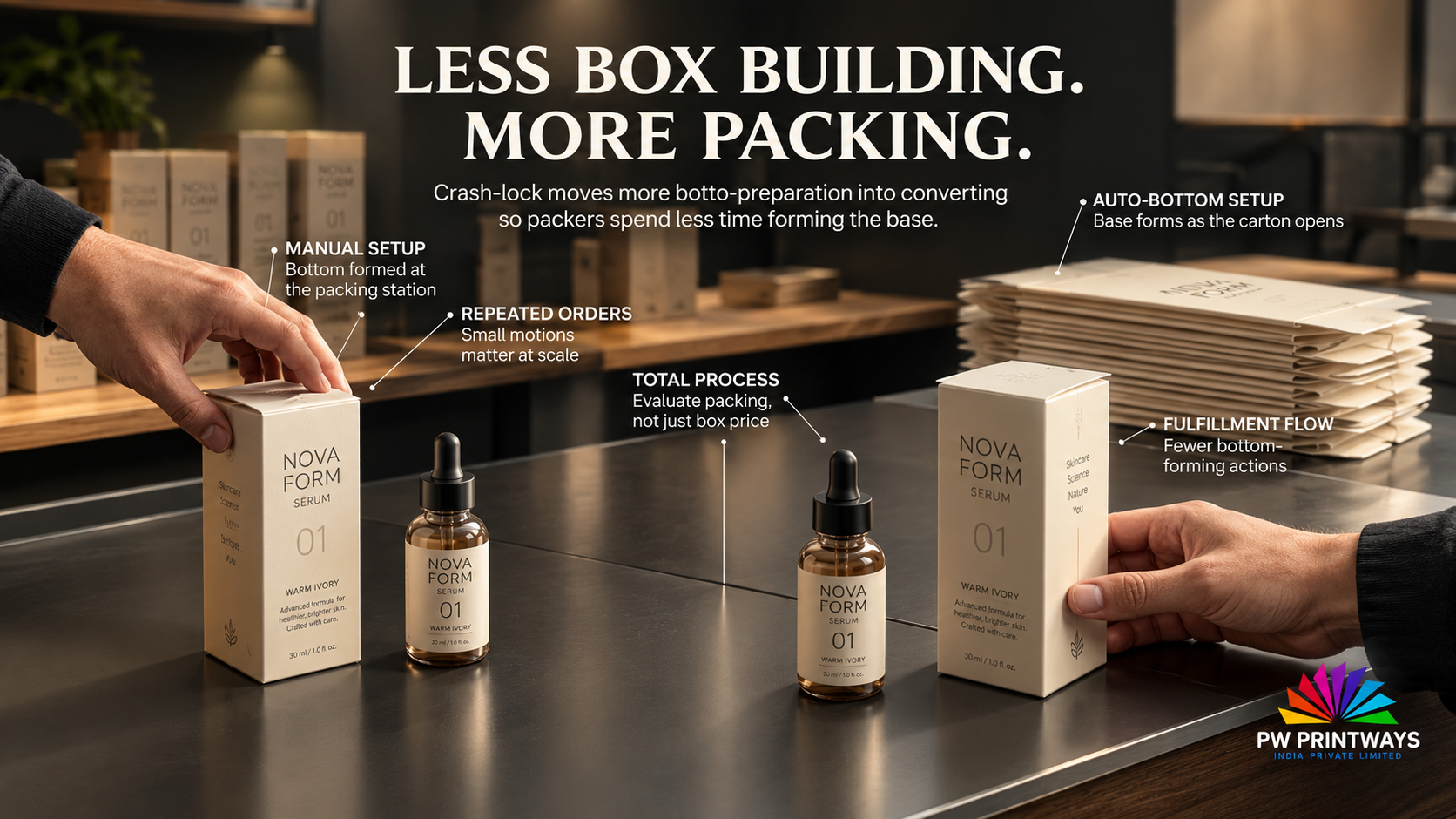
Crash-lock bottom is requested when the packing workflow needs the base to form itself.
In the folding-carton context, an auto-bottom is glued by the converter so that the base assembles as the carton is erected. Peczuh describes auto-bottom as also being known as a “Crash Lock Bottom” and highlights its quick setup and sturdy closure. The Paperboard Packaging Council similarly describes an Automatic Bottom as pre-glued at the converter and automatically assembled as the carton is erected.
E-commerce brands may request this structure when repetitive carton setup is a meaningful part of their fulfilment operation, or when the product benefits from a formed, load-bearing base. The exact benefit still depends on product weight, carton geometry, packing method and the rest of the packaging system.
One terminology point matters
“Auto-lock,” “auto-bottom” and “crash-lock” are often used loosely—so confirm the actual dieline.
Supplier terminology can vary. In one established folding-carton style guide, “Auto-Bottom” is explicitly described as also known as “Crash Lock Bottom,” while a separate “Snap Lock Bottom” or “1-2-3 Bottom” is shown as a different manually assembled style. That distinction is important when approving a quote or structure drawing.
Best practice: approve the actual dieline, closure sequence and bottom construction—not only the name used in the quotation.
01 / What the bottom actually does
How a Crash-Lock Bottom Works
A conventional tuck carton relies on the operator or packing process to fold and tuck the lower closure into place. A crash-lock structure is different: the bottom components are pre-glued during converting, and opening the flat carton causes the base panels to move into their designed locking position.
Flat carton arrives
Carton is squared
Bottom forms & locks
Product can be loaded
The exact locking geometry varies by carton design. Base panel dimensions, crease configuration, glue placement, board characteristics and erection conditions all have to work together.
02 / Why e-commerce teams notice it
Why E-Commerce Brands Request a Crash-Lock Bottom
E-commerce changes the packaging workflow. The carton may be erected at a fulfilment station, packed in batches, moved through pick-and-pack operations and then placed inside another shipping format. A structure that reduces repetitive bottom assembly can therefore have value even when the carton itself is not the final transport container.
| Fulfilment concern | What crash-lock can contribute | What still needs validation |
|---|---|---|
| Packing speed | The bottom forms during erection instead of requiring a separate sequence of bottom tucks. | Actual improvement depends on the packing method, operator motion and carton size. |
| Base support | The formed base can provide useful stability for suitable product loads. | Board, dimensions, load path and product weight still determine structural performance. |
| Repeat fulfilment | A consistent erection sequence can simplify repeated packing operations. | The carton must open reliably and lock correctly over the production quantity. |
| Training / handling | A self-forming base can reduce some repetitive folding actions. | Operators still need the correct opening, loading and top-closure procedure. |
03 / Mono carton vs shipping outer
A Crash-Lock Mono Carton Is Not Automatically an E-Commerce Shipping Box
This distinction matters. PW Printways’ e-commerce and retail packaging guidance separates the branded product-facing mono carton from the corrugated shipper or mailer used for transport. A product can therefore have a crash-lock mono carton inside a separate corrugated outer designed for warehousing, parcel handling and last-mile delivery.
Layer 01
Mono carton
Brand identity, product information, retail presentation, fit and secondary protection.
Layer 02
Corrugated outer
Grouping, warehouse handling, transport and parcel protection where the distribution system requires it.
The e-commerce packaging system should therefore be designed from the delivery journey backwards—not by assuming that one carton must do every packaging job.
04 / When the structure earns its place
When a Crash-Lock Bottom Makes Sense
The strongest business case usually appears when several requirements point in the same direction: the carton is erected repeatedly, the bottom needs meaningful support, and the packing process benefits from a self-forming base.
Repeated packing
The same carton is erected many times through an ongoing fulfilment process.
Meaningful base load
The product places more demand on the base than a very light pack would.
Fast setup matters
The packing operation values fast carton erection and consistent formation.
Product-facing premium pack
The mono carton must remain a polished branded package even inside the e-commerce distribution system.
05 / When it may not be the right answer
When a Crash-Lock Bottom Can Be Unnecessary
More structure is not automatically better. A simple tuck-end carton may be more appropriate when the product is lightweight, the bottom already meets the performance requirement and the fulfilment workflow does not gain enough from automatic base formation.
| Low assembly pressure | If cartons are erected in small quantities, the extra structure may not create a meaningful operational benefit. |
| Very light product | A conventional tuck structure may already provide adequate support for the application. |
| Material efficiency is critical | The larger or more complex blank should be checked against sheet utilisation and total carton economics. |
| Packing line already optimised | The current carton may already provide adequate throughput without changing the base structure. |
06 / Structure and board
Crash-Lock Performance Starts With the Board and Dieline
The auto-forming mechanism is not independent of the rest of the carton. Board stiffness, caliper, grain direction, crease behaviour, panel geometry and glue placement all contribute to how reliably the bottom opens and locks.
Board
Grade, caliper, stiffness and fibre direction.
Crease
Crease geometry must allow the base to fold into position.
Glue
Pre-glued areas have to remain correctly positioned through production.
Erection
The finished carton needs a predictable opening and lock sequence.
BOBST’s current folder-gluer documentation includes dedicated crash-lock modules and describes folding/gluing as a sequence of feeding, pre-breaking, folding, gluing, transfer and delivery. The practical message is simple: the structure must be designed for the converting route that will produce it.
07 / Cost engineering
Does a Crash-Lock Bottom Increase Mono-Carton Cost?
It can. A more engineered base may change the blank, glue pattern, die layout, sheet utilisation and folding/gluing process. But the correct commercial question is not whether the structure costs more on paper; it is whether the operational or performance benefit is worth the additional manufacturing complexity.
Total carton decision
= Board + Blank Efficiency + Converting + Fulfilment Benefit + Required Performance
Your existing PW Printways cost guide makes the same broader point about mono-carton economics: sheet utilisation and UPS matter, but the total production cost also depends on die-cutting, finishing, pasting, quantity and structural requirements.
Read the UPS cost guide →
08 / The brand side of the equation
Why E-Commerce Brands May Want the Same Structure Across Retail and Online Fulfilment
Omnichannel packaging can create a practical need for one product-facing carton to work in more than one environment. The same mono carton may appear on a retail shelf, in an unboxing experience or inside a corrugated shipper.
A crash-lock base can therefore be part of a broader packaging system rather than an “e-commerce-only” structure. It should be selected when the closure improves the actual use case without compromising artwork, board efficiency or converting performance.
Retail
Shelf-facing brand presentation and product information.
D2C
Packing workflow and branded unboxing experience.
Marketplace
Product-facing carton may sit inside a separate shipping package.
09 / Product category
Which Products Often Benefit From Considering a Crash-Lock Base?
The structure is particularly worth evaluating when the product or packing workflow puts meaningful emphasis on bottom support or fast erection. This is a suitability question, not a list of automatic recommendations.
| Application | Why evaluate it | Primary validation |
|---|---|---|
| Cosmetics / skincare | Some packs combine premium presentation with heavier bottles, jars or accessories. | Base load, fit, finish, opening and unboxing experience. |
| FMCG | Repeat packing volumes can make erection efficiency more relevant. | Throughput, structure, board and total carton economics. |
| Pharma | Selected secondary packs may benefit from a formed base and consistent erection. | Primary-pack fit, approved artwork, packing process and repeatability. |
| Electronics / accessories | Product weight, inserts and repeated fulfilment can create structural or setup requirements. | Load path, insert interaction, fit and shipping outer. |
| D2C / subscription packs | Repeated manual erection can make setup time a practical operational concern. | Packing station motion, carton consistency and the full fulfilment journey. |
10 / Structural workflow
Design the Crash-Lock Bottom Before You Finalise the Artwork
Closure geometry uses valuable carton real estate. If the structure is changed late, the result can affect the blank, front-panel space, glue areas, creases, sheet layout and artwork. Treat the structure as an early packaging decision.
Product
Size
Closure
Board
Dieline
Artwork
Production
PW Printways’ current FMCG and e-commerce packaging pages follow a similar principle: product dimensions, weight, packing method, closure style, board, artwork and converting are considered together rather than selecting a structure from a generic catalogue.
11 / Approval checklist
12 Questions to Ask Before Ordering Crash-Lock Mono Cartons
| ✓ What is the filled product weight? | ✓ How will the carton be erected? |
| ✓ Does the packing station need faster bottom formation? | ✓ Is the bottom load-bearing requirement clear? |
| ✓ Which board grade and caliper are planned? | ✓ Has the crease configuration been tested? |
| ✓ Is the actual crash-lock geometry documented? | ✓ Has the pre-glued base been validated in production? |
| ✓ Does the blank remain efficient on the printing sheet? | ✓ Does the base interfere with inserts or product fit? |
| ✓ Does the mono carton still work with the brand artwork? | ✓ Is a separate corrugated outer required? |
| ✓ Has the final assembled carton been tested—not only the flat blank? | ✓ Does the structure remain reliable at the intended production volume? |
12 / Related PW Printways guides
Continue the Mono Carton Engineering Series
13 / The fulfilment decision
The Right Question Is Not “Is Crash-Lock Better?”
The useful question is whether the structure improves the actual packaging system enough to justify its additional geometry and manufacturing requirements.
Product fit → Base requirement → Fulfilment workflow → Dieline → Production economics
Some e-commerce products will benefit from a crash-lock bottom. Others will be better served by a simpler tuck-end structure. Good packaging engineering keeps both possibilities open until the product and production requirements are understood.
India packaging manufacturing
Crash-Lock Mono Cartons Should Be Developed Around the Real Fulfilment Journey
PW Printways India manufactures custom printed mono cartons, folding cartons and corrugated packaging. Its current packaging guidance connects structure selection with product dimensions, weight, artwork, paperboard, packing method, converting and the delivery journey.
For e-commerce and D2C packaging, the objective is to create a branded product-facing carton that also fits the operational reality of fulfilment and transport.
Packaging structure review
Planning a Mono Carton for E-Commerce Fulfilment?
Review the actual product dimensions, filled weight, current carton, packing method, sales channel, quantity and shipping outer before locking the bottom structure. A crash-lock bottom should be selected because it solves a real packaging requirement—not simply because it is a more advanced-looking carton.
Frequently Asked Questions
Crash-Lock Bottom & E-Commerce FAQs
What is a crash-lock bottom?
Why do e-commerce brands request crash-lock cartons?
Is crash-lock the same as auto-bottom?
Is a crash-lock bottom stronger than a tuck bottom?
Does a crash-lock bottom replace a corrugated shipping box?
Can a crash-lock bottom be used with a tuck top?
Does crash-lock increase carton cost?
What information should be shared before designing a crash-lock mono carton?
Should crash-lock performance be tested on a physical carton?
Technical References
Paperboard Packaging Council —
5 Must-Know Folding Carton Designs
Peczuh Printing —
Folding Carton Style Guide
About PW Printways India Pvt. Ltd.
PW Printways India Pvt. Ltd. manufactures custom-printed mono cartons, folding cartons and printed corrugated packaging. Its current About page describes packaging manufacturing since 1982 and an in-house workflow covering client brief, structure and artwork, proof approval, printing, finishing, die-cutting, folding and pasting, followed by inspection and dispatch.
Its e-commerce and retail packaging guidance specifically lists Auto-Lock / Crash-Lock Bottom as a structure to consider where a stronger base is suitable and recommends selecting packaging around product dimensions, weight, fulfilment process and delivery journey.
Manufacturing: Bawana Industrial Area, Delhi, India · PAN India packaging support
