Packaging Engineering · Printing Technology · Mono Cartons
Offset vs Gravure vs Flexo: Which Printing Process Suits Your Carton Run Size?
Printing 5,000 cartons or planning a production run of several lakh units? The printing technology you select can influence artwork reproduction, tooling investment, production efficiency and the final cost per carton. Understand the differences between Offset, Gravure and Flexographic printing—and discover why upgrading to printed mono cartons may require a different packaging approach.
Offset Printing
Gravure Printing
Flexographic Printing
The Quick Answer
Offset, Gravure and Flexo are designed around different printing requirements. The best choice depends on the packaging material, artwork, production quantity and repeat-order economics—not simply the number of cartons.
For detailed graphics on folding paperboard and printed mono cartons, sheet-fed offset is a common manufacturing route. Gravure is generally considered for very long, repeat production runs, particularly in flexible packaging, where engraved-cylinder investment can be justified. Flexographic printing is widely used for corrugated boxes, shipping cartons and other suitable packaging substrates.
If your brand is upgrading from a basic shipping box to a retail-facing mono carton, the decision should cover both printing technology and the complete packaging structure.
01 · Understand the technology
First Understand the Three Printing Processes
Before comparing printing costs, it is important to understand how Offset, Gravure and Flexographic printing actually work.
All three processes transfer ink to a substrate, but they use different image carriers, ink-transfer mechanisms and production configurations. These differences influence how each process performs on paperboard, corrugated board, films and other packaging materials.
Another important distinction: a mono carton, a corrugated shipping box and a flexible packaging pouch are different packaging formats. A printing process that is efficient for one format is not automatically the best choice for another.
01 / OFFSET
Plate → Blanket → Sheet
Ink transfers from a printing plate onto a rubber blanket and then onto the paperboard or other suitable sheet substrate.
Common application: Folding cartons and mono cartons.
02 / GRAVURE
Engraved Cylinder → Substrate
Tiny engraved cells on a metal cylinder hold ink, which transfers onto the material as the cylinder contacts the substrate.
Common application: Long-run flexible packaging.
03 / FLEXO
Flexible Plate → Substrate
Raised image areas on a flexible printing plate transfer ink directly to the substrate using a controlled ink-metering system.
Common application: Corrugated boxes and shipping packaging.
Printing Technology and Packaging Format Are Not the Same Thing
A common mistake during packaging procurement is comparing the printing process without first identifying the package being manufactured.
For example, a corrugated shipping box may be printed directly using flexography. A detailed folding paperboard carton may use sheet-fed offset. A flexible packaging film used for snacks or confectionery may be produced using gravure or flexography, depending on the application and production requirements.
The first question should therefore be: What packaging material and finished product are we manufacturing? The printing process should follow from that decision.
02 · Offset lithography
Offset Printing: Why Is It Commonly Used for Mono Cartons?
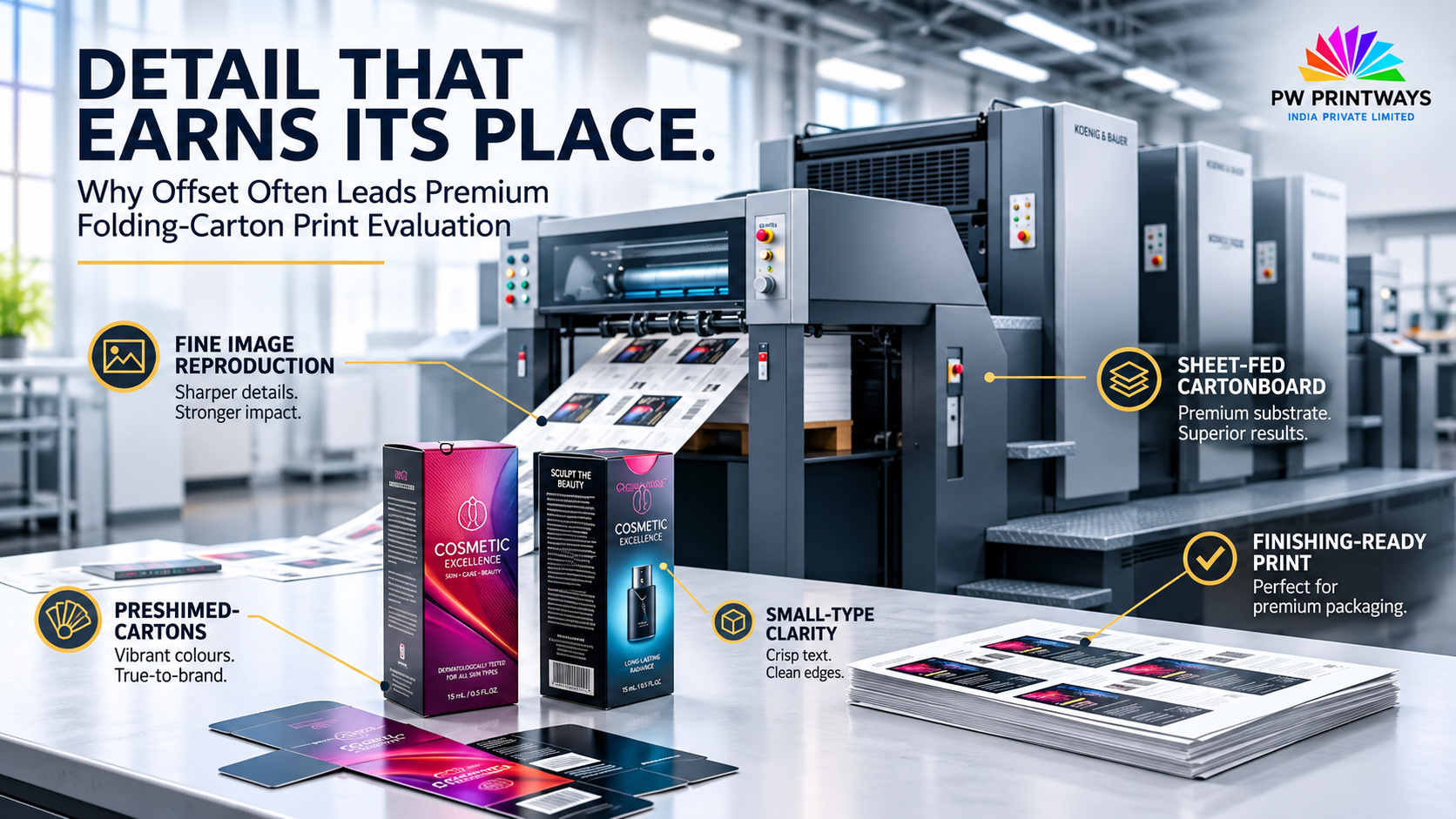
Offset lithography is a widely used printing method for folding paperboard cartons. In sheet-fed offset, individual sheets of paperboard pass through the printing press and receive the artwork through a plate-to-blanket-to-sheet transfer process.
The rubber blanket helps transfer the image onto the sheet, making offset suitable for detailed artwork, photographs, fine typography, gradients and controlled colour reproduction on appropriate paperboard surfaces.
For cosmetics, FMCG, pharmaceutical and retail brands, these print characteristics can be important when a mono carton carries prominent brand colours, product information and detailed graphics.
How Offset Printing Works
The image areas receive ink.
The image transfers onto a rubber blanket.
The blanket transfers the image onto paperboard.
The printed sheet moves into specified finishing and converting.
Where Does Offset Printing Perform Well?
Detailed Artwork
Useful for fine typography, photographs, gradients, product illustrations and complex brand graphics on suitable paperboard.
Colour Management
Supports CMYK process colours and specified spot colours, subject to the board, ink, press setup and approved reference.
Surface Finishing
Printed sheets can be planned for suitable coating, lamination, foil, embossing, debossing and other finishing operations.
Folding Cartons
A common route for paperboard mono cartons that subsequently require die-cutting, creasing, folding and pasting.
What About Setup Cost and Run Size?
Offset printing requires plate preparation, press make-ready, ink setup and other production preparation before the approved result is achieved. These activities contribute to the initial job cost.
Once the setup is complete, production cost is distributed across the printed quantity. This makes sheet-fed offset relevant to a range of short-to-medium and larger folding-carton projects, depending on the artwork, press configuration, board and converting requirements.
It can also be considered for repeat orders and multiple SKU requirements, although different artwork versions, colours, sheet layouts and production arrangements can change the economics.
When Should You Evaluate Offset?
When the project requires detailed graphics on folding paperboard, controlled colour reproduction, suitable surface finishing and a carton structure designed around the actual product.
Explore our
commercially printed mono cartons and folding carton manufacturing
.
03 · Rotogravure printing
Gravure Printing: When Does High-Volume Production Justify It?
Gravure printing, also known as rotogravure, uses an engraved cylinder as the image carrier. The surface of the cylinder contains numerous small cells that hold ink. A doctor blade removes excess ink from the non-image surface, allowing the ink contained in the engraved cells to transfer onto the substrate.
Gravure is commonly associated with long-run flexible packaging applications such as snack wrappers, confectionery films, coffee packaging and other products requiring repeated high-volume production.
It can also be used for certain paper and paperboard applications, including selected label and carton work. However, it is not automatically the first process to evaluate for a conventional sheet-fed mono-carton project.
How Gravure Printing Works
The image is engraved into tiny recessed cells.
The cylinder picks up printing ink.
Excess ink is removed from the cylinder surface.
Ink from the engraved cells transfers to the material.
Why Does Gravure Suit Long, Repeat Production?
The main commercial consideration is cylinder investment. Gravure cylinders are manufactured with engraved image information and represent a significant tooling commitment, particularly when several colours require separate cylinders.
For a long and stable production programme, that initial investment can be distributed across a substantial quantity of finished material. Once the cylinder set and printing conditions are established, repeated production of the same artwork can become commercially attractive.
However, changes to artwork, SKU design, colour separation or cylinder specifications may increase the tooling requirement. This makes the number of repeat orders and the stability of the design important parts of the decision.
Very Long Runs
More suitable to evaluate when the same artwork is expected to run repeatedly over substantial production quantities.
Consistent Artwork
A stable design and repeat-order pattern can help spread cylinder-related investment over production.
Flexible Packaging
A widely established production route for suitable roll-fed films and other compatible packaging substrates.
What Are the Limitations to Consider?
Cylinder manufacturing requires upfront investment, planning and storage considerations. A project with frequent artwork changes or a large number of small, separate versions may not make efficient use of that investment.
Gravure is also a production-system decision. Press capability, available cylinder specifications, compatible inks, drying systems and the chosen substrate need to be evaluated together.
When Should You Evaluate Gravure?
When you have a high-volume, repeatable production requirement with stable artwork and a compatible material. Compare the cylinder investment against expected lifetime volume and the complete production cost.
Technical reference:
Arkay Packaging – Printing Methods and When to Use Each
.
04 · Flexographic printing
Flexographic Printing: Where Does Flexo Fit in Packaging?
Flexographic printing, commonly called Flexo, uses a flexible relief plate with raised image areas. Ink is metered through an anilox roll and transferred from the plate directly onto the selected substrate.
Flexo is widely used for corrugated shipping boxes, labels, flexible packaging, paper sacks and other applications where the substrate and production configuration suit the process.
In corrugated packaging, flexographic printing can be applied directly to the outer liner. The surface quality of the liner, flute structure, ink system, plate and press settings all influence the finished print result.
How Flexographic Printing Works
A flexible raised-image plate is prepared.
The anilox roll meters a controlled ink film.
The raised plate areas transfer ink to the substrate.
The specified ink system is dried or cured.
Why Is Flexo Popular for Corrugated Packaging?
Suitable Board Applications
Flexo is established for direct printing on suitable corrugated liners, paper and other compatible substrates.
Repeat Production
Can be efficient for repeatable production where plate setup, press configuration and production speed suit the requirement.
Shipping Information
Useful for suitable logos, handling symbols, shipping details and other packaging graphics.
What Should Be Checked Before Choosing Flexo?
Modern flexographic printing can deliver very good image reproduction. However, fine details, small reversed text, thin lines and photographic graphics need to be evaluated against the selected press, plate, anilox, ink and material.
A direct-printed corrugated box and a smooth paperboard mono carton are different printing applications. The board surface, corrugated flute structure and required artwork can change the technical and commercial suitability.
For a premium corrugated pack requiring more detailed graphics, a separate offset-printed paper sheet laminated onto corrugated board may also be considered. This process is commonly called litho-lamination. It involves additional material and converting steps.
When Should You Evaluate Flexo?
When the packaging requirement involves corrugated shipping boxes, suitable roll-fed packaging or repeat production where the substrate, artwork and press configuration are compatible.
Explore our
custom printed corrugated boxes and shipping packaging
.
05 · Side-by-side comparison
Offset vs Gravure vs Flexo: Complete Printing Comparison
Now that we understand how each process works, let’s compare them from a packaging buyer’s perspective.
The following table describes common industry applications and cost considerations. It is a selection guide, not a guaranteed ranking of quality or a fixed price comparison.
| Comparison Factor | Offset Printing | Gravure Printing | Flexographic Printing |
|---|---|---|---|
| Image Carrier | Flat printing plate and rubber blanket. | Engraved metal cylinder with recessed cells. | Flexible raised-image plate. |
| Ink Transfer | Indirect transfer through a blanket. | Ink transfer directly from engraved cylinder cells. | Direct transfer from raised plate areas. |
| Common Packaging Fit | Folding cartons, mono cartons and paperboard packaging. | Long-run flexible films and selected paper or board applications. | Corrugated boxes, labels, flexible packaging and paper applications. |
| Artwork Suitability | Strong fit for fine text, detailed images and gradients on suitable board. | Suitable for consistent reproduction on long repeat runs, depending on artwork and substrate. | Suitable for packaging graphics; detail depends on plate, anilox, substrate and press. |
| Initial Tooling | Printing plates and press make-ready. | Engraved cylinders, generally a substantial initial investment. | Flexible printing plates and setup components. |
| Run-Size Consideration | Works across a range of folding-carton quantities; setup and sheet utilisation matter. | Often justified for very long, repeat production when cylinder investment is spread over volume. | Can be efficient for suitable repeat medium-to-long packaging runs. |
| Mono-Carton Relevance | Commonly evaluated for printed folding paperboard cartons. | Project-specific; not generally the first route for standard sheet-fed mono cartons. | Possible for suitable carton production systems, but substrate and press capability must be confirmed. |
| Primary Cost Driver | Plates, make-ready, board, printing, finishing and converting. | Cylinder investment, repeat volume, material and running costs. | Plates, anilox setup, ink, material, press speed and conversion. |
Remember: There Is No Universal Run-Size Break-Even Point
The same quantity can have different economics depending on board size, colours, artwork, tooling, sheet utilisation, number of SKUs, production speed and finishing. Compare supplier quotations using the same finished-pack specification instead of relying on a general industry quantity rule.
For an additional comparison focused specifically on corrugated packaging and mono cartons, read our existing guide:
Offset vs Flexo Printing: Corrugated Packaging & Mono Cartons
.
06 · Choosing by production quantity
Which Printing Process Should You Choose for Your Carton Run Size?
The correct printing process is not determined by quantity alone. A buyer should consider the material, artwork complexity, number of design versions, repeat-order frequency and final packaging format.
The following practical scenarios can help packaging procurement teams decide which printing route to evaluate first.
SCENARIO 01 / PRODUCT-FACING CARTONS
You Need Detailed Printed Mono Cartons
If your product requires detailed illustrations, photographs, clear product information, colour-sensitive branding and suitable finishing on folding paperboard, evaluate sheet-fed offset first.
First process to evaluate: OFFSET
SCENARIO 02 / LONG-TERM REPEAT PRODUCTION
You Have a Large, Stable Packaging Programme
If the same artwork and material are expected to run repeatedly in large quantities, evaluate gravure where the selected substrate and press are compatible. Compare the cost of engraved cylinders with expected production over the full programme.
First process to evaluate: GRAVURE
SCENARIO 03 / SHIPPING AND DISTRIBUTION
You Need Printed Corrugated Boxes
For shipping cases, outer boxes and suitable corrugated packaging with practical graphics and handling information, direct flexographic printing is a common route to evaluate.
First process to evaluate: FLEXO
SCENARIO 04 / MULTIPLE DESIGN VERSIONS
Your Order Has Several SKUs and Changing Artwork
When artwork changes frequently, multiple variants are required or quantities per version are small, compare the separate setup investment for each version. Digital printing may also deserve consideration for very short runs and variable artwork, even though it is outside this three-process comparison.
Evaluate: OFFSET vs DIGITAL, depending on the job
Why Should You Avoid Fixed Quantity Rules?
Suppose two brands each require 50,000 printed packages. One needs detailed folding paperboard cartons across several different designs. The other needs one repeated flexible packaging design on a roll.
Although both orders contain the same quantity, their substrates, tooling requirements, material handling and manufacturing processes are completely different.
This is why production quantity should be evaluated together with packaging format, repeat frequency and artwork—not treated as the only selection criterion.
07 · Upgrade to mono cartons
Upgrading to Mono Cartons: What Should D2C and Product Brands Change?
Many businesses begin their packaging journey with basic printed corrugated boxes or generic shipping packaging. As their products develop a stronger retail identity, they may consider adding a dedicated product-facing carton.
This is where mono cartons become relevant. A mono carton provides a folding paperboard structure around the product or primary container, with additional surfaces for brand identity, product information, variant differentiation and finishing.
However, upgrading to mono cartons is not simply a decision to replace Flexo with Offset. It is a change in the overall packaging architecture.
The Mono-Carton Upgrade / Packaging Layers
01 / Primary Pack
Bottle, jar, tube, pouch or product container.
02 / Mono Carton
Printed folding paperboard pack for product presentation and information.
03 / Corrugated Shipper
Outer packaging for suitable storage, grouping and transport protection.
What Happens to the Printing Decision After an Upgrade?
| Packaging Layer | Typical Printing Consideration | Main Objective |
|---|---|---|
| Primary Product Container | Depends on the bottle, jar, pouch, tube or other primary pack. | Product containment and required protection. |
| Mono Carton | Sheet-fed offset is commonly evaluated for printed folding paperboard cartons. | Product presentation, brand identity and information. |
| Corrugated Shipper | Direct flexo or another suitable corrugated printing route, depending on the job. | Outer protection, stacking, handling and logistics. |
| Additional Inserts | A compatible printed sheet or insert production process. | Product positioning, instructions and additional information. |
Three Examples of Mono-Carton Upgrades
EXAMPLE 01 / COSMETICS
Skincare Serum
A glass serum bottle can be placed inside a custom printed mono carton. Suitable finishing, product information and carton fit can be planned around the primary container.
EXAMPLE 02 / FMCG
Consumer Product
A retail carton can help distinguish different product variants while maintaining a common packaging format across repeat production.
EXAMPLE 03 / PHARMACEUTICAL
Medicine Secondary Carton
A paperboard carton can hold the approved pharmaceutical product information, identify the SKU and surround the specified primary pack.
Important: Mono Cartons Do Not Automatically Replace Shipping Boxes
A mono carton is commonly used for retail-facing product presentation and secondary packaging. A corrugated outer may still be required for transport, stacking and distribution. The correct solution depends on product weight, fragility, the delivery route and the required packaging performance.
Explore our
mono carton manufacturing solutions
and
e-commerce and retail packaging systems
.
08 · Cost and procurement
What Actually Determines the Cost per Carton?
A common purchasing mistake is comparing quotations only by their per-carton price without checking whether the printing process, material, finishing and final packaging specification are identical.
A meaningful comparison should consider the entire production cost, from initial artwork preparation to the finished carton ready for dispatch.
01. Tooling and Setup
Include plates, cylinders, prepress, die preparation, press make-ready and other job-specific setup requirements.
02. Board and Material
Evaluate paperboard grade, GSM, caliper, surface, sheet size, corrugated construction or the relevant substrate.
03. Printing
Compare colours, ink system, print coverage, production speed, make-ready waste and expected print quality.
04. Finishing
Include coating, lamination, varnishing, foil stamping, embossing, die-cutting and other specified operations.
05. Converting
Check stripping, creasing, folding, pasting, glue requirements and structural specifications.
06. Delivery and Quality
Consider inspection, rejection allowances, packing, freight and delivery schedule.
A Practical Checklist Before Comparing Supplier Quotations
- Packaging format: mono carton, folding carton, corrugated box or flexible packaging.
- Finished dimensions and approved dieline.
- Paperboard grade, GSM, caliper or corrugated specification.
- Artwork file, colour requirements and number of versions.
- Printing process, plates or cylinders and setup costs.
- Finishing, die-cutting, creasing, folding and pasting.
- Order quantity, number of SKUs and expected repeat orders.
- Packed format, delivery location and required dispatch schedule.
For a deeper understanding of paperboard requirements, read
What GSM Means for Mono Carton Printing
.
09 · Quality and production
Production Checks Before Selecting a Printing Process
The correct printing technology should support the final packaging specification. A quotation may look commercially attractive, but the printed material still needs to meet the required visual, structural and converting standards.
Before approving production, brands should review the following points with their packaging manufacturer.
1
Artwork and Colour Specification
Confirm CMYK separations, spot colours, artwork versions, trapping, fine details and approved colour references before production.
2
Substrate Compatibility
Verify that the selected press and ink system are suitable for the actual paperboard, corrugated liner, film or other material.
3
Print Registration and Detail
Evaluate fine typography, small reversed text, graphics, colour alignment and image reproduction using a representative sample.
4
Colour Consistency Across Batches
Retain an approved reference and verify the production result under comparable viewing conditions. Account for substrate and finishing variations.
5
Finishing and Surface Quality
Check coating, lamination, foil, varnish, scuff response and compatibility with the final carton structure.
6
Die-Cutting, Creasing and Folding
Check registration between print and die-line, crease quality, flap dimensions, closure, folding and pasting.
7
Final Packed-Product Evaluation
Review the finished carton with the actual product and intended shipping or storage configuration before approving the final packaging specification.
Same Artwork Does Not Always Mean Identical Colour
The paperboard surface, ink, press conditions, coating, lamination and viewing conditions can all influence the final printed appearance. Brands with recurring packaging orders should maintain approved references and agreed inspection requirements.
Related reading:
Why Printed Carton Colour Changes Between Production Batches
.
Manufacturing perspective · PW Printways India
How PW Printways Approaches Mono-Carton Manufacturing in India
Understanding printing technology is only one part of a successful packaging project. The paperboard, artwork, printing, surface finishing and converting operations must work together to produce a carton that is ready for commercial packing.
PW Printways India Pvt. Ltd. is a printing and packaging manufacturer based in Bawana Industrial Area, Delhi. Its printing and packaging manufacturing journey began in 1982, with more than four decades of experience in printed packaging production.
The company manufactures custom printed mono cartons, folding cartons and corrugated packaging for industries including FMCG, pharmaceuticals, cosmetics, healthcare, electronics and D2C.
PW Printways / Manufacturing Setup
PRINTING
Heidelberg Six Colour + Coater
Commercial offset carton printing with inline coating capability.
CONVERTING
Bobst Automatic Die-Cutter
Cutting and creasing printed sheets into approved carton structures.
FOLDING & PASTING
Four-Fold Carton Pasting
Folding and gluing die-cut cartons for inspection and dispatch.
From the Approved Artwork to the Finished Mono Carton
01. Understand the Requirement
Product dimensions, quantity, existing sample, board requirement, artwork and packing method are reviewed.
02. Develop the Carton Structure
The dieline, closure style, board and product clearance are considered together.
03. Prepare Artwork and Proof
Artwork, colour references, panels and finishing requirements are reviewed before approval.
04. Commercial Offset Printing
The approved artwork is printed on the selected paperboard using the agreed production specification.
05. Finishing and Converting
Specified finishing, die-cutting, creasing, stripping, folding and pasting operations are carried out.
06. Inspection and Dispatch
Finished cartons are checked against the approved job specification before packing and dispatch.
PW Printways’ mono-carton manufacturing offering is based on its commercial offset printing and converting workflow. Gravure and flexography are discussed in this article as alternative industry printing technologies, not as services claimed by PW Printways.
Learn more about
PW Printways India and its printing and packaging manufacturing capabilities
.
Common questions · Printing and packaging
Frequently Asked Questions About Offset, Gravure, Flexo and Mono Cartons
Answers to common questions from packaging buyers, brand owners and production procurement teams.
1. Which printing process is best for mono cartons?
Sheet-fed offset is a common choice for folding paperboard mono cartons because it supports detailed artwork, typography, colour reproduction and suitable finishing. The final choice depends on board, artwork, press configuration, quantity and converting requirements.
2. Is offset printing cheaper than gravure printing?
There is no universal cost answer. Offset generally has a different tooling and make-ready cost structure from gravure. Gravure involves engraved cylinder investment, which may become commercially attractive when spread across sufficiently large and repeatable production volumes. Compare both processes using the actual job specifications and expected lifetime quantity.
3. Why is gravure printing used for high-volume packaging?
Gravure uses engraved metal cylinders that carry ink in recessed cells. The cylinders involve an initial tooling investment, making long, repeatable production programmes a relevant application where the cost can be distributed across larger quantities.
4. Is flexo printing suitable for corrugated boxes?
Yes. Flexographic printing is widely used for direct printing on suitable corrugated liners and shipping boxes. The final print result depends on liner quality, flute structure, plate, anilox roll, ink, artwork and press configuration.
5. Can flexo printing be used for folding cartons?
Flexo can be used for selected paperboard and folding-carton applications where a suitable press and production setup are available. However, sheet-fed offset is a common route for detailed conventional folding-carton production. The actual substrate and required print result should determine suitability.
6. Does gravure printing always require a higher minimum order quantity?
Gravure’s engraved-cylinder investment makes it more relevant to large and repeatable production programmes. However, there is no universal minimum order quantity for every gravure supplier. The economic break-even point depends on cylinder costs, colours, substrate, artwork, press capacity and the expected production programme.
7. Can a brand move from flexo-printed corrugated boxes to offset-printed mono cartons?
Yes. A brand can evaluate adding an offset-printed mono carton as product-facing packaging while retaining flexo-printed corrugated boxes as an outer shipping layer where required. The two packaging formats perform different functions and can work together.
8. What is the difference between a mono carton and a corrugated box?
A mono carton is generally a folding paperboard carton used for product presentation, information and secondary packaging. A corrugated box uses fluted board and is commonly used for grouped handling, stacking, storage and distribution protection.
9. What factors determine the printing cost per carton?
Important factors include tooling, press setup, paperboard, ink, artwork, number of colours, print coverage, production quantity, make-ready waste, surface finishing, die-cutting, folding, pasting, inspection and delivery.
10. Does PW Printways manufacture offset-printed mono cartons in India?
Yes. PW Printways India Pvt. Ltd. manufactures custom printed mono cartons and folding cartons through its commercial offset printing and converting setup in Bawana Industrial Area, Delhi. The manufacturing requirement is evaluated according to product dimensions, paperboard, artwork, quantity and finishing.
Technical References and Further Reading
The printing-process explanations and application comparisons in this guide draw on established packaging and printing references.
- Pro Carton: Cartonboard and the Printing Process
- Arkay Packaging: 6 Packaging Printing Methods and When to Use Each One
- Netpak: Flexographic vs Offset Printing for Folding Cartons
- UK Government: Printing Flexible Packaging: Process Guidance
Related Packaging and Printing Guides
- Offset vs Flexo Printing: Corrugated Packaging & Mono Cartons
- Mono Cartons: Custom Printed Folding Carton Manufacturing
- Printed Corrugated Boxes and Shipping Packaging
- What GSM Means for Mono Carton Printing
- Why Printed Carton Colour Changes Between Production Batches
- FMCG Packaging Manufacturer India
- Pharmaceutical and Nutraceutical Packaging
- E-Commerce and Retail Packaging Solutions
Planning Your Next Printing and Packaging Project?
Ready to Upgrade Your Packaging to Custom Mono Cartons?
The right packaging begins with the actual product, the correct paperboard, a suitable printing process and a structure designed for the packing requirement.
Whether you are launching a new product, developing a new mono carton or reviewing an existing printed carton, PW Printways India can discuss the appropriate commercial offset printing and converting requirements.
Share your product dimensions, current packaging sample, artwork, paperboard specification and expected quantity to begin the discussion.
Discuss Your Packaging Requirement
PW Printways India Pvt. Ltd. · K-30, Sector-5, DSIIDC Bawana Industrial Area, Delhi – 110039, India
Printing & Packaging Since 1982 · PAN India Packaging Support
