Offset Printing vs Flexo for Corrugated Packaging: When to Upgrade to Mono Cartons
Offset and flexographic printing solve different packaging problems. The right choice depends on the board, artwork, run length, cost structure and job the package must perform. If you are considering mono cartons, first separate retail presentation from shipping protection.
A practical guide for packaging buyers, brand teams and production planners across India.
The short answer
Choose the print process for the substrate and the job—not just the box.
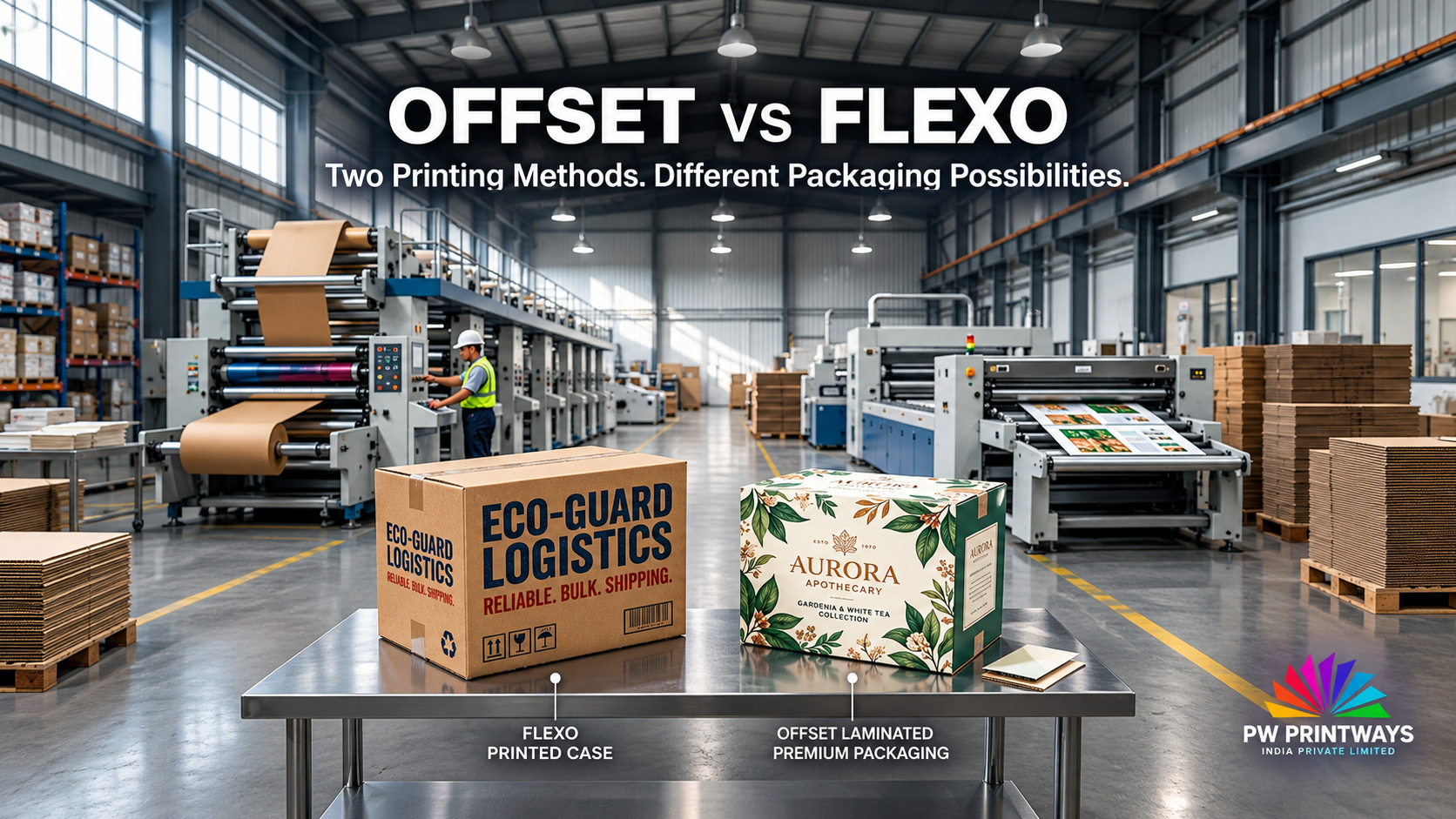
Flexographic printing is commonly used to print directly on corrugated board, particularly for shipping cartons, logos, handling instructions and repeat jobs where production efficiency matters. Offset printing is widely used for detailed graphics on smooth paperboard, including folding mono cartons. For premium corrugated packs, an offset-printed paper sheet can also be laminated to corrugated board.
A mono carton and a corrugated shipper usually serve different roles. A mono carton can improve product-facing presentation and organise product information; a corrugated outer may still be needed for stacking, warehouse handling and distribution protection. Moving to mono cartons is therefore a packaging-system decision, not simply a change from flexo to offset.
First, understand the difference
Offset and flexo are printing processes. Corrugated and mono cartons are packaging formats.
These terms describe different things. Offset transfers ink from a plate to a rubber blanket and then onto a sheet or substrate. Flexography uses a flexible relief plate and an ink-metering system to transfer ink onto the material. Corrugated packaging is built around a fluted paper structure; a mono carton is a folding carton made from paperboard. The best decision starts with the package’s job, then matches the print route to the material and artwork.
01 / How the processes work
How Offset and Flexo Printing Differ
OFFSET LITHOGRAPHY
Plate → blanket → sheet
Ink transfers from a printing plate to a rubber blanket, then to the sheet. This process is commonly used for detailed, high-quality printing on smooth paperboard.
- Good fit for fine graphics, photographs and tonal detail.
- Widely used for printed folding mono cartons.
- Can support a wide range of coatings and finishing routes, depending on the stock and press.
- Plate and make-ready costs should be considered in the total job economics.
FLEXOGRAPHY
Flexible plate → substrate
A raised-image flexible plate transfers ink to the substrate. Direct flexo is commonly used on corrugated liners for shipping cartons and other repeat packaging jobs.
- Fits bold logos, text, symbols and shipping information.
- Can be efficient for repeatable medium- to long-run work.
- Results depend on board surface, flute structure, plate, anilox, ink and press settings.
- Fine details and small reversed text need appropriate design and process checks.
Modern flexo quality can be very good. These are typical application patterns, not absolute limits. Always evaluate the actual artwork, substrate, press capability and sample.
02 / Corrugated printing routes
Offset Printing on Corrugated Is Often a Different Workflow
When a corrugated box needs premium, high-detail graphics, offset printing is commonly used to print a separate paper sheet or label. That printed sheet is then laminated to the corrugated structure before die-cutting and converting. This is often referred to as litho-lamination or litho-labeling, depending on the construction.
Print on the liner
Ink is applied directly to the outside liner of the corrugated board. The board texture and flute structure can influence the print appearance.
Print a sheet, then laminate
Graphics are printed on a separate paper sheet and then bonded to the corrugated structure, creating a smoother, detailed printed face.
Print the liner roll first
The liner is flexo-printed before being combined with the fluted layer. It can suit high-volume work when the production route and print requirements align.
Offset litho-lamination should not be confused with printing directly onto the corrugated flutes using a conventional offset press. The process adds sheet and laminating steps, which need to be included in the quote, schedule and quality plan.
03 / Compare the decision factors
Offset vs Flexo: What Should Packaging Buyers Compare?
Print choice should be based on the full specification. The table below describes common tendencies; it is not a price guarantee or an absolute ranking of quality.
| Decision factor | Offset / litho route | Flexo route |
|---|---|---|
| Typical fit | Detailed folding-carton graphics; premium corrugated graphics through litho-lamination. | Direct printing on corrugated liners, repeat shipping cartons and bold graphic work. |
| Fine detail | Often strong for small details, photographs, smooth gradients and fine screens on suitable paperboard. | Modern flexo can reproduce detailed work, but minimum type, line weight and halftone behaviour must suit the substrate and press. |
| Corrugated surface | Litho-lamination provides a separate printed face, with additional material and converting steps. | Prints on the liner, so liner quality and flute-related surface variation can affect visual results. |
| Run length and repeat work | Setup and plate costs must be considered against quantity, artwork and finishing requirements. | Plate and setup costs may be spread over repeat production; economics depend on speed, number of colours and job stability. |
| Finishing options | Printed sheets can support various finishing choices before conversion, subject to the job specification. | Available finishes depend on the specific press, ink system, substrate and downstream route. |
| Cost comparison | Include plates, press setup, paper sheet, lamination and converting where applicable. | Include plates, ink, make-ready, board, production speed, waste and downstream conversion. |
04 / Upgrading to mono cartons
When Does a Mono Carton Make Sense?
If your product needs a more controlled retail presentation, product information, SKU differentiation or a premium printed surface, a mono carton may be the right product-facing package to evaluate. Offset printing is a common route for detailed graphics on smooth folding paperboard, including many mono-carton applications.
But a mono carton is not automatically a substitute for a corrugated shipper. A retail-facing paperboard carton and a corrugated outer box usually perform different tasks. Depending on the product, handling and distribution route, the right system may use both: a printed mono carton for product presentation and a corrugated case for grouped transport and storage.
Explore PW Printways’ mono-carton manufacturing and complete product range.
05 / A practical selection guide
Which Printing Route Should You Evaluate First?
SHIPPING / DISTRIBUTIONStart by evaluating direct flexo
Useful for corrugated boxes with bold graphics, shipping information and repeatable production requirements. Confirm board, print detail and colour expectations with the supplier.
RETAIL-READY CORRUGATEDCompare flexo with litho-lamination
If photographic detail, smoother print presentation or special finishing is important, compare the complete offset-printed sheet and lamination route against direct flexo samples and total cost.
PRODUCT-FACING CARTONEvaluate offset on folding paperboard
For a mono-carton upgrade, offset is a common route for detailed graphics and colour-sensitive branding. Final suitability still depends on board, artwork, quantity, press configuration and converting needs.
If the quantity is low or artwork changes frequently across multiple SKUs, ask whether digital printing should also be considered. It is outside the main comparison here, but can be relevant where plate setup and version changes dominate the decision.
06 / Colour, artwork and finishing
The Printing Process Cannot Be Chosen in Isolation
Even when two suppliers use the same artwork file, their finished output may differ because of the substrate, plate preparation, ink, press conditions, colour targets and finishing route. This matters for both direct-printed corrugated boxes and premium mono cartons.
- Define whether the design needs CMYK, spot colours or a combination.
- Specify the actual board or liner, including surface and shade where important.
- Review minimum type size, line weight, reversed text and fine detail against the selected process.
- Include coatings, lamination, foil or other finishes in the production plan.
- Approve a representative sample where colour, detail or finished appearance is critical.
- Compare the completed and converted package—not only an image on a monitor.
Related reading: CMYK vs Pantone for Packaging → and Why Printed Carton Colour Changes Between Batches →.
07 / Buyer checklist
What to Send for a Useful Printing and Packaging Quote
- Packaging format and purpose: mono carton, shipping box, retail display or complete system.
- Finished dimensions, board grade, flute type or paperboard specification where known.
- Artwork file, number of colours, brand colour references and fine-detail requirements.
- Finishing requirements such as coating, lamination, varnish, foil or embossing.
- Order quantity, number of SKUs and expected repeat-order pattern.
- Dieline, existing sample or approved reference packaging.
- Packing method, delivery location and required schedule.
- Any critical print, scan, handling or distribution acceptance criteria.
A proper comparison includes setup, material, print, converting, finishing, waste and the performance of the finished package. Avoid choosing from a per-box number without confirming that both quotations cover the same specification.
Related resources
Explore More Packaging and Print Guides
Packaging ProductsSee mono cartons, corrugated boxes and other printed packaging.
FMCG PackagingPlan shelf packaging and corrugated distribution packaging together.
Print Colour ConsistencyUnderstand substrate and process factors behind colour differences.
GSM and Mono-Carton PrintingLearn why grammage alone does not determine print quality.
About PW PrintwaysRead about the company’s printing and converting workflow.
PW Printways / Delhi, India
Upgrading to Mono Cartons? Start With the Product and Its Job.
PW Printways India Pvt. Ltd. manufactures custom-printed mono cartons, folding cartons and printed corrugated boxes from Bawana Industrial Area, Delhi. Its published mono-carton workflow combines commercial offset printing with finishing, die-cutting, creasing, folding and pasting.
If you are moving from a basic shipping box to a more detailed retail carton—or reviewing a complete pack system—share the product, artwork, quantity, board specification and distribution requirement. The printing route should follow the actual packaging job.
Discuss Your Packaging Requirement →
K-30, Sector-5, DSIIDC Bawana Industrial Area, Delhi-110039, India · +91 98993 80302 · [email protected]
Frequently Asked Questions
Is flexo or offset better for corrugated packaging?
Is offset printing used for mono cartons?
Does flexo always cost less than offset?
Can a mono carton replace a corrugated shipping box?
What information should I send to compare printing routes?
Does offset printing mean printing directly on corrugated flutes?
About This Guide
This guide combines packaging-print process references with PW Printways’ published information on mono cartons, corrugated boxes and in-house printing and converting. It is intended to help buyers frame the right questions before requesting quotations. Final print quality, cost and suitability must be evaluated against the actual substrate, artwork, machine capability, quantity and finished-pack requirements.
Technical references: Packaging Corporation of America: print options for packaging · Esko: comparing flexo with other print methods · Netpak: flexographic vs offset printing for folding cartons.
Learn more about PW Printways India Pvt. Ltd., explore our products or contact the team.
