Printing Technology • Packaging • Automation • AI
The Evolution of Printing Technology and Its Impact on Modern Packaging
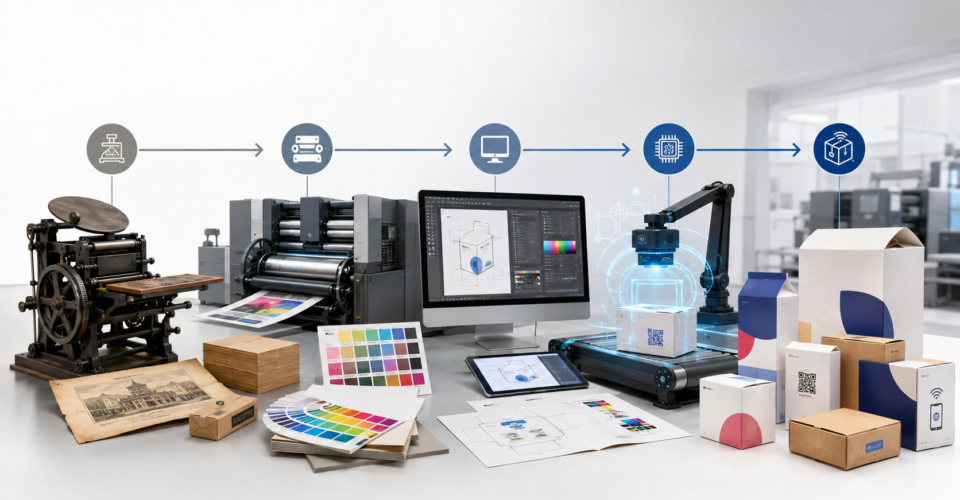
Printing has evolved from manual reproduction into a connected manufacturing system involving offset presses, digital prepress, automation, data, quality control and smart packaging.
Quick Answer
Modern printing technology helps packaging manufacturers improve colour consistency, prepress accuracy, production repeatability, finishing precision and workflow efficiency. For brands, that can mean clearer approvals, more consistent packaging and stronger control from artwork to finished carton.
🧭 The Printing Technology Evolution Map
| Stage | Technology Shift | Impact on Packaging |
|---|---|---|
| 1 | Manual & mechanical printing | Made repeat reproduction possible |
| 2 | Lithography & offset printing | Enabled consistent commercial print production |
| 3 | Digital prepress workflows | Improved artwork checking, proofing and file control |
| 4 | Automation | Improved repeatability and production flow |
| 5 | AI & data-assisted systems | Supports faster checking, planning and defect detection |
| 6 | Smart packaging | Connects physical packs with digital information and experiences |
📜 From Manual Printing to Mechanical Production
Early printing methods such as woodblock printing and movable type changed how information could be reproduced at scale.
As mechanical presses and lithographic processes developed, printing became faster and more commercially practical.
🖨️ Offset Printing Becomes a Packaging Workhorse
Offset printing remains highly relevant for commercial folding-carton production because it can provide clean detail, consistent colour reproduction and efficient output across larger quantities.
In packaging, offset printing is commonly used for:
- Mono cartons
- Folding cartons
- Printed paperboard packaging
- Product inserts and leaflets
- Premium printed brand materials
Why offset still matters:
New technology does not automatically replace older technology. In manufacturing, the best process depends on quantity, material, print requirement, quality expectations and economics.
💻 The Digital Revolution Happened Before the Press
One of the biggest changes in modern printing did not happen only on the printing machine. It happened in the workflow around it.
Digital tools now support artwork preparation, prepress checking, proofing, colour planning, file corrections and job management before a production sheet reaches the press.
Modern Prepress Flow
Artwork File
→
Dieline Check
→
Colour Review
→
Proofing
→
Approval
→
Production
⚡ Digital Printing Adds Speed and Flexibility
Digital printing is particularly useful for short runs, prototypes, test designs, samples, personalized applications and situations where printing plates are not economically justified.
Typical uses include:
- Packaging mockups
- Short-run promotional materials
- Product samples
- Variable data applications
- Design testing before larger commercial production
Offset vs Digital: Different Tools for Different Jobs
| Factor | Offset Printing | Digital Printing |
|---|---|---|
| Typical Quantity | Medium to high volume | Short runs / samples |
| Plates | Required | Normally not required |
| Personalisation | Less flexible | More flexible |
| Packaging Use | Commercial carton production | Prototypes and shorter runs |
⚙️ Automation Changes the Production Floor
Automation increasingly connects prepress, printing, cutting, creasing, folding, pasting and inspection into more controlled production workflows.
Automation can support:
- Prepress checks
- Colour-management workflows
- Job scheduling
- Machine-assisted cutting and creasing
- Folding and pasting
- Quality inspection
Emerging Layer
🤖 AI Is Entering the Printing Workflow
Artificial intelligence can assist with artwork review, image enhancement, layout checking, defect detection, workflow planning and customer-support processes.
But AI does not remove the need for practical packaging knowledge. Material behaviour, machine capability, carton structure, creasing, finishing and product requirements still require manufacturing judgement.
📦 Why Packaging Printing Is Different From Ordinary Printing
A brochure only needs to print well. A carton must print well and then survive converting.
After printing, packaging may need to be coated, laminated, die-cut, creased, folded, pasted, packed, stacked and transported.
Must remain consistent
Artwork must align
Requires precision
Must perform physically
Must survive folding
Confirms finished output
📐 The Dieline Connects Design With Manufacturing
A dieline is the technical layout that tells the packaging process where the carton will be cut, creased, folded and pasted.
It also helps designers place logos, text, barcodes and graphics so they remain correctly positioned after conversion.
A beautiful artwork file is not production-ready packaging until it works correctly with the dieline and converting process.
📱 Printing Is Becoming Connected: The Rise of Smart Packaging
Modern packaging can connect a printed carton with digital content through QR codes and other scannable elements.
Possible applications include:
- Product information
- Usage instructions
- Authentication support
- Promotions
- Customer feedback
- Brand storytelling
The package therefore becomes both a physical communication surface and an entry point into a digital experience.
♻️ Technology Is Also Changing How Packaging Efficiency Is Planned
Modern printing technology can support responsible packaging through better artwork control, more efficient layouts, fewer avoidable reprints and more informed material and finishing decisions.
Responsible packaging can include right-sized cartons, suitable paperboard, material-efficient die layouts and finishes selected according to actual performance requirements.
Read our
Sustainable Printing & Responsible Packaging Guide
.
🏭 Technology in Practice: PW Printways India
At PW Printways India Pvt. Ltd., printing technology is part of a broader manufacturing workflow that includes structural development, design adaptation, proofing, printing, finishing and final quality inspection.
Our published manufacturing setup includes Heidelberg printing and Bobst finishing equipment used for the production of mono cartons, folding cartons and printed packaging boxes.
With more than four decades of experience in printing and packaging, technology is used to support commercial production — while material knowledge, machine experience and quality control remain essential.
What Does This Technology Produce?
Modern print and converting technology supports a wide range of packaging and printed materials.
Mono Cartons — premium folding paperboard packaging.
Corrugated Boxes — shipping, retail and secondary packaging.
Inserts & Leaflets — product information and communication.
Paper Bags — branded retail and gifting applications.
Tags & Printed Materials — product identification and brand communication.
Explore the PW Printways product range →
PAN India Manufacturing Support
🇮🇳 Printing & Packaging Solutions for Brands Across India
PW Printways India manufactures from Bawana, Delhi, while supporting packaging requirements for businesses across India.
Our nationwide market focus includes businesses across North, West, South, Central, East and North-East India.
That includes packaging enquiries from major commercial and manufacturing markets such as Mumbai, Pune, Ahmedabad, Surat, Jaipur, Chandigarh, Lucknow, Bengaluru, Hyderabad, Chennai, Kochi, Kolkata, Indore and other cities and industrial regions across India.
Global Requirements
🌍 Packaging Enquiries From Overseas Markets
PW Printways India also supports discussions for international and export-oriented packaging requirements.
Businesses in markets such as the USA, UK and other international locations can discuss carton specifications, artwork, materials, finishing, quantities and delivery requirements before production planning.
Technology Serves Different Packaging Priorities
💊 Pharmaceuticals
Information accuracy, repeatability and carton consistency.
🛒 FMCG
Scale, colour consistency and efficient commercial production.
💄 Cosmetics
Premium colour, surface finishing and presentation.
🍫 Food
Product-specific structure and print requirements.
📦 E-commerce
Durability, branding and shipping presentation.
⚡ Electronics
Clear communication with appropriate structural protection.
🚀 What Comes Next for Printing & Packaging?
AI-Assisted Prepress
Faster artwork checking and production preparation.
Smarter Quality Inspection
More data-driven defect detection and consistency control.
Connected Packaging
QR codes and digital experiences linked to physical cartons.
More Flexible Production
Improved short-run and personalization options.
More Efficient Manufacturing
Better planning around materials, production waste and workflow.
Key Takeaway
Technology Has Changed Printing — But Packaging Still Has to Perform
The most advanced print workflow is valuable only when the final carton prints accurately, folds correctly, protects the product and reaches the customer with the intended brand presentation.
India • PAN India • International Enquiries
Need a Production-Ready Packaging Solution?
Share your carton dimensions, quantity, paperboard requirement, artwork and finishing specifications with PW Printways India.
🔗 Explore Related Packaging Knowledge
Finishing Technology →
Aqueous Coating vs Lamination Film
Packaging Psychology →
Does Transparent Packaging Build Consumer Trust?
Responsible Manufacturing →
Sustainable Printing & Responsible Packaging
Brand & Print →
Custom Printing & Packaging Solutions
❓ Frequently Asked Questions
What is the evolution of printing technology?
It describes the progression from manual printing methods to mechanical presses, offset printing, digital workflows, automation, AI-assisted systems and connected packaging technologies.
Why is printing technology important for packaging?
Printing technology affects colour accuracy, artwork reproduction, production consistency and the quality of the printed surface before the carton moves into cutting, creasing, folding and finishing.
Is offset printing still relevant?
Yes. Offset printing remains widely used for commercial packaging where larger quantities, colour consistency and high-quality printed paperboard are required.
Is digital printing better than offset printing?
Neither is universally better. Offset is often suited to larger commercial runs, while digital printing can be useful for samples, short runs, prototypes and personalized applications.
How is AI used in printing?
AI can assist with artwork checking, image enhancement, workflow planning, quality inspection and other data-assisted tasks. Human manufacturing expertise is still required for material, structure, machine and converting decisions.
Does PW Printways supply packaging across India?
Yes. PW Printways India manufactures from Delhi and supports packaging production and coordinated delivery for businesses across India.
Can overseas businesses contact PW Printways?
Yes. International and export-oriented requirements can be discussed with the team, including carton specifications, materials, printing, finishing, quantities and delivery requirements.
About PW Printways India Pvt. Ltd.
PW Printways India is a custom printed packaging manufacturer with over four decades of experience in mono cartons, folding cartons and printed corrugated packaging. Its published production workflow includes structural development, prepress, proofing, printing, finishing and final quality inspection.
Manufacturing Location:
K-30, Sector-5, DSIIDC Bawana Industrial Area,
Delhi – 110039, India
Market Reach:
PAN India • USA • UK • International / export-oriented enquiries
About Us
•
Products
•
Industries
•
Contact