
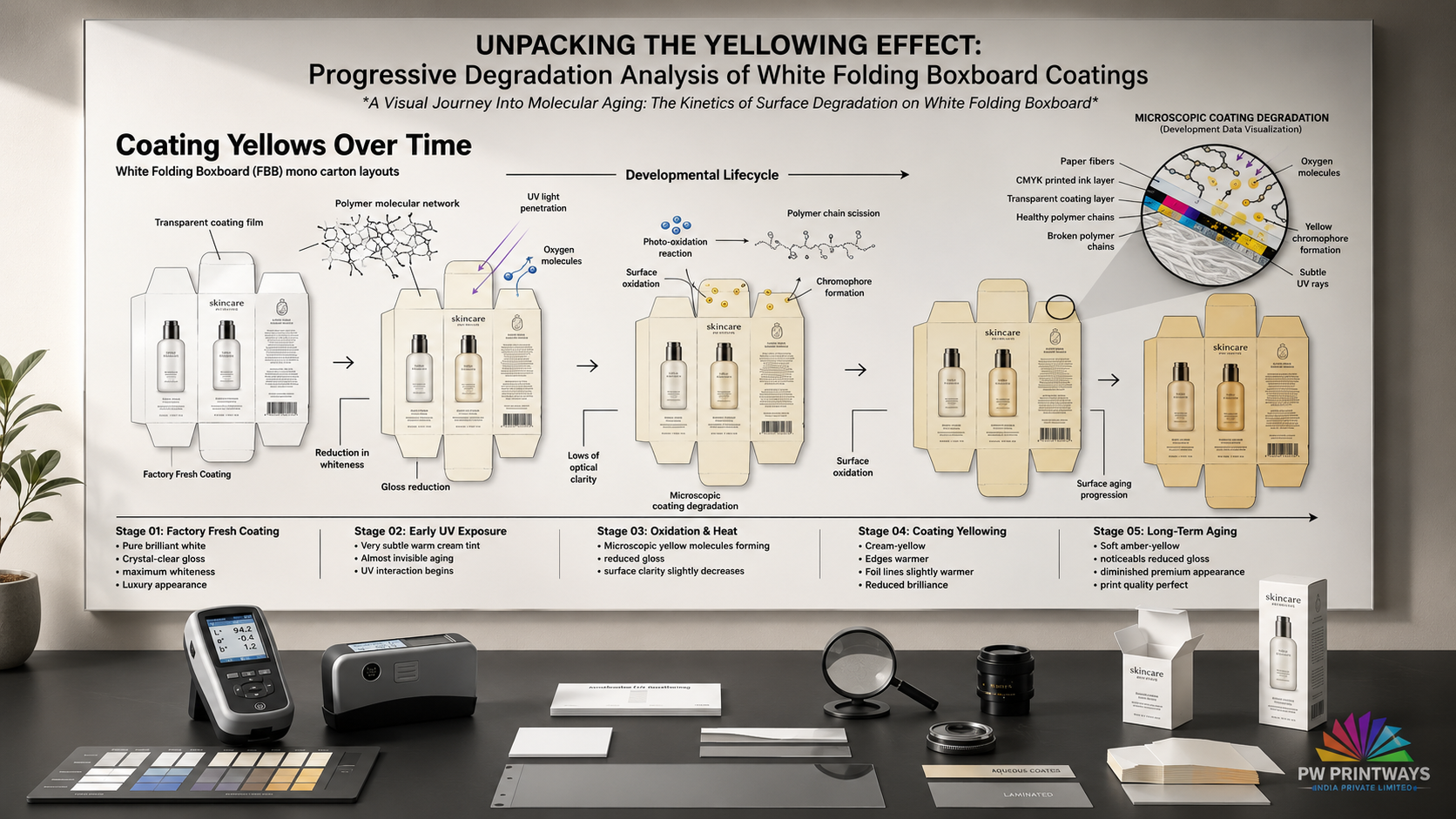
White Stability Laboratory / Folding Boxboard / Coating Ageing
Coating That Yellows Over Time on White Folding Boxboard: Causes, Diagnosis & Prevention
A white carton can look perfectly clean when it leaves production — yet appear warmer, creamier or visibly yellow months later.
The coating may be involved, but it should not automatically be blamed.
White Turns Warm / Yellow
Weeks or Months Later
Board / Finish / Exposure
Identify the Layer First
Quick Answer
Why Can a White Folding Carton Yellow Over Time?
The visible shade of a white folding carton is created by a complete material system — paper fibres, pigments, paperboard coating, optical brightening agents, ink, varnish or protective coating and sometimes additional finishing.
Exposure to light, ultraviolet radiation, heat, oxygen and storage conditions can gradually affect parts of that system.
Possible contributors include:
01. Ageing of the paperboard or fibre structure
02. Changes in optical brightening agents
03. Yellowing of certain varnish or coating chemistries
04. UV and light exposure
05. Elevated storage temperature
06. Interaction between board, ink and finishing
07. Different ageing behaviour between production batches or materials
A yellow carton does not automatically prove that the clear coating failed.
The first task is to identify which layer changed colour.
Investigation 01
“White” Is Not Just the Colour of the Paper
Paperboard whiteness is an optical property. The way a board appears depends on how its surface absorbs, scatters and reflects different wavelengths of light.
Many bright white paperboards also use fluorescent or optical brightening agents — commonly called OBAs or FWAs — to increase the perceived blue-white appearance of the sheet.
That means two cartons can initially appear similarly white even though their fibre composition, coating system and optical-brightener strategy are different.
Fibre Structure
↓
Paperboard Surface Coating
↓
Optical Brightening / Pigments
↓
Ink + Clear Finish
↓
Final Perceived White
1. The Paperboard Itself May Be Changing
Folding boxboard can contain different fibre layers. Depending on the grade and construction, some boards may include mechanical-pulp components within the structure.
Wood components such as lignin can undergo chemical changes during ageing and light exposure, which may contribute to a warmer or more yellow appearance over time.
This is why the correct question is not simply:
“Is this a white board?”
A better specification question is:
“How stable does this board’s white shade need to remain throughout the expected shelf life?”
2. Optical Brighteners Can Change How White Is Perceived
Optical brightening agents absorb ultraviolet energy and re-emit light in the blue region, making a surface appear brighter and less yellow to the human eye.
If that optical effect changes with ageing or exposure, the carton may appear warmer even when the underlying physical board has not changed dramatically.
Important for premium white cartons:
A very blue-white carton is not automatically a more age-stable white carton. Initial whiteness and long-term white stability are separate performance questions.
Investigation 02
3. Can the Clear Coating or Varnish Yellow?
Yes — depending on the chemistry.
Different varnish and coating technologies age differently. Traditional oil-based varnishes, water-based dispersion coatings and UV-curable systems do not have identical chemistry or yellowing behaviour.
For white or very pale carton designs, even a small colour shift in a transparent finish can become visible because there is little printed colour beneath it to mask the change.
| Finish Type | White-Stability Consideration | Recommended Action |
|---|---|---|
| Oil-Based Varnish | Yellowing can be a concern depending on formulation and ageing | Check suitability for exposed white areas |
| Water-Based / Dispersion Coating | Often selected where clean colour stability is important | Confirm grade-specific ageing data |
| UV Coating | Behaviour varies with formulation, curing and coating weight | Specify low-yellowing performance where critical |
| Film Lamination | Film and adhesive become additional optical layers | Evaluate complete laminated structure |
For a broader comparison between coating and film finishing, read our
Aqueous Coating vs Lamination Film Guide →
4. Light Exposure Can Accelerate Shade Change
A carton displayed near a retail window, strong artificial lighting or another source of ultraviolet-rich illumination may age differently from an identical carton stored inside a closed shipper.
This creates a useful diagnostic clue.
Exposure Comparison
Exposed panel yellows but covered area remains white?
Light-sensitive ageing becomes a stronger suspect. The next step is to determine whether the changing component is the board, OBA system, ink or clear finish.
5. Heat and Storage Conditions Matter Too
Packaging is rarely stored under laboratory conditions throughout its life.
Finished cartons may experience warehouses, transport vehicles, distribution centres, retail lighting and varying seasonal temperatures.
Elevated temperature can accelerate some chemical ageing processes, which is why colour-stability expectations should be discussed alongside the intended storage and shelf environment.
Do not diagnose from age alone.
“Yellowed after six months” is incomplete information. Where the carton was stored, what light it received, temperature exposure and whether the reference sample changed are also important.
Investigation 03
Where Is the Yellowing Visible?
The pattern of discoloration can help narrow the investigation.
Review the coating system, coating weight, cure/drying and ageing performance.
The board or optical-white system becomes a stronger suspect.
Investigate light and UV exposure.
Review storage position, process variation and material consistency.
Measure both samples rather than judging them only by eye.
Build a Simple “Specimen Set” Before Changing the Production Specification
When possible, retain representative samples from the same production job so each layer can be compared.
SPECIMEN A
Original Board
Unprinted / unfinished reference where available.
SPECIMEN B
Printed Board
Shows whether print changes without the final finish.
SPECIMEN C
Printed + Coated
Represents the finished visual construction.
SPECIMEN D
Protected Control
Stored away from significant light for comparison.
Measurement
Don’t Depend Only on “It Looks Yellow”
Human vision is extremely useful for spotting changes, but lighting conditions can make the same white carton appear different.
For repeatable comparison, white and near-white samples can be measured using colour and whiteness data under controlled illumination.
| Measurement | What It Helps Track |
|---|---|
| L* | Lightness change |
| a* | Red / green direction |
| b* | Blue / yellow direction |
| ΔE | Overall colour difference between samples |
| CIE Whiteness | Change in perceived board whiteness |
Measurements should be compared using the same instrument configuration, illumination condition and sample orientation. Acceptance limits should be agreed for the actual project rather than copied from an unrelated carton.
Board, Coating or Storage? Use Elimination — Not Assumption
| Suspect | What to Compare | Useful Clue |
|---|---|---|
| Paperboard | Unfinished aged vs retained board | Both coated and uncoated areas shift |
| Optical Brightener | White shade under consistent illumination | Blue-white appearance becomes warmer |
| Clear Coating | Coated vs uncoated control | Change follows coating boundary |
| UV / Light | Exposed vs covered area | Light-facing surface changes faster |
| Heat / Storage | Different stored batches | Warehouse position correlates with change |
| Process Interaction | Different finish combinations | Only one production construction changes |
Pre-Production Control
For Critical White Packaging, Test Ageing Before Scaling Up
A carton approved immediately after printing tells you how the pack looks today.
It does not automatically tell you how the same board-and-finish combination will look after extended storage or light exposure.
For high-value white packaging, the manufacturer, board supplier and coating supplier can agree on appropriate colour-stability evaluation based on the intended application.
Suggested Evaluation Logic
Baseline: measure approved fresh sample
Control: retain protected sample
Exposure: evaluate under agreed light / temperature conditions
Measurement: compare colour values consistently
Decision: approve only against an agreed tolerance appropriate to the product
Accelerated testing should not be presented as an exact prediction of real shelf life unless the method has been properly correlated with the actual application.
Why Yellowing Is More Serious on Premium White Packaging
Minimal white cartons are visually unforgiving.
A design containing large white areas, fine typography and restrained graphics gives small material or colour changes fewer places to hide.
This is especially relevant to:
For cosmetics and wellness brands specifically, read our
Cosmetics & Wellness Mono Carton Premiumization Guide →
Choosing the “Whitest” Board Is Not Always the Complete Specification
When premium brands compare paperboards, the brightest initial sample can be visually attractive.
But long-term applications may require additional questions:
What fibre and board construction is being used?
Does the board rely heavily on optical brightening for its shade?
How consistent is its white shade between batches?
What does the board supplier say about light and ageing stability?
Is the board compatible with the required coating and finishing system?
Specification Warning
Avoid These Oversimplified Packaging Rules
× “UV coating always yellows.”
× “Water-based coating can never yellow.”
× “If the carton is yellow, the coating must be defective.”
× “The highest whiteness number gives the best long-term result.”
× “One ageing result applies to every board, coating and storage environment.”
How Should a Brand Specify a Finish for a White Carton?
Instead of requesting only “gloss coating” or “matte coating,” a more complete specification can include the visual and ageing requirement.
1. Define the board grade.
The substrate is part of the colour-stability system.
2. Identify exposed white areas.
Large unprinted white panels make slight coating colour more visible.
3. State expected storage and shelf conditions.
Light and heat exposure can influence ageing behaviour.
4. Request an appropriate coating system.
Where white retention is critical, coating stability should be part of supplier selection.
5. Keep an approved control sample.
It provides a reference if a future batch or aged pack appears different.
6. Agree how colour change will be evaluated.
Visual inspection and instrument measurements should use consistent conditions.
Would Lamination Automatically Solve Yellowing?
No.
Lamination changes the finishing system by adding a film and bonding layer, but the underlying board can still age and the film-and-adhesive combination has its own optical and ageing characteristics.
The decision between coating and lamination should therefore consider the required:
- Surface protection
- White and colour stability
- Gloss or matte appearance
- Handling resistance
- Folding performance
- Material complexity
- Commercial cost
Compare both finishing systems in our
Aqueous Coating vs Lamination Film article →
White-Retention Checklist
10 Questions to Ask Before Approving a White Mono Carton
- Which folding boxboard grade is being used?
- What shade of white has been approved?
- Are optical brighteners relevant to the chosen board?
- Which clear coating, varnish or laminate is being applied?
- Are large areas of the carton left unprinted white?
- How long is the expected product shelf life?
- Will packs face strong retail or daylight exposure?
- Could transport or warehousing expose them to elevated temperatures?
- Will a production control sample be retained?
- Has acceptable colour change been agreed where white stability is critical?
Manufacturer Perspective
How PW Printways Approaches White Folding-Carton Quality
At PW Printways India Pvt. Ltd., the appearance of a finished mono carton is considered across the complete production sequence rather than viewing board, print and finishing as unrelated steps.
PW Printways’ published workflow includes structural development, prepress, proofing, printing, finishing and final quality inspection.
Its in-house Heidelberg printing and Bobst finishing equipment supports controlled commercial production of mono cartons, folding cartons and other printed packaging.
For a white-retention problem, useful investigation can include the board specification, printed control, coating or lamination requirement, storage history and comparison between fresh and aged samples.
The objective is not to promise that every white carton will remain visually identical forever. It is to select and control materials appropriate to the expected application.
White Mono Cartons for Premium & High-Visibility Products
PW Printways manufactures premium folding paperboard mono cartons for sectors including pharmaceuticals, FMCG, cosmetics, electronics, food and retail.
For white packaging, board shade, print coverage, coating, finishing and production repeatability should be considered together rather than choosing the finish only for its initial gloss or tactile appearance.
Explore Custom Mono Cartons & Packaging Products →
Longer Visual Life Can Also Reduce Avoidable Packaging Rejection
If cartons become visibly unacceptable before the packed product reaches the intended end of its commercial life, packaging may be rejected or replaced even when its structural function remains intact.
Choosing appropriate materials and preventing avoidable finishing defects can therefore support material-efficiency goals.
PAN-India Packaging Manufacturing
Custom Mono & Folding Cartons for Brands Across India
PW Printways India manufactures custom printed packaging from Bawana, Delhi and supports packaging requirements and coordinated delivery for businesses across India.
White and premium folding-carton requirements can be developed for brands across North, West, South, Central, East and North-East India.
Businesses in commercial markets including Mumbai, Pune, Ahmedabad, Surat, Bengaluru, Hyderabad, Chennai, Kolkata, Jaipur, Chandigarh, Lucknow, Indore, Kochi and other Indian locations can discuss carton specifications according to their actual products, quantities and finishing requirements.
International Packaging Requirements
White Carton Specifications for Export-Oriented Brands
International brands and sourcing teams can discuss custom mono-carton requirements with PW Printways India based on product dimensions, board, printing, finish, commercial quantity and destination requirements.
For export-oriented packaging, expected storage time, transport environment and retail exposure should also be considered where long-term appearance is important.
What to Send Your Manufacturer If a White Carton Has Yellowed
Fresh production sample
Aged / yellowed sample
Paperboard grade and GSM / caliper
Coating, varnish or lamination specification
Production date / batch
Storage duration and location
Light / heat exposure information
Photos showing exposed and protected carton surfaces
Related Packaging Knowledge
Coatings & Protection
Aqueous Coating vs Lamination Film →
Beauty Packaging
Cosmetics & Wellness Mono Carton Premiumization →
Brand Presentation
Why Premium Packaging Matters for Brand Success →
Material Efficiency
Responsible Packaging & Sustainable Printing →
Packaging Products
Explore Our Packaging Product Range →
Technical Reading
Paperboard Whiteness & Optical Properties:
Holmen / Iggesund Paperboard — Whiteness
Varnishing & Yellowing Considerations:
Holmen — Varnishing Techniques for Paperboard
Paperboard Ageing Resistance Example:
Stora Enso — Graphical Board / Yellowing & Ageing
White Packaging Evaluation
Is Your White Carton Changing Colour Over Time?
Share your existing carton, fresh and aged samples, board specification, coating or lamination requirement, quantity and storage information with the PW Printways India team.
Frequently Asked Questions
White Folding Boxboard & Coating Yellowing FAQs
Why does white folding boxboard turn yellow over time?
Possible causes include ageing of the paperboard, changes in optical brightening agents, coating or varnish chemistry, ultraviolet and light exposure, elevated temperature and interactions between the board, print and finishing system.
Can clear varnish make a white carton yellow?
Certain varnish or coating chemistries can develop colour during ageing. The degree depends on the specific formulation, coating weight, drying or curing and exposure conditions, so the actual finish should be evaluated rather than assuming all clear coatings behave the same way.
Does UV coating always turn yellow?
No. UV-coating formulations vary considerably, and low-yellowing products are available. Where white retention is important, formulation-specific ageing and application data should be reviewed.
Can optical brighteners affect long-term whiteness?
Yes. Optical brighteners influence perceived whiteness, particularly under UV-containing illumination. Changes in their optical contribution can alter the apparent shade of a board over time.
Is FBB more likely to yellow than every other board?
That should not be generalized. Ageing behaviour depends on the specific board construction, fibre composition, surface coating, optical brightening system and exposure conditions. Individual board grades should be evaluated using supplier data and application testing.
Can lamination prevent paperboard yellowing?
Not automatically. Lamination adds a film and bonding layer, but the underlying board and the complete laminated construction still have their own ageing behaviour.
How can white-carton colour change be measured?
Fresh and aged samples can be compared using consistent visual conditions and instrumental colour measurements such as L*, a*, b*, overall colour difference and relevant whiteness values.
Which packaging categories need high white stability?
White stability can be particularly important for cosmetics, skincare, wellness, pharmaceutical and premium retail packaging where large clean white areas are central to the brand presentation.
Does PW Printways manufacture white mono cartons in India?
PW Printways India manufactures custom printed mono cartons and folding cartons from its Bawana, Delhi manufacturing location and supports packaging requirements for businesses across India.
Can international brands discuss premium white carton requirements?
Yes. International and export-oriented requirements can be discussed according to product dimensions, board, printing, finishing, quantity, expected storage conditions and delivery requirements.
About PW Printways India Pvt. Ltd.
PW Printways India is a custom printed packaging manufacturer specialising in mono cartons, folding cartons and printed corrugated packaging. Its published workflow covers structural development, prepress, proofing, printing, finishing and final quality inspection.
The company’s in-house Heidelberg printing and Bobst finishing equipment supports controlled production of custom printed packaging.
Manufacturing Location:
K-30, Sector-5, DSIIDC Bawana Industrial Area,
Delhi – 110039, India
Market Reach:
PAN India • International / export-oriented enquiries
About
/
Products
/
Industries
/
Contact
