
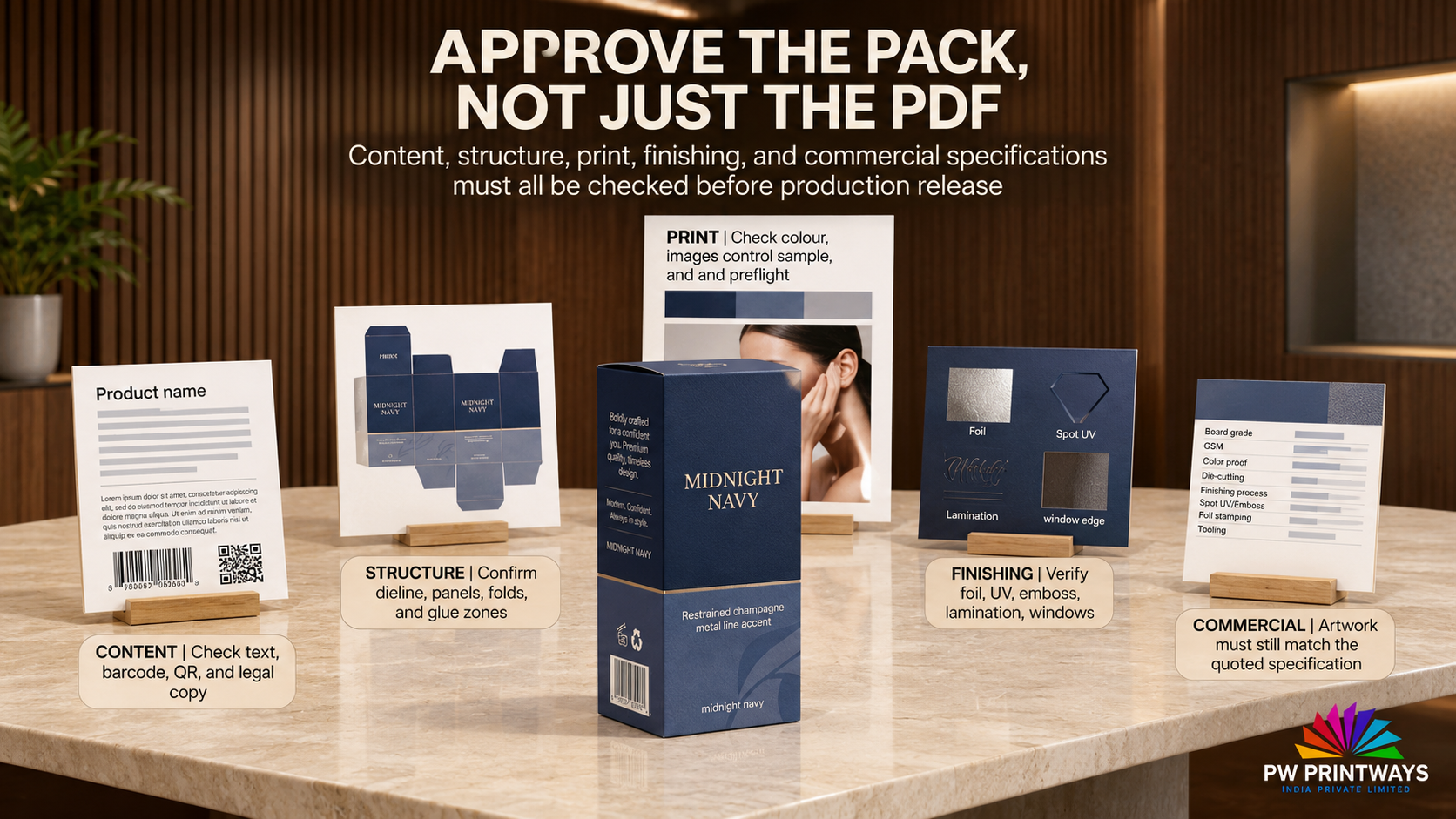
What Purchase Managers Should Check Before Approving Artwork
A practical pre-production checklist for printed mono cartons—covering specifications, dielines, copy, colour, barcodes, finishing and artwork version control before bulk printing begins.
Packaging procurement · Prepress review · Folding cartons · Production readiness
The short answer
Artwork approval is a production control—not just a design sign-off.
Before approving mono-carton artwork, a purchase manager should confirm that the file matches the agreed product specification, physical dieline, approved text, colour requirements, board and finish, variable-data zones and packing process. The artwork should be the correct version for the correct SKU, quantity and market.
A design can look right on screen yet still contain an incorrect revision, an unsuitable barcode placement, artwork crossing a crease or a finish that conflicts with a glue area. A structured review helps identify these issues before commercial production, when corrections are usually less disruptive.
First principle
Approve the complete packaging specification—not an isolated PDF.
A packaging artwork file must be reviewed alongside the purchase order or job brief, approved copy, carton dieline, paperboard specification, printing and finishing requirements, and any agreed inspection criteria. If these documents disagree, stop and reconcile them before releasing the job.
01 / Start with the brief
Confirm the Job Details Before Opening the Artwork
The first check is administrative, but it prevents a common type of mistake: approving technically correct artwork for the wrong product, version or order. Match the file to the purchase specification and make sure the teams are reviewing the same revision.
For repeat orders, do not assume that a previous job file is still the approved version. Confirm whether product details, artwork, structure, board, finishing or customer requirements have changed since the last production run.
02 / Checklist at a glance
The 8 Checks to Complete Before Artwork Approval
Use this table as a shared review sheet for procurement, design, prepress, quality and the packaging supplier. The level of review should match the product, the approved specification and the risk of the job.
| Check | What to confirm | Evidence to retain |
|---|---|---|
| 1. Job identity | Correct SKU, product, quantity, market and artwork revision. | Purchase order / job brief and approved file reference. |
| 2. Dieline | Panel dimensions, cut and crease lines, fold direction, glue flap and closure construction. | Approved structural drawing or sample. |
| 3. Text and product data | Spelling, codes, product details and the customer-approved content. | Signed-off copy or artwork approval record. |
| 4. Colour and print | CMYK / spot-colour references, colour target, fine detail and print method. | Approved proof or physical reference where required. |
| 5. Barcode / QR | Encoded data, symbol size, contrast, quiet zones and placement. | Verified code data and scan / verification result where specified. |
| 6. Board and finish | Board grade / GSM, intended print surface, coating, lamination and special finishes. | Approved material and finishing specification. |
| 7. Converting readiness | Safe zones, bleed, glue-free areas, folding and packing-line compatibility. | Prepress check and structural / production review. |
| 8. Final release | All queries resolved and the correct final proof explicitly approved. | Dated approval with revision and job reference. |
03 / Dieline and structure
Check That the Artwork Fits the Actual Carton
A mono carton is not just a flat graphic. The dieline defines the panels and the way the paperboard blank will be cut, creased, folded and glued. If artwork is placed without checking the actual structure, important details may sit too close to cuts or folds, or printing and finishing features may interfere with glue areas.
Structural lines
Check that the approved cut, crease, panel and closure geometry matches the current dieline. Do not rely on an older blank without confirmation.
Safe areas and bleed
Keep critical text, logos and codes clear of trim and crease areas according to the supplier’s approved prepress specification; allow appropriate bleed where artwork extends to an edge.
Glue and special finishes
Confirm glue areas are compatible with coatings, varnishes, foil, embossing, lamination and other specified finishes. Keep finish-free areas wherever the agreed structure requires them.
The structure should be approved before final artwork is released. If the dieline changes, the artwork should be checked again against the revised structure.
Related reading: Mono Carton Manufacturing → and Straight-Line Gluer vs Auto-Lock Bottom →.
04 / Text and regulated content
Check Every Detail—But Do Not Create Unapproved Content
Purchase managers should confirm that the wording and identifiers match the approved source document. The reviewer should look for missing text, spelling errors, outdated details, incorrect product codes and differences between the approved copy and the file prepared for print.
For pharmaceutical packaging, the pharmaceutical company or authorised product owner must approve applicable labelling text and regulatory content. The packaging converter should manufacture the agreed printed component from that approved artwork; it should not independently invent, revise or approve medicine declarations.
Read about pharmaceutical packaging → FDA carton-labelling design guidance →
05 / Colour and board
Approve Colour Against the Intended Board and Finish
A colour specified in artwork is not by itself proof that the finished carton will look identical across all paperboards or production runs. Substrate shade, coated or uncoated surface, ink system, print conditions and finishing can all influence the visual result.
- Confirm whether each colour is specified as CMYK, a spot colour or a defined simulation.
- Retain the Pantone suffix (C or U) or other agreed reference where relevant.
- Check board grade, GSM and surface against the purchase specification.
- Identify coating, lamination, UV, foil, embossing or other finishing requirements.
- For colour-critical work, agree how the physical proof or approved sample will be evaluated, including the final finish where required.
Related reading: Why Printed Carton Colour Changes Between Batches →, Pantone Colours on Coated vs Uncoated Board → and What GSM Means for Mono-Carton Printing →.
06 / Barcode and variable data
Do Not Treat Barcodes and Coding Zones as Artwork Decorations
Barcodes, QR codes and variable-data fields have functional requirements. They should not be moved, cropped, recoloured or resized casually to solve a layout problem. Confirm the code type, encoded data, size, contrast, quiet zone and placement against the product specification and relevant standard.
Before approving
- Confirm encoded data and check digits where applicable.
- Keep required quiet zones and suitable contrast.
- Check size and orientation against the packaging application.
- Preserve customer-specified batch/date coding areas.
- Request barcode verification or scanning on a representative printed sample where required.
07 / Final sign-off
Use a Controlled Proof-and-Approval Workflow
After approval, any change to text, colour, dimensions, board, finishing or structure should follow a defined change-control process. A revised file should not enter production until the relevant changes have been reviewed and approved.
08 / Responsibility matters
Who Should Approve What?
Artwork approval works best when each participant knows the boundaries of their responsibility. Procurement coordinates the commercial specification and supplier workflow, while the relevant content owner approves product-specific text and the converter checks manufacturing feasibility.
| Role | Primary approval focus |
|---|---|
| Purchase manager | Correct job, specification, quantity, commercial conditions and supplier sign-off record. |
| Brand / design team | Approved visual layout, brand assets, artwork version and intended appearance. |
| Regulatory / product owner | Applicable product copy, declarations and regulated information, where relevant. |
| Packaging / prepress team | Dieline fit, print setup, bleed, safe areas, codes and converting constraints. |
| Converter / supplier | Manufacturing feasibility and reproduction of the agreed artwork and specification. |
The precise approval process varies by product and customer quality system. This table is a responsibility guide, not a replacement for contractual or regulatory procedures.
Related resources
Explore More Mono-Carton and Packaging Guides
Printed Carton Colour ConsistencyLearn how substrate, printing and finish affect repeat batches.
Pantone on Coated vs Uncoated BoardClarify colour references and substrate behaviour.
What GSM Means for Mono Carton PrintingUnderstand grammage, caliper and print performance.
SBS vs FBB vs Duplex BoardCompare board choices beyond a single GSM figure.
About PW PrintwaysLearn about the company’s printing and converting workflow.
PW Printways / Bawana, Delhi
Need Help Turning an Approved Specification into a Finished Mono Carton?
PW Printways India Pvt. Ltd. manufactures printed mono cartons, folding cartons, inserts and other paper-based packaging from Bawana Industrial Area, Delhi. The production workflow connects the client brief, structure and artwork, proof approval, printing, finishing, die-cutting, folding, pasting, inspection and dispatch.
For an enquiry, share your product or SKU, carton dimensions or sample, approved artwork status, board and finish specification, quantity and delivery location. This helps align the packaging brief with the actual production requirement.
Discuss Your Mono-Carton Requirement →
PW Printways India Pvt. Ltd. · K-30, Sector-5, DSIIDC Bawana Industrial Area, Delhi-110039, India · +91 98993 80302 · [email protected]
Frequently Asked Questions
What should a purchase manager check before approving mono-carton artwork?
Why does the dieline need approval before artwork release?
Should a screen proof be the only approval reference?
Who approves pharmaceutical carton wording?
What should be checked on a barcode before printing?
What happens if artwork changes after approval?
About This Guide
This guide is written for packaging procurement teams and buyers coordinating printed mono-carton production. It provides a practical review framework; actual acceptance criteria should follow the purchase specification, customer quality system and product-specific approvals.
External technical references: GS1 barcode quality checks and, where pharmaceutical packaging is involved, the FDA carton-labelling design guidance. The FDA material is US guidance and does not replace applicable Indian requirements.
Learn more about PW Printways India Pvt. Ltd., browse our packaging products or contact the team.
