Shelf Sightline Blueprint / Window Cartons / Retail Packaging
Window Placement Tips for Maximum Impact in Mono Cartons
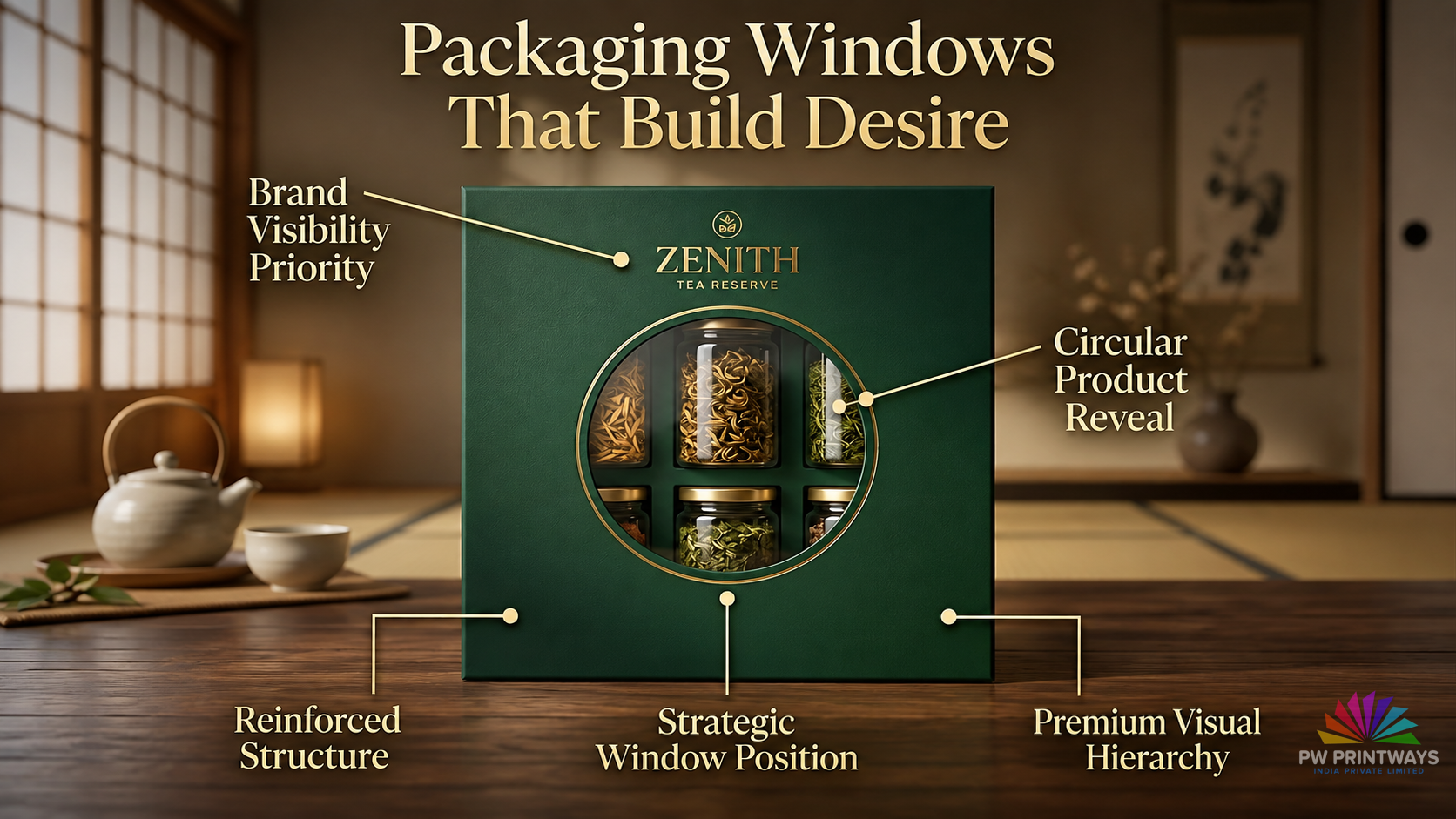
A transparent window can turn the actual product into part of the packaging design — but only when the window shows the right product area, from the right viewing position, without weakening the carton or sacrificing important communication.
Quick Answer
Where Should a Window Be Placed on a Mono Carton?
There is no universal “best” location.
The strongest window position is usually the one that allows a shopper to see the most meaningful and visually attractive part of the real product while keeping enough paperboard for:
- Brand identity
- Product name and variant
- Required information
- Panel stiffness
- Crease and folding performance
- Glue and converting requirements
- Product protection
Don’t ask:
“Where can we cut a hole?”
Ask:
“Which part of the real product should the shopper notice first?”
Sightline Principle 01
Window Size Is Only Half the Decision — Placement Determines What People Actually See
A carton can have a large transparent window and still communicate poorly.
Why?
Because customers do not evaluate the percentage of transparent material. They evaluate the product information visible through that area.
For example, a window may reveal:
Useful view: product colour, shape, texture, quantity or premium container
Weak view: empty space, inner tray, barcode area, product base or visually unimportant surface
That is why window placement should begin with the actual packed product rather than simply finding an unused area in the artwork.
Related illustrative reading: Illustrative Example: Designing a Window Carton for Product Visibility. These examples do not report verified client outcomes.
Front-Panel Map
Think of the Front Panel as Competing Zones
Every front panel has limited area. A window takes some of that area away from print, so the designer has to decide what deserves the strongest visual territory.
Brand / Logo
Product Name
& Variant
Possible Window /
Product Hero Area
Supporting Communication
The exact arrangement will vary, but the principle is useful:
the window should have a defined communication role.
If a window occupies prime front-panel space without revealing anything persuasive, it is using valuable packaging real estate inefficiently.
Placement Tip 01
Show the Product’s Strongest Visual Feature
Start by asking what physical characteristic makes the product worth seeing.
| Product | Potential Hero Feature | Window Objective |
|---|---|---|
| Cookies / confectionery | Texture, coating, decoration | Show actual appetising surface |
| Premium bottle | Bottle silhouette / label | Turn primary container into visual element |
| Gift set | Arrangement and colour | Create preview without revealing everything |
| Toy / accessory | Actual shape and scale | Help buyer understand physical product quickly |
| Cosmetic item | Container colour / premium finish | Support premium presentation where suitable |
Placement Tip 02
Design for the Product’s Real Packed Position — Not an Idealised Mock-Up
A digital rendering may place the product perfectly in the centre.
Real products may behave differently after packing, transport and shelf handling.
Depending on the product and internal structure, it may:
- Settle downward
- Rotate
- Move laterally
- Lean
- Shift inside a tray or insert
Practical rule:
Approve the window with the actual product packed inside the physical carton—not from the flat dieline alone.
Placement Tip 03
Place the Window According to the Shopper’s Viewing Angle
The carton should not be evaluated only while lying flat on a designer’s table.
Ask where the product will actually be seen:
Eye-Level Shelf
Front panel may dominate.
Lower Shelf
Shopper may look downward at the pack.
Counter Display
Top/front relationship may matter more.
Hanging Display
Product orientation and viewing distance change.
A perfectly centred opening is not automatically the most visible opening in the real retail environment.
Placement Tip 04
Don’t Make the Window Fight the Brand
A window should work with the printed graphics rather than becoming an unrelated cut-out.
Keep the strongest brand identifiers easy to find:
- Logo
- Product name
- Variant
- Key product benefit
- Important mandatory information where applicable
The window should create a visual relationship with these elements.
A useful design hierarchy:
Brand → Product Name → Real Product → Supporting Information
Placement Tip 05
Keep the Window Away From Critical Crease and Folding Areas
A window changes the geometry of the paperboard panel.
If an opening comes too close to a critical crease, corner, flap or heavily loaded structural area, it can potentially influence:
- Panel stiffness
- Folding behaviour
- Corner strength
- Carton squareness
- Machine handling
There is no responsible universal rule such as “always keep the window exactly X millimetres from the crease.”
The required bridge of paperboard depends on carton dimensions, board grade and caliper, opening geometry, product weight, crease design, converting process and final use.
Structural warning:
Do not move or enlarge a window purely in the artwork file without reviewing the structural dieline.
Placement Tip 06
Protect Enough Paperboard Around the Window
The paperboard surrounding the opening acts as the structural frame of that panel.
A very large window may create excellent visibility but leave narrow strips of paperboard that flex, bow or tear more easily.
Instead of maximising transparent area, evaluate the balance between:
Useful Product Visibility
+
Adequate Paperboard Frame
+
Brand Communication Space
+
Required Protection
Is There an Ideal Percentage of Product to Show?
Not universally.
Window performance varies by product, visual attractiveness, package shape, physical viewing conditions, shelf environment and customer expectations.
Research on transparent packaging generally supports the idea that seeing the real product can influence evaluation and purchase behaviour in suitable categories, but the effect has important boundary conditions.
For example, recent consumer research found a preference advantage for visible products in certain conditions, but also found that the effect weakened when the product itself was less desirable or when the buying context changed.
So don’t copy a percentage from another package.
Determine how much visibility your actual product needs to communicate quality, shape, texture or quantity — then validate it with a physical prototype.
Placement Tip 07
Consider What Happens Behind the Window
A good window is not only about the cut-out.
The designer also needs to control what appears behind it.
Check whether the shopper can see:
- The intended product surface
- An unattractive inner flap
- A tray edge
- Empty headspace
- Product labels turned away from the opening
- Internal packing components
For multi-unit products such as confectionery or gifting, product arrangement can become part of the window design.
Placement Tip 08
Use Shape to Frame the Product — But Don’t Sacrifice Manufacturability
A window does not have to be a simple rectangle.
Curves, arches and product-inspired shapes can help integrate the transparent area into the visual identity.
Research has also shown that window shape itself can influence consumer perception in some food-packaging contexts.
But the die-cut geometry still needs to be practical.
Avoid adding complicated narrow cuts, fragile bridges or decorative geometry simply because it looks dramatic in a digital mock-up.
Good window geometry:
Visually intentional + structurally sensible + repeatable during die-cutting and converting.
Placement Tip 09
Remember the Window Film Needs Its Own Manufacturing Area
Where a transparent film is patched behind the opening, the visible window is only one part of the construction.
The film generally needs to extend beyond the opening so it can be attached securely to the inside surface of the carton.
That means the internal area around the window must also be checked for:
- Film overlap
- Bonding area
- Nearby creases
- Glue flaps
- Internal product clearance
- Other converting operations
The exact overlap and process tolerances should be agreed according to the window material, carton structure and converting equipment rather than copied from another project.
Placement Tip 10
Check Light, Hygiene and Product-Sensitivity Requirements Before Creating Visibility
A visually attractive product is not automatically a good candidate for a window carton.
Some products may need protection from:
- Light or ultraviolet exposure
- Contamination
- Moisture
- Physical contact
- Other environmental conditions
Food, pharmaceutical, healthcare and personal-care applications may also have product-specific safety, hygiene, barrier and regulatory requirements.
Protection comes before visibility.
If the product requires an opaque barrier or another protective structure, a transparent window should not be forced into the design merely for shelf impact.
Placement Tip 11
Use the Side or Top Panel When the Front Panel Isn’t the Best Answer
Most brands automatically put the window on the front.
But sometimes the front panel needs maximum space for branding, product information or regulatory communication.
Depending on how the carton is displayed, a window may work on:
Front Panel
Maximum immediate shelf visibility.
Side Panel
Useful where the pack is viewed from multiple directions.
Top Panel
Can work for counter, gift or bakery-style viewing.
Multi-Panel Window
Possible where structure and converting permit.
The retail environment should determine the viewing priority—not a default design convention.
Placement Tip 12
Prototype the Window at Real Size Before Approving Production
A screen cannot reliably tell you how the complete window-carton system will behave.
Before scaling to commercial production, evaluate a physical sample with:
Actual product inserted
Correct product orientation
Correct board thickness / specification where practical
Realistic window size and shape
Expected internal tray / insert
Likely shelf orientation
Shelf Test
The 5-Second Window Test
Place the finished prototype at approximately the intended shelf position and look at it from normal shopping distance.
Ask:
1. What part of the product do I notice first?
2. Can I still identify the brand immediately?
3. Is the visible product attractive from this angle?
4. Does the opening look intentional or randomly placed?
5. Is any important information being sacrificed?
6. Would a smaller or repositioned window communicate more effectively?
Product-Specific Placement
Different Products Need Different Window Logic
| Category | What the Window Should Help Reveal | Placement Consideration |
|---|---|---|
| Bakery | Decoration, freshness cues, texture | Match window to product’s stable resting position |
| Confectionery | Colour, arrangement, quantity | Avoid exposing unattractive empty gaps |
| Cosmetics | Bottle / jar presentation | Frame premium container without losing brand hierarchy |
| Gift Sets | Arrangement and premium presentation | Controlled preview may work better than full exposure |
| Toys / Accessories | Physical form, scale, colour | Keep product stable behind the opening |
| Food / FMCG | Texture, shape, quantity | Review barrier, hygiene and shelf-life requirements first |
Sometimes the Best Window Placement Is No Window at All
Not every product becomes more persuasive when exposed.
A fully printed mono carton may be a better choice where:
- Product appearance does not influence purchase
- Maximum branding area is important
- The product requires light protection
- Regulatory information consumes substantial panel area
- The window would weaken a critical structural area
- The visible product is inconsistent in appearance
For a deeper discussion, read
Does Transparent Packaging Build Consumer Trust? →
Can a Window Make a Mono Carton Look More Premium?
It can—but transparency itself is not a premium finish.
A premium result comes from how the window works with:
- Paperboard quality
- Structural proportion
- Typography
- Colour control
- Print quality
- Selective finishing
- The product visible behind the opening
An oversized irregular window surrounded by weak graphics can make a carton look cheaper rather than more premium.
For beauty and wellness applications, explore our
Cosmetics & Wellness Mono Carton Premiumization Guide →
Engineering Workflow
Where Window Placement Should Enter the Development Process
01
Understand dimensions, weight and product orientation.
02
Choose the product feature the customer should see.
03
Establish panels, flaps, creases and glue areas.
04
Preserve the required paperboard frame and converting areas.
05
Let graphics and visible product work together.
06
Insert the actual product and inspect the real view.
07
Review visibility, stability, folding and protection.
Window Design Mistakes
Seven Window Placements That Look Good on Screen but Can Fail in Reality
× Window centred on the panel but not on the visible product
× Opening enlarged until the remaining board becomes too narrow
× Window positioned across or too close to a critical crease
× Product moves behind the opening after transport
× Window removes the best area for product name or branding
× Film overlap or internal construction was never considered
× Prototype approved empty instead of with the real product inserted
Real Packaging Lesson
What Happened When We Changed the Window Instead of Adding More Graphics?
In one PW Printways packaging case, the existing carton already had a transparent window.
The problem was not the absence of visibility. The problem was that the window was not aligned with the product’s strongest visual area.
The redesign reviewed:
- Window size
- Window position
- Visible product area
- Branding space
- Panel strength
- Front-panel balance
After the redesign reached the shelf, the client observed stronger product pickup compared with the previous configuration.
The result is presented qualitatively because no verified numerical shelf-pickup percentage has been published for the case.
Illustrative Example: Designing a Window Carton for Product Visibility
Manufacturer Perspective
How PW Printways Approaches Window Carton Development
At PW Printways India Pvt. Ltd., a window should be considered as part of the complete carton structure rather than treated as an isolated graphic feature.
PW Printways’ published workflow includes structural development, prepress, proofing, printing, finishing and final quality inspection.
Its product range includes premium custom printed mono cartons for pharmaceuticals, FMCG, cosmetics, electronics, food and retail applications.
For a window-carton project, useful development information can include:
- Actual product dimensions
- Filled product weight
- Product orientation
- Board requirement
- Artwork and branding hierarchy
- Desired visible product area
- Required window material where applicable
- Quantity
- Retail and distribution conditions
The objective is to make the product, structure and graphics work as one packaging system.
Explore Our Manufacturing Process →
Custom Window Mono Cartons Built Around the Product
Window placement should be developed around the actual product dimensions and carton structure rather than added after the packaging size has already been finalised.
PW Printways manufactures custom mono cartons and folding-paperboard packaging according to product dimensions, material specifications, artwork, printing and finishing requirements.
Explore Our Mono Carton & Packaging Products →
Which Industries Can Benefit From Window Cartons?
Food & Confectionery — visible texture, shape, decoration or quantity where product requirements permit
Cosmetics & Personal Care — show suitable bottles, containers or premium presentation
FMCG — help customers understand unfamiliar products more quickly
Gifting — provide a controlled product preview
Toys & Accessories — reveal actual shape, colour and scale
Retail Products — use physical product visibility as part of shelf communication
Explore Industries Served by PW Printways →
PAN-India Packaging Manufacturing
Custom Window & Mono Cartons for Brands Across India
PW Printways India manufactures custom printed packaging from Bawana, Delhi and supports packaging requirements and coordinated delivery for businesses across India.
Window-carton and mono-carton projects can be developed for businesses across North, West, South, Central, East and North-East India according to product dimensions, board, structure, printing, finishing, quantity and distribution requirements.
This keeps Bawana, Delhi as the manufacturing-location signal while supporting PAN-India commercial search intent.
International Requirements
Window Cartons for Export-Oriented Packaging Requirements
International brands and sourcing teams can discuss custom mono-carton requirements with PW Printways India.
For export-oriented window packaging, product protection, expected storage duration, light exposure, transport conditions, window material, carton strength and destination requirements should be reviewed before final production.
Window Carton Brief
What Should You Send Your Packaging Manufacturer?
| Actual Product | Physical sample where possible |
| Dimensions | Exact product L × W × H |
| Weight | Actual filled / packed weight |
| Orientation | How the product should sit inside the carton |
| Desired Visibility | Which feature of the product should be visible |
| Artwork | Brand hierarchy and mandatory information |
| Quantity | Commercial production volume |
| Retail Environment | Shelf, counter, hanging display, gifting or D2C |
Final Approval Checklist
Before Approving the Window Dieline
☐ The most useful product feature is visible.
☐ Product position remains stable behind the window.
☐ Brand and product name remain clear.
☐ Required information still has sufficient space.
☐ Adequate paperboard remains around the opening.
☐ Critical creases and folds have been reviewed.
☐ Internal film / bonding area has been considered.
☐ Product does not require incompatible light protection.
☐ Shelf viewing angle has been evaluated.
☐ Window shape is manufacturable.
☐ A real-size physical prototype has been inspected.
☐ The actual packed product—not an empty carton—has been approved.
Research Context
Consumer research has found that transparent packaging can influence product preference and purchase evaluation in suitable situations, but results vary by product and context. Window design should therefore be treated as a product-specific packaging decision rather than a universal conversion tactic.
International Journal of Research in Marketing — Transparent Packaging & Product Preference →
Food Quality and Preference — Transparent Packaging vs Product Imagery →
Related Packaging Insights
Related illustrative reading: Illustrative Example: Designing a Window Carton for Product Visibility. These examples do not report verified client outcomes.
CONSUMER TRUST
Does Transparent Packaging Build Consumer Trust? →
FORMAT SELECTION
Folding Carton vs Rigid Box vs Corrugated Mailer →
Related illustrative reading: Illustrative Example: Reducing Board Use Through Carton Dieline Design. These examples do not report verified client outcomes.
PRODUCTS
Explore Custom Mono Cartons →
Window Carton Development
Is Your Window Showing the Right Part of the Product?
Share your actual product, carton dimensions, artwork, board requirement, desired visible area and production quantity with the PW Printways India team to discuss a custom window-carton structure.
Frequently Asked Questions
Window Carton Design FAQs
Where should a window be placed on a mono carton?
The window should be positioned where it reveals the most useful and visually attractive part of the actual product while preserving branding space, structural strength, crease performance and required product protection.
Should the window always be centred?
No. A centred opening may look balanced graphically but may not align with the most important product feature or the actual retail viewing angle.
Is a bigger transparent window always better?
No. A larger opening can reduce printable branding area and may reduce panel stiffness depending on the carton dimensions, board specification and window position. The objective should be useful visibility rather than maximum visibility.
Can a window be placed close to a crease line?
The opening and its surrounding paperboard should be evaluated structurally. A window positioned too close to a critical crease or corner may affect folding or panel performance depending on the board and carton design.
Can the window be on the side or top of the carton?
Yes. Front, side, top and multi-panel window concepts can all be considered when appropriate. The correct position depends on product orientation, retail display, carton structure and manufacturing feasibility.
Does window shape affect packaging appearance?
Yes. Window geometry becomes part of the visual design and can frame the product differently. However, complex shapes must still retain adequate paperboard and remain practical for die-cutting and converting.
Do all window cartons require transparent film?
Not necessarily. Some structures may use an open window where the product and application permit, while others use a transparent film or another suitable window material. Product protection, hygiene and structural requirements should determine the construction.
Which products work well with window cartons?
Window cartons are often considered for visually persuasive products such as confectionery, bakery, gifting, cosmetics, accessories, toys and selected FMCG products, provided product-protection requirements allow visibility.
Can transparent packaging improve purchase interest?
Consumer research suggests that seeing the actual product can improve evaluation and product preference in some situations. The effect depends on the product, presentation and buying context, so transparent packaging should not be treated as a guaranteed sales improvement.
Does PW Printways manufacture custom mono cartons in India?
PW Printways India manufactures custom printed mono cartons and folding-paperboard packaging from its Bawana, Delhi manufacturing location and supports packaging requirements for businesses across India.
Can overseas brands discuss window carton requirements?
Yes. International and export-oriented enquiries can be discussed according to product dimensions, carton structure, board, window requirement, printing, finishing, quantity, transport conditions and destination requirements.
About PW Printways India Pvt. Ltd.
PW Printways India is a custom printed packaging manufacturer specialising in mono cartons, folding cartons and printed corrugated packaging. Its published manufacturing workflow covers structural development, prepress, proofing, printing, finishing and final quality inspection.
Custom cartons can be developed according to actual product dimensions, material specifications, artwork, printing and finishing requirements.
Manufacturing Location:
K-30, Sector-5, DSIIDC Bawana Industrial Area,
Delhi – 110039, India
Market Reach:
PAN India • International / export-oriented enquiries
About
/
Products
/
Industries
/
Contact
