
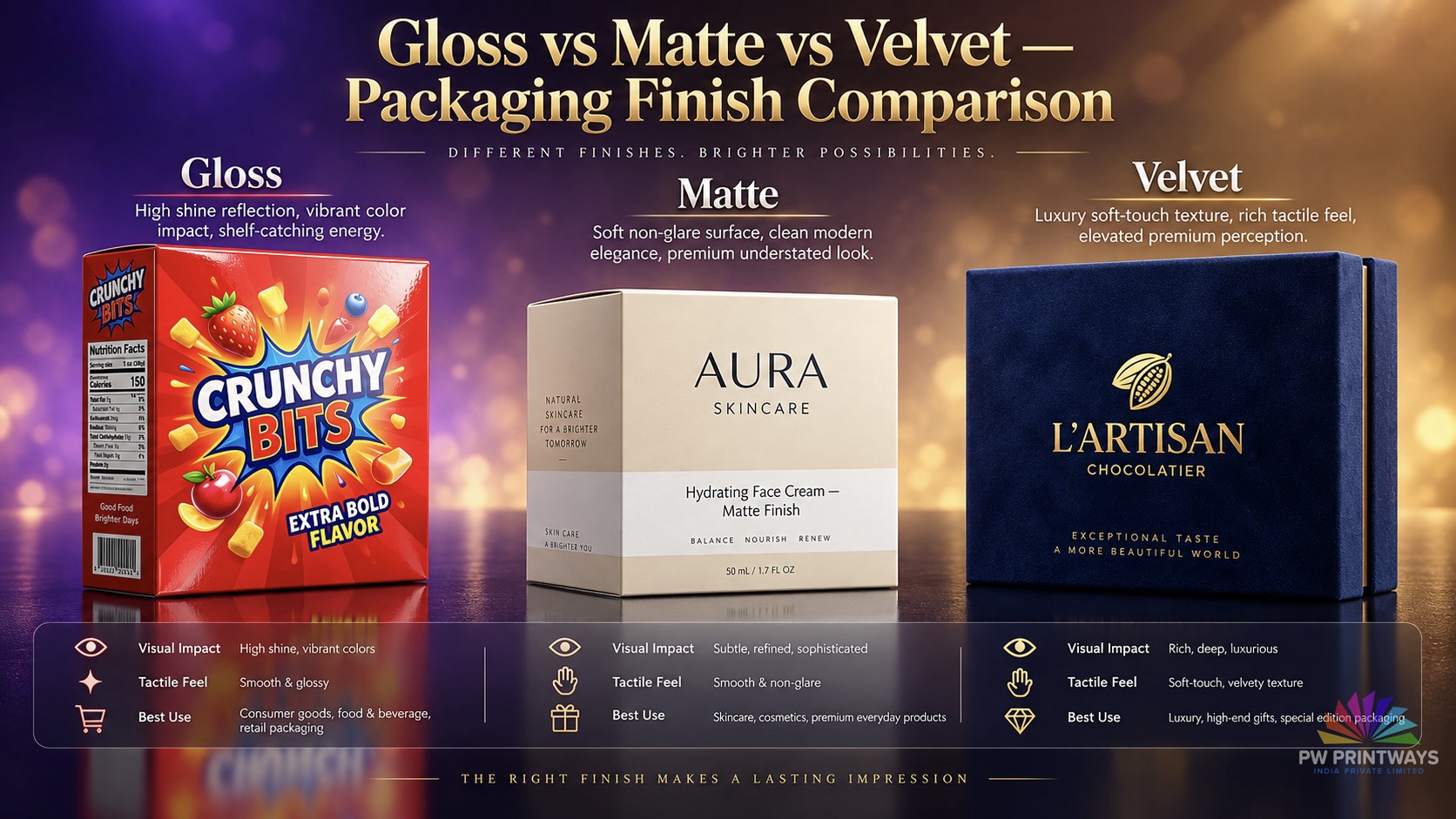
Finish Swatch Book / Mono Cartons / Surface Engineering
Gloss, Matte or Velvet: Which Finish Is Right for a Mono Carton?
Gloss catches light. Matte controls it. Velvet adds another dimension entirely:
touch.
But choosing between them should involve more than deciding which sample looks more premium.
Technical Terminology
First: “Velvet Finish” Does Not Describe One Universal Process
Gloss and matte can be produced using several coating or varnishing systems.
A velvet or soft-touch effect can also be created in different ways. Depending on the specification, it may involve a specialised soft-touch coating or a tactile film lamination.
So a purchasing specification should not simply say “velvet finish.” It should identify whether the requirement is a coating, lamination film, desired tactile effect, visual gloss level and required performance.
Finish Selector
The Difference in One Minute
| Finish | Visual Character | Tactile Character | Common Reason to Choose It |
|---|---|---|---|
| Gloss | Bright, reflective, vivid | Smooth | Colour impact and visual energy |
| Matte | Low reflection, restrained | Smooth to dry depending on system | Controlled premium presentation and readability |
| Velvet / Soft-Touch | Usually dull-matte | Soft, tactile, skin-like or velvety | Tactile differentiation and premium handling experience |
Swatch 01 — Reflection
Gloss Finish: When the Packaging Should Look Bright & Energetic
A gloss surface reflects light more strongly than a matte surface.
On suitable printed paperboard, gloss varnishing can make colour imagery appear more intense and saturated because of the way the finished surface reflects light.
Paperboard finishing guidance from Holmen/Iggesund similarly notes that gloss varnish can brighten graphic presentation, while contrast between glossy and matte areas can be used deliberately to attract attention.
Gloss works particularly well when:
The artwork depends on bright colours • product photography is important • visual energy matters • shelf lighting can help the design • the brand wants a polished commercial appearance
What Gloss Can Change Visually
Gloss can increase perceived contrast and make dark or saturated print appear visually richer.
However, strong reflection can also create glare depending on lighting and viewing angle.
That means gloss is not automatically ideal for every information-heavy package.
Swatch 02 — Restraint
Matte Finish: When Less Reflection Creates More Control
A matte finish reduces specular reflection and creates a more subdued surface.
That makes it useful for packaging built around restrained typography, soft colour systems, large unprinted areas or a premium editorial aesthetic.
Holmen/Iggesund specifically notes that matte surfaces can make text easier to read, while glossy surfaces provide a brighter graphic effect.
Matte works particularly well when:
Typography is important • the design is minimal • glare should be controlled • the brand position is refined rather than flashy • selective gloss effects will be added later
Does Matte Always Mean Premium?
No.
A matte surface cannot rescue weak typography, poor colour control, an unsuitable paperboard or inaccurate converting.
Premium presentation is a system involving board, structure, print, colour, finish and repeatability.
For a broader premium-packaging strategy, see our
Cosmetics & Wellness Mono Carton Premiumization Guide →
Swatch 03 — Touch
Velvet / Soft-Touch Finish: When the Hand Becomes Part of the Design
Soft-touch or velvet finishes are selected primarily because they add a tactile experience.
Instead of simply controlling reflection, the surface is designed to feel noticeably softer or more tactile than a standard gloss or matte carton.
Aqueous soft-touch coating systems exist specifically for paper-based packaging. ACTEGA, for example, describes one of its systems as a water-based dull-matte soft-touch coating designed to simulate the feel of matte film lamination.
But soft-touch film lamination is also widely used in premium folding cartons.
Velvet / soft-touch works particularly well when:
The package will be handled before purchase • tactile differentiation matters • the design uses restrained luxury cues • cosmetics, wellness, gifting or premium retail positioning justify the additional finish
The Core Difference
Gloss communicates through light.
Matte communicates through restraint.
Velvet communicates through touch.
Technical Comparison
Gloss vs Matte vs Velvet Finish
| Decision Factor | Gloss | Matte | Velvet / Soft-Touch |
|---|---|---|---|
| Reflection | High | Low | Usually low / dull matte |
| Colour Appearance | Often appears brighter or more saturated | More restrained | Usually restrained and soft-looking |
| Tactile Effect | Smooth | Smooth / dry depending on system | Strong tactile character |
| Text Readability | Can be affected by glare | Often strong under varied lighting | Generally similar to dull matte visually |
| Protection | Depends on coating chemistry/specification | Depends on coating chemistry/specification | Highly system-dependent |
| Premium Potential | High when design suits it | High for restrained brands | High when tactility adds real value |
| Typical Cost Direction | Standard to premium depending on system | Standard to premium depending on system | Often higher when specialty chemistry or film is required |
Important Specification Warning
Do Not Assume Gloss = Durable and Matte = Delicate
Durability depends on the actual product formulation, coating weight, curing or drying, substrate, ink system and expected handling.
Some gloss aqueous coatings are specifically engineered for high rub and scratch resistance.
Some matte systems may be more rub-sensitive, while specialised matte or soft-touch products can also be designed for improved mechanical resistance.
Specify the required performance rather than choosing only by the words gloss, matte or velvet.
Colour Behaviour
The Same Artwork Can Look Different After Finishing
Colour approval should not stop at the uncoated printed sheet.
A high-gloss finish may make colours appear richer and deeper, while a matte or soft-touch finish can visually soften the same artwork.
That is why premium cartons should ideally be approved using the intended board, ink and finishing system whenever colour appearance is critical.
Board → Ink → Coating / Film → Lighting
All four influence what the customer finally sees.
For White Cartons, Look Beyond the Initial Sample
White packaging is especially sensitive because subtle changes in board shade, varnish tone or ageing can become visible across large unprinted areas.
Do not assume every gloss, matte or soft-touch system will age identically.
For a deeper technical explanation, read:
Coating Yellowing on White Folding Boxboard →
Process Choice
Are You Choosing an Appearance — or a Manufacturing Process?
This is one of the most common specification mistakes.
Words such as gloss and matte describe appearance. They do not automatically tell the printer whether you want:
- Water-based coating
- UV varnish
- Overprint varnish
- Film lamination
- Another specialty finishing system
Likewise, “velvet” may describe the desired tactile result rather than the process used to create it.
Compare the two broader technologies in our
Aqueous Coating vs Lamination Film Guide →
If Velvet Means Film Lamination, the Crease Must Be Part of the Specification
A laminated folding carton is no longer simply printed paperboard.
The board, adhesive, film and crease geometry work together during folding.
A carton that looks flawless while flat can still develop visible cracking, splitting or delamination around a demanding fold if the complete construction has not been properly considered.
See our technical guide:
Laminate Cracking at Carton Crease Lines →
Brand Positioning
Which Finish Fits Which Brand Language?
| Bold FMCG | Gloss can support saturated colour and high visual energy. |
| Clinical / Minimal | Matte can support restrained typography and controlled reflection. |
| Premium Beauty | Matte or soft-touch may suit understated premium positioning. |
| Luxury Gifting | Tactile surfaces can become part of the opening experience. |
| High-Information Pharma | Readability, regulatory communication and production consistency may be more important than tactile novelty. |
These are strategic starting points, not fixed rules. The correct finish depends on the actual artwork, board, product, handling, regulatory needs and brand position.
When Does Tactility Actually Add Value?
A tactile finish creates the most value when customers physically handle the carton as part of product evaluation or unboxing.
It may create less value where cartons are primarily handled by warehouse staff, immediately discarded, hidden inside another package or purchased without meaningful physical interaction.
Premium finishing should answer:
“What does this surface add to the product experience?”
Not simply:
“What is the most expensive finish available?”
What About Fingerprints, Scuffs & Rub Marks?
Do not rely on generic assumptions.
Gloss surfaces can show fingerprints and surface marks under directional light.
Matte and soft-touch surfaces may also mark or polish differently depending on formulation.
Some matte coatings are more rub-sensitive than their glossy counterparts, while specialised coating systems can be engineered specifically for higher rub, scratch or scuff performance.
For cartons exposed to repeated handling, request performance appropriate to the actual supply chain rather than judging only a pristine sample.
Approval Protocol
How to Compare Finish Samples Properly
01
The same finish can appear different on different substrates.
02
Do not approve a finish only on blank white paper.
03
Retail, office and daylight conditions can change perceived gloss and colour.
04
Especially important for matte and soft-touch systems.
05
The flat sample is not the finished mono carton.
06
Evaluate likely transport, packing and shelf contact.
07
Use it when assessing repeat commercial production.
You Don’t Always Have to Choose Only One Surface Effect
Contrast can sometimes create more impact than applying one strong finish across the entire carton.
Examples can include:
- Matte background + selective gloss
- Soft-touch surface + foil detail
- Matte overall finish + gloss logo element
- Controlled varnish contrast around photography
Paperboard finishing guidance highlights this principle: the eye is highly sensitive to differences in gloss level, so selective contrast can attract attention without finishing every square centimetre aggressively.
Commercial Decision
Which Finish Costs More?
There is no reliable universal price table.
Cost can depend on:
- Coating or film chemistry
- Application method
- Coverage
- Sheet size
- Production quantity
- Board specification
- Additional curing or converting operations
- Compatibility with foil, glue or other finishing
A specialty velvet coating or soft-touch film will often carry a higher cost than a straightforward production coating, but actual pricing should be compared project by project.
Finish Selection Mistakes
Don’t Specify a Finish This Way
× “Gloss is always more durable.”
× “Matte automatically looks luxury.”
× “Velvet means lamination.”
× “Soft-touch coatings never scuff.”
× “The same finish looks identical on every board.”
× “We approved the print, so the finished colour will be identical.”
× “More finishing always means more premium.”
Decision Route
Choose Your Starting Point
Want maximum colour energy and reflective impact?
Evaluate a gloss finish.
Want low reflection and restrained premium presentation?
Evaluate a matte finish.
Want customers to notice the carton through touch?
Evaluate a soft-touch / velvet system.
Need substantially greater surface protection?
Compare coating and lamination systems rather than selecting by appearance alone.
Need premium impact without coating the entire carton heavily?
Evaluate selective contrast such as matte + gloss effects.
Remember: Finish Comes After Packaging Format
A beautiful surface finish cannot compensate for choosing the wrong packaging structure.
The product may first need a folding carton, corrugated structure or another format based on weight, protection, retail channel and distribution.
Read:
Folding Carton vs Rigid Box vs Corrugated Mailer →
Manufacturer Perspective
How PW Printways Approaches Mono-Carton Finishing
At PW Printways India Pvt. Ltd., finishing should be considered alongside the board, structural design, printing and converting requirements rather than selected as an isolated decorative step.
The company’s published packaging workflow covers structural development, prepress, proofing, printing, finishing and final quality inspection.
Its in-house Heidelberg printing and Bobst finishing equipment supports controlled production of mono cartons, folding cartons and printed packaging.
For a finish-selection project, useful information can include:
- Product category
- Board grade
- Artwork and colour coverage
- Desired gloss level
- Required tactile character
- Handling and scuff expectations
- Folding / crease requirements
- Foil, embossing or other finishing
- Commercial quantity
The objective is not to choose the most dramatic sample. It is to specify a surface that can be produced consistently and perform appropriately on the finished carton.
Explore PW Printways Manufacturing →
Premium Mono Cartons Need More Than a Premium Finish
PW Printways manufactures custom folding-paperboard mono cartons for product categories including pharmaceuticals, FMCG, cosmetics, electronics, food and retail.
Board, structure, print, surface finish and converting should therefore be considered together.
Explore Custom Mono Cartons & Packaging Products →
Different Industries — Different Finish Priorities
| Cosmetics | Tactility, colour control and premium shelf presentation. |
| Wellness | Clean, controlled and trustworthy visual language. |
| FMCG | Shelf visibility, rub performance and production efficiency. |
| Pharmaceutical | Legibility, repeatability and application-specific requirements. |
| Premium Retail | Visual and tactile differentiation. |
| D2C | Unboxing appearance plus handling through fulfilment. |
Explore Industries Served by PW Printways →
PAN-India Packaging Manufacturing
Custom Finished Mono Cartons for Brands Across India
PW Printways India manufactures custom printed packaging from Bawana, Delhi and supports packaging requirements and coordinated delivery for businesses across India.
Gloss, matte and premium tactile carton requirements can be discussed for brands across North, West, South, Central, East and North-East India according to the actual board, artwork, finish, quantity and end-use requirements.
Bawana, Delhi remains the manufacturing-location signal while the commercial focus stays PAN India.
International Requirements
Finish Specifications for Export-Oriented Mono Cartons
International brands and sourcing teams can discuss custom mono-carton requirements with PW Printways India.
Where appearance must remain consistent after longer storage or transportation, finish selection should also consider handling, temperature, light exposure, rubbing, folding and destination requirements.
Buyer Specification
Instead of Writing “Need Velvet Finish,” Send This
| Desired Appearance | High gloss / satin / matte / dull matte |
| Desired Touch | Standard smooth / dry matte / soft-touch / velvet |
| Preferred Process | Coating / lamination / open to recommendation |
| Board | Grade, GSM / caliper where known |
| Artwork | Colours, solids, white areas, photography |
| Performance | Rub, scratch, scuff, handling or other requirements |
| Other Finishing | Foil, embossing, spot UV or other effects |
| Quantity | Commercial run quantity |
Technical References
Holmen / Iggesund — Paperboard Varnishing & Finishing →
ACTEGA — Aqueous Soft-Touch Coating Technical Data →
Related Packaging Insights
COATING VS FILM
Aqueous Coating vs Lamination Film →
PREMIUM PACKAGING
Cosmetics & Wellness Mono Carton Premiumization →
FAILURE ANALYSIS
Laminate Cracking at Carton Crease Lines →
WHITE PACKAGING
Coating Yellowing on White Folding Boxboard →
PACKAGING FORMAT
Folding Carton vs Rigid Box vs Corrugated Mailer →
Surface Finish Selection
Not Sure Whether Your Mono Carton Should Be Gloss, Matte or Soft-Touch?
Share your board, artwork, product category, quantity, desired appearance, tactile expectation and handling requirement with PW Printways India to discuss an appropriate finishing specification.
Frequently Asked Questions
Gloss, Matte & Velvet Finish FAQs
Which is better for a mono carton: gloss or matte?
Neither is universally better. Gloss is useful when strong reflection, bright colour and visual energy are desired. Matte is useful where controlled reflection, typography and understated presentation are priorities.
What is a velvet finish on packaging?
Velvet usually describes a soft tactile surface rather than one universal production process. It may be produced using a specialised soft-touch coating or a soft-touch / velvet lamination film depending on the specification.
Is soft-touch the same as matte?
Not exactly. Soft-touch finishes are commonly matte or dull-matte in appearance, but they add a deliberately tactile surface that a standard matte coating may not provide.
Does gloss make colours look brighter?
Gloss varnishing can increase visual brightness and make colour imagery appear more saturated because of stronger surface reflection. The final result also depends on the board, inks, coating and lighting.
Is matte coating easier to read?
Low-reflection matte surfaces can improve readability under some lighting conditions because they reduce glare. Artwork contrast, typography and lighting still remain important.
Is velvet finish more expensive?
Specialty soft-touch coatings or films can cost more than simpler standard finishing systems, but actual price depends on material, coverage, carton size, quantity and production process.
Which finish is most durable?
Durability cannot be determined from gloss level alone. Scratch, rub, scuff, chemical and handling resistance depend on the specific coating or film formulation and the complete printed-board construction.
Can I combine matte and gloss on one carton?
Yes. Selective differences in gloss level can create contrast and help direct attention toward logos, imagery or other design elements where the production process supports the intended effect.
Which finish is best for cosmetic packaging?
Cosmetic packaging can use gloss, matte or soft-touch surfaces depending on brand position. Premium presentation should be developed around the complete system of board, structure, print, colour, finish and repeatability rather than choosing one finish by category alone.
Does PW Printways manufacture custom mono cartons in India?
PW Printways India manufactures custom printed mono cartons and folding cartons from its Bawana, Delhi manufacturing location and supports packaging requirements for businesses across India.
Can overseas brands discuss premium carton finishing?
Yes. International and export-oriented requirements can be discussed according to board, carton structure, artwork, finishing specification, quantity, handling conditions and destination requirements.
About PW Printways India Pvt. Ltd.
PW Printways India is a custom printed packaging manufacturer specialising in mono cartons, folding cartons and printed corrugated packaging. Its published manufacturing workflow covers structural development, prepress, proofing, printing, finishing and final quality inspection.
The company’s in-house Heidelberg printing and Bobst finishing equipment supports controlled production of printed packaging according to approved specifications.
Manufacturing Location:
K-30, Sector-5, DSIIDC Bawana Industrial Area,
Delhi – 110039, India
Market Reach:
PAN India • International / export-oriented enquiries
About
/
Products
/
Industries
/
Contact
