
Packaging History / Folding Cartons / Manufacturing Evolution
1879 Changed the Folding Carton — What Has Changed Since?
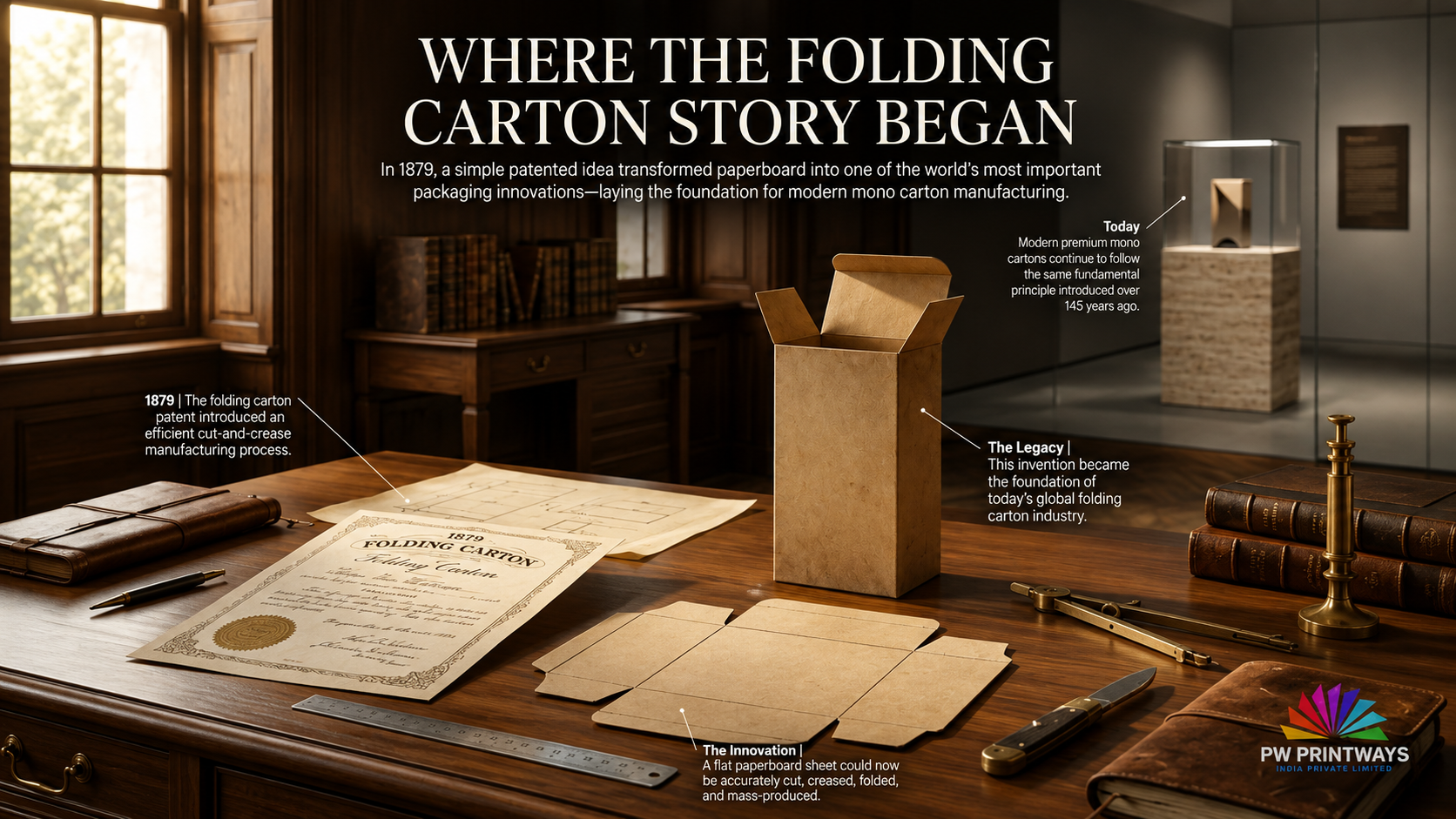
More than a century ago, folding paperboard packaging began moving from labour-intensive box making toward something far more scalable:
a flat blank that could be cut, creased, shipped efficiently and later folded into a box.
Historical Accuracy Note
Was the First Folding Carton Really Patented in 1879?
1879 is one of the most important years in folding-carton history, but the popular version of the story needs some clarification.
The Smithsonian documents a three-sided folding-box prototype patented in 1879 by Italian inventor Charles E. Bolchini under U.S. Patent 218,479.
The same Smithsonian history also connects 1879 with Robert Gair’s famous manufacturing breakthrough in Brooklyn, where cutting and creasing could be combined to create folding-box blanks efficiently.
However, the Smithsonian specifically notes that there is no evidence that Gair’s manufacturing process itself was patented in 1879. Later Robert Gair paper-box patents are documented in the 1890s.
The Evolution in One View
What Changed From Early Folding Boxes to Today’s Mono Cartons?
| Then | Today |
|---|---|
| Basic folded paperboard structures | Product-specific engineered carton structures |
| Manual cutting and box making | Precision die-cutting and creasing |
| Limited printed communication | Full brand, product and regulatory communication |
| Primarily functional container | Protection + branding + shelf presentation |
| High reliance on manual production | Mechanised production supported by skilled operators |
| Basic closure systems | Tuck ends, crash-lock bottoms, windows and specialised structures |
| Little digital integration | Digital prepress, QR codes and connected packaging possibilities |
Before the Breakthrough
Before Folding Cartons Became Practical at Scale
Boxes existed long before modern folding cartons.
Earlier paperboard boxes often required considerably more manual assembly and occupied their finished three-dimensional form during storage and transportation.
That created practical limitations for businesses that wanted inexpensive packaging in larger quantities.
The ability to produce a carton as a flat paperboard blank fundamentally changed that equation.
1879
The Year Folding Carton Manufacturing Changed Direction
Industry histories from the Smithsonian and the Paperboard Packaging Council both identify 1879 as a major turning point in the development of inexpensive mass-produced folding cartons.
The well-known Robert Gair story involves a press setup that accidentally cut through material where it was intended only to crease it.
The observation led to a powerful manufacturing idea:
cutting and creasing could be integrated to produce a folding-box blank efficiently.
That idea helped move cartons toward repeatable industrial production.
The Real Innovation
The Box Didn’t Need to Travel as a Box
A folding carton could be manufactured, stored and transported in a substantially flat form before being erected around the product. That meant packaging could consume less storage and transport space than an equivalent pre-assembled rigid structure.
1890s
Carton Structures Became More Engineered
Later patents show folding boxes evolving into increasingly deliberate structures made from one-piece paper or paperboard blanks.
Robert Gair’s documented patents from the 1890s describe knock-down and folding paper boxes with panels, flaps, scored lines and closure features designed so boxes could remain relatively flat before use.
The principle sounds familiar because it remains at the heart of many modern folding cartons today:
design the flat blank so it becomes a reliable three-dimensional package.
20TH
CENTURY
The Carton Became a Communication Surface
As printing, paperboard production and packaging equipment improved, the folding carton became much more than a convenient container.
The outer surface could increasingly carry:
- Brand names and logos
- Product illustrations and photography
- Ingredients and instructions
- Usage information
- Promotional communication
- Retail differentiation
The carton was becoming both packaging and media.
Transformation 01
Printing Turned the Carton Into Part of the Brand
Modern offset printing enables folding cartons to carry detailed graphics, controlled brand colours, fine typography and product information at commercial scale.
This completely changed the role of the folding carton.
Old role:
Contain the product
Modern role:
Contain + Protect + Inform + Differentiate + Present
For the broader technological journey behind print production, see our
Evolution of Printing Technology & Modern Packaging →
Transformation 02
Die-Cutting Turned a Sheet Into an Engineered Structure
A modern mono carton begins as a flat structural layout.
The dieline determines where the paperboard will be:
Cut
Creased
Folded
Glued
Locked
Opened
Closed
Presented around the product
That means today’s carton designer is not simply drawing a box.
The designer is developing a flat geometry that must survive printing, finishing, die-cutting, creasing, folding, gluing, packing, transportation and customer handling.
Related illustrative reading: Illustrative Example: Reducing Board Use Through Carton Dieline Design. These examples do not report verified client outcomes.
Transformation 03
Mechanised Folding & Gluing Changed Production Speed
Early box production depended heavily on skilled hand operations.
Modern folder-gluer systems can repeatedly fold and paste suitable carton structures at commercial speeds, improving consistency for repeat production.
But mechanisation did not remove every manual operation.
Special constructions, development work, sampling, inspection and jobs requiring unusual handling can still depend on experienced operators.
Modern manufacturing is not simply machine vs human.
Machines provide speed and repeatability. Skilled people provide setup, judgement, troubleshooting and quality control.
Transformation 04
One Folding Carton Became Hundreds of Structural Possibilities
Modern folding cartons can be developed around very different products and packing requirements.
| Structure | Why It May Be Used |
|---|---|
| Straight Tuck End | Clean, common retail-carton format |
| Reverse Tuck End | Efficient folding-carton configuration for suitable products |
| Auto / Crash-Lock Bottom | Faster erection and a more secure bottom configuration |
| Window Carton | Allows suitable products to become part of the visual presentation |
| Special / Custom Structure | Developed around specific product and packing needs |
The Carton Started Competing on the Shelf
As packaged retail expanded, folding cartons had another job:
attract attention next to competing products.
Graphic hierarchy, brand colour, typography, structural shape, finishing and product visibility became commercial decisions rather than decoration alone.
A window carton is a good example. Cutting away part of the printed board can reduce branding space, but it can also allow shoppers to evaluate the real product.
Related illustrative reading: Illustrative Example: Designing a Window Carton for Product Visibility. These examples do not report verified client outcomes.
Transformation 05
Finishing Added Texture, Protection & Premiumisation
Modern carton finishing can influence both appearance and performance.
Depending on the packaging requirement, brands may evaluate:
- Aqueous coatings
- Lamination
- Spot effects
- Foil stamping
- Embossing or debossing
- Matte or gloss surface effects
But more finishing does not automatically create better packaging.
The finish must still suit the board, fold lines, product, expected handling and brand position. Compare two common surface approaches in our
Aqueous Coating vs Lamination Film Guide →
Transformation 06
Digital Prepress Changed What Happens Before the Press Starts
One of the biggest changes in modern carton manufacturing happens before paperboard enters the printing press.
Today’s prepress workflow can involve:
Structural dieline review
Artwork adaptation
Colour preparation
Bleed and trapping checks
Barcode / QR placement review
Proofing before commercial production
The goal is to identify problems before they become thousands of printed cartons.
Today’s Carton Carries Much More Information
A nineteenth-century folding box and a modern pharmaceutical, cosmetic or FMCG carton may share the same basic idea — fold a flat blank into a box — but the communication requirements are dramatically different.
Modern cartons may need space for:
- Brand identity
- Product description
- Usage information
- Ingredients or composition
- Warnings and mandatory statements
- Barcodes
- QR codes
- Batch-related information
- Manufacturer and market information
Exact regulatory labelling requirements vary by product category and destination market and should be checked with the relevant regulatory requirements.
Transformation 07
The Industry Is Returning to an Old Advantage: Material Efficiency
One reason folding cartons became important historically was efficiency: a paperboard blank could be shipped flat and use material differently from a permanently erected box.
Today, brands are again examining efficiency — but with more advanced engineering tools.
That can include:
- Right-sizing cartons around products
- Reviewing excess flap geometry
- Improving sheet utilisation
- Choosing board according to performance needs
- Avoiding unnecessary packaging layers
- Reducing avoidable production waste
Read:
Responsible Packaging & Sustainable Printing →
After More Than a Century
What Hasn’t Changed?
Despite advances in printing, automation and finishing, the basic engineering challenge remains surprisingly familiar:
“How do we turn a flat piece of paperboard into a reliable three-dimensional package?”
The difference is that today’s carton must solve that problem while also meeting brand, manufacturing, protection, information, cost and presentation requirements.
So What Is a Modern Mono Carton?
A modern mono carton is typically a printed folding-paperboard package manufactured from a flat blank that is converted through processes such as printing, finishing, die-cutting, creasing, folding and gluing.
Its exact design can be customised around:
PW Printways’ Products page describes its mono cartons as premium folding-paperboard packaging for pharmaceuticals, FMCG, cosmetics, electronics, food and retail.
Manufacturer Perspective
From a Flat Blank to a Finished Carton at PW Printways India
At PW Printways India Pvt. Ltd., modern folding-carton production is managed as a connected workflow rather than a collection of isolated operations.
The company’s published process includes structural development, prepress, proofing, printing, finishing and final quality inspection.
PW Printways also lists in-house Heidelberg printing and Bobst finishing equipment supporting colour reproduction, cutting, creasing and finishing for mono cartons, folding cartons and printed packaging boxes.
The manufacturing technology is dramatically different from the late nineteenth century — but the central idea remains recognizable:
start flat, engineer the folds correctly and create a package that performs around the product.
From Simple Boxes to Industry-Specific Packaging
Today, folding-paperboard cartons serve very different product categories, each with its own structural, visual and information needs.
Pharmaceuticals — information, repeatability and production precision
Cosmetics — premium presentation, print and finishing
FMCG — commercial-scale production and shelf communication
Food — product-specific structure and retail presentation
Electronics — product fit, protection and branded presentation
D2C / Retail — branding, delivery journey and unboxing experience
Explore the
industries served by PW Printways India →
Modern Packaging Manufacturing in India
Custom Mono & Folding Cartons for Brands Across India
PW Printways India manufactures custom printed packaging from Bawana, Delhi and supports coordinated packaging production and delivery for businesses across India.
Modern folding-carton requirements can be developed for businesses across North, West, South, Central, East and North-East India according to product, structure, board, print, finishing and commercial quantity.
This keeps Delhi as the manufacturing-location signal while positioning PW Printways for packaging enquiries from markets across India.
International Requirements
Folding-Carton Manufacturing for Export-Oriented Requirements
International brands and sourcing teams can discuss custom mono-carton and folding-carton requirements with PW Printways India.
Specifications should be reviewed according to product dimensions, board, structure, artwork, printing, finishing, quantity, shipping conditions and destination requirements.
What’s Next?
The Next Folding Carton Evolution
The next chapter is unlikely to come from one single invention.
It is more likely to come from multiple improvements working together:
- More efficient carton structures
- Better material utilisation
- Faster automated converting
- Improved colour and quality control
- Digital workflow integration
- QR and connected-packaging experiences
- More data-led production decisions
- Closer integration between design and manufacturability
What began as an efficient way to turn a flat sheet into a box is now an integrated packaging system connecting manufacturing, branding, logistics and customer experience.
The 145+ Year Lesson
Five Things That Changed — and One That Didn’t
1. Production moved from highly manual work toward mechanisation and automation.
2. Cartons became sophisticated printed communication surfaces.
3. Structural options expanded for different product and packing needs.
4. Finishing and premiumisation added new visual and tactile possibilities.
5. Digital prepress and quality systems improved repeatability.
What didn’t change?
The carton still has to fold correctly around the product and perform its job.
Historical Source Note
This article intentionally distinguishes between the 1879 folding-carton manufacturing breakthrough associated with Robert Gair and the claim that Gair patented that process in 1879. The Smithsonian states that there is no evidence of such a Gair patent in that year.
Smithsonian Lemelson Center — Boxed Up →
Continue Exploring Modern Packaging
Printing Technology
The Evolution of Printing Technology →
Related illustrative reading: Illustrative Example: Reducing Board Use Through Carton Dieline Design. These examples do not report verified client outcomes.
Related illustrative reading: Illustrative Example: Designing a Window Carton for Product Visibility. These examples do not report verified client outcomes.
Responsible Packaging
Responsible Packaging & Sustainable Printing →
Our Products
Explore Mono Cartons & Packaging Products →
From History to Modern Production
Need a Modern Mono Carton Built Around Your Product?
Share your product dimensions, weight, board requirement, artwork, quantity, carton structure and finishing expectations with the PW Printways India team.
Frequently Asked Questions
Folding Carton History FAQs
Was the folding carton invented in 1879?
1879 is widely treated as a major turning point in folding-carton manufacturing. Industry histories associate the year with Robert Gair’s development of an inexpensive method for cutting and creasing folding-box blanks at scale.
Was Robert Gair’s folding-carton process patented in 1879?
The Smithsonian states that there is no evidence that Gair’s process was patented in 1879. Documented Robert Gair paper-box patents appear later, including patents from the 1890s.
Was there a folding-box patent in 1879?
Yes. Smithsonian records identify U.S. Patent 218,479, issued in 1879 to Charles E. Bolchini, for a three-sided folding-box design cut from a single piece of material.
Why were folding cartons important?
Their flat or knock-down form made storage, transportation and large-scale packaging production more efficient than relying only on permanently erected box structures.
What is the difference between an old folding box and a modern mono carton?
The basic flat-blank principle is similar, but modern mono cartons can include sophisticated structural design, offset printing, coatings, lamination, die-cutting, precision creasing, automated gluing, premium finishing and detailed product communication.
Are modern folding cartons still shipped flat?
Many folding-carton structures are supplied in a flat or collapsed form and erected during packing, although the exact condition depends on the carton structure and packing process.
What industries use mono cartons today?
Mono cartons are used across categories including pharmaceuticals, cosmetics, FMCG, electronics, food, healthcare and retail products, depending on product and packaging requirements.
Does PW Printways manufacture folding cartons in India?
PW Printways India manufactures custom printed mono cartons and folding cartons from its Bawana, Delhi manufacturing location and supports packaging requirements and coordinated delivery for businesses across India.
Can international brands discuss custom folding-carton requirements?
Yes. International and export-oriented requirements can be discussed according to product dimensions, structure, board, artwork, printing, finishing, quantity and delivery requirements.
About PW Printways India Pvt. Ltd.
PW Printways India is a custom printed packaging manufacturer specialising in mono cartons, folding cartons and printed corrugated packaging. Its published workflow covers structural development, prepress, proofing, printing, finishing and final quality inspection.
The company’s in-house Heidelberg printing and Bobst finishing equipment supports accurate and consistent production including colour reproduction, cutting, creasing and finishing.
Manufacturing Location:
K-30, Sector-5, DSIIDC Bawana Industrial Area,
Delhi – 110039, India
Market Reach:
PAN India • International / export-oriented enquiries
About
/
Products
/
Industries
/
Contact
