
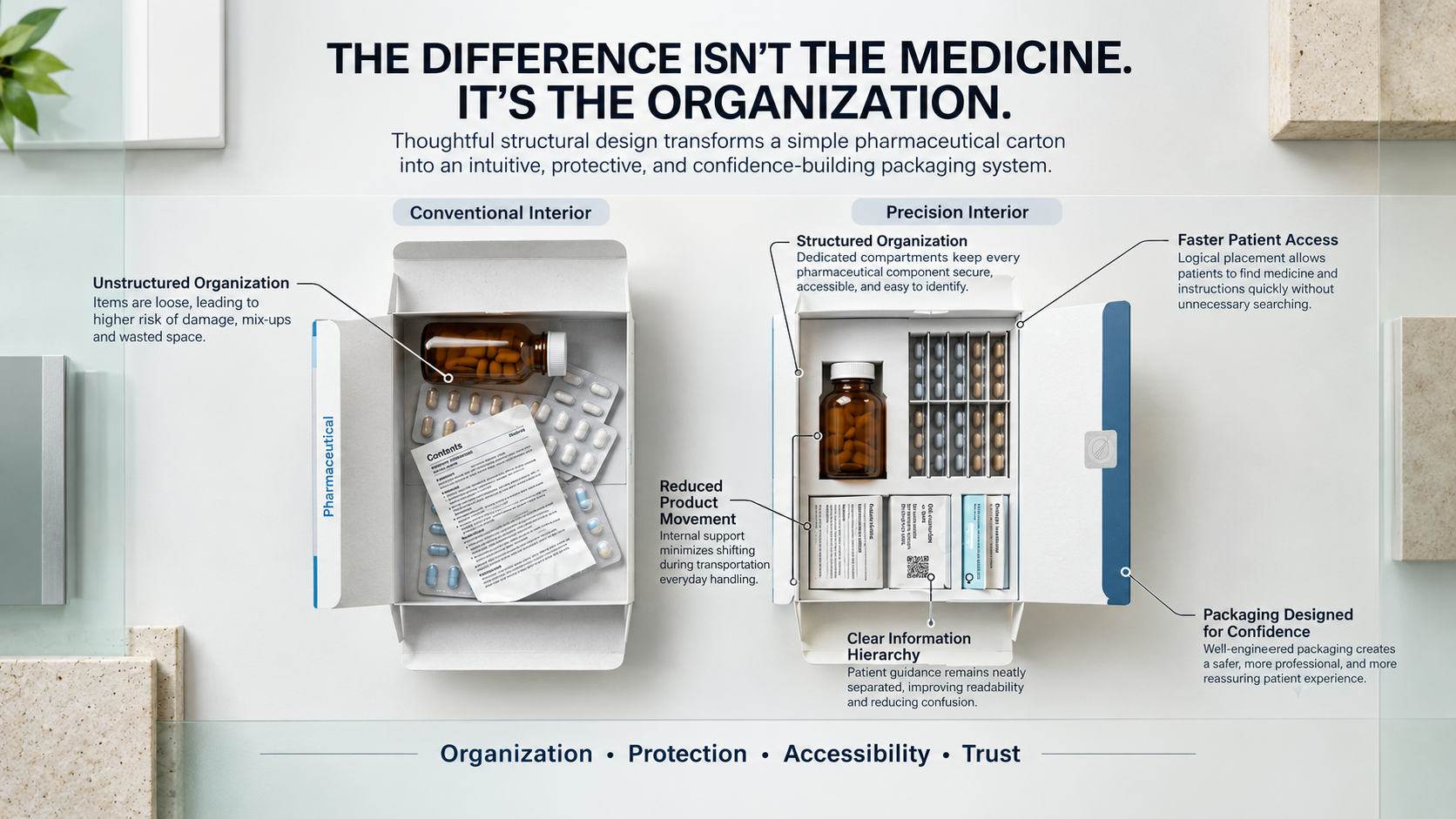
A Pharma Carton Has Limited Space. Every Detail Needs a Purpose.
Pharmaceutical mono cartons must balance approved product information, legibility, brand identity and manufacturing requirements. Good packaging design is not about filling every panel. It is about giving each element a clear role.
Packaging design guide · Pharmaceutical mono cartons · Information hierarchy · Print and converting
The short answer
A carton is a small information system—not just a printed box.
A well-planned pharmaceutical carton organises the approved artwork so product identity, strength or variant information, required instructions and other specified details are placed clearly within the available panels. It also has to work as a physical package: the board, dimensions, closure, folds and pasting must suit the primary pack and packing process.
The pharmaceutical company or authorised product owner remains responsible for approved content and regulatory decisions. The packaging converter’s job is to manufacture the agreed component accurately and consistently.
Design principle
Clarity comes from hierarchy, spacing and consistency.
The FDA’s guidance on container labels and carton labelling highlights legible typography, adequate text-background contrast and avoiding crowded layouts that can make important information harder to find. It is a useful design reference; applicable Indian requirements and the product owner’s approved artwork must govern the actual pack.
01 / Start with the product
Why Every Pharma Carton Needs a Defined Purpose
A tablet blister, syrup bottle, tube or vial creates different space, support and closure needs. Before designing the carton, packaging teams should understand the primary pack dimensions, pack count, loading direction, insert or leaflet requirement and how the carton will be erected and closed.
Product and pack
Dimensions, primary pack format, count and protection needs.
Approved artwork
Final text, language, version, symbols and specified coding zones.
Packing method
Manual or automated erection, closure, leaflet insertion and line fit.
This sequence helps avoid designing the artwork first and discovering later that the carton has insufficient room, unsuitable folds or a closure that does not fit the process.
02 / Information architecture
Five Details That Need Deliberate Planning
| Design area | What to plan | Production consideration |
|---|---|---|
| Product identity | Prominence and placement of the approved product name and variant information. | Keep placement consistent across related SKUs where the approved design calls for it. |
| Text legibility | Type size, weight, contrast, spacing and reading order. | Review on the actual printed substrate and finish, not only on a monitor. |
| Panel allocation | Which information belongs on the main display panel and which can be placed on another panel, subject to approved artwork. | Reserve space around creases, cuts, glue areas and closures. |
| Variant differentiation | Controlled colour, typography and layout differences across product versions. | Use clear file naming, artwork approvals and version control. |
| Variable information | Space for batch, date, barcode or other fields where specified. | Confirm position, printability, scan requirements and customer process before production. |
The exact content and mandatory declarations depend on the product, applicable rules, market and approved artwork. Do not add or revise pharmaceutical claims independently at the design or converting stage.
03 / The cost of clutter
Why Filling Every Panel Is Not the Same as Using Every Panel Well
When too much information, decorative graphics and logos compete for attention, text can become crowded and harder to read. Small text, low contrast and insufficient spacing may undermine the purpose of the design. More decoration does not automatically create a more professional carton.
Signs of a crowded layout
- Too many competing visual elements
- Insufficient space between text blocks
- Low contrast or overly light typography
- Artwork too close to folds or cut lines
- Variant details that are difficult to distinguish
Signs of a considered layout
- Clear hierarchy and reading order
- Consistent alignment and spacing
- Readable text-background contrast
- Purposeful use of each panel
- Artwork coordinated with the dieline
The goal is not to remove required information to make the carton look cleaner. It is to work with the approved content and organise it so the finished pack remains legible and manufacturable.
04 / Structure supports communication
A Good Layout Must Also Work as a Real Carton
A pharmaceutical mono carton starts as a flat printed paperboard blank and becomes a three-dimensional package through die-cutting, creasing, folding and pasting. Panel dimensions and artwork zones must be coordinated with that structure.
Grade, caliper and stiffness matched to the pack.
Panels, folds, closures and clearances coordinated with artwork.
Cutting, creasing, folding and pasting planned for repeat production.
Closure, erection and leaflet needs checked against the process.
A visually strong design that interferes with folding, pasting or packing is not a successful packaging solution. Design, prepress and converting need to work together from the start.
05 / Multiple SKUs
Consistency Matters When a Pharma Brand Has Multiple Variants
Pharmaceutical product families may share a brand identity while differing in strength, pack count, dosage form, market or language. The carton system should make approved differences clear without allowing one version to be confused with another.
A practical production approach is to maintain controlled artwork versions, approved colour references, clearly identified job files and documented checks before printing. Changes should pass through the customer’s artwork approval process rather than being inferred by the converter.
For colour-critical packaging, see Why Printed Carton Colour Changes Between Batches → and Pantone Colours on Coated vs Uncoated Board →.
06 / Manufacturing workflow
From Approved Artwork to Finished Mono Carton
Pack specification
Product dimensions, quantity, board and packing requirements.
Dieline planning
Panels, folds, closure and clearances.
Artwork and proof
Approved content and production references.
Printing and finish
Colour, registration and specified surface finish.
Die-cut and fold
Creasing, folding and pasting to the agreed structure.
QC and dispatch
Finished packaging checked against the agreed specification.
This describes the packaging-component manufacturing workflow. Pharmaceutical product manufacture, regulatory approval and medicine batch release remain with the pharmaceutical company.
07 / Procurement checklist
What to Share Before Requesting a Pharma Carton Quote
- Primary-pack dimensions or an accurate sample.
- Existing carton sample or dieline, if available.
- Customer-approved artwork and version reference.
- Board or GSM requirement, if already specified.
- Printing colours and finishing requirements.
- Leaflet or insert requirements.
- Quantity by SKU and any expected repeat-order pattern.
- Delivery location and relevant packing-line requirements.
A clear brief helps the packaging manufacturer evaluate structure, materials, production steps and repeatability before commercial production begins.
08 / Related packaging guides
Explore More Mono Carton and Pharma Packaging Resources
Pharmaceutical Packaging
Explore printed secondary packaging and pharma-specific requirements.
Mono Carton Manufacturing
Learn how structure, board, artwork and packing method shape the carton.
Choosing a Carton Closure
Compare reverse tuck, straight tuck and auto-lock bottom structures.
Printed Carton Colour Consistency
Understand why substrates, ink and finishing affect repeat batches.
About PW Printways
Review the company’s manufacturing process and capabilities.
Discuss a Packaging Requirement
Share dimensions, artwork, board specification and quantity.
PW Printways / Manufacturing perspective
The Carton Should Be Designed Around the Product, the Information and the Process
PW Printways India Pvt. Ltd. manufactures printed mono cartons, folding cartons, inserts and other paper-based packaging components from Bawana Industrial Area, Delhi. The packaging workflow connects the customer brief, structure and artwork, proof approval, printing, finishing, die-cutting, folding, pasting and inspection.
For pharmaceutical work, the customer’s approved artwork and specifications remain the reference. The converter’s role is to manufacture the agreed printed component accurately and consistently—not to create or independently approve medicine claims or regulatory text.
Frequently Asked Questions
Why is information hierarchy important on pharmaceutical mono cartons?
What information should appear on a pharma carton?
How can carton design support multiple product variants?
Why must the dieline be checked with the artwork?
Does the packaging converter approve pharmaceutical labelling?
About PW Printways India Pvt. Ltd.
PW Printways India Pvt. Ltd. is a Delhi-based printing and packaging manufacturer producing custom printed mono cartons, folding cartons, inserts and printed corrugated packaging. Its published workflow covers structure and artwork, proof approval, printing, finishing, die-cutting, folding, pasting, inspection and dispatch.
This article is a packaging-design and manufacturing guide, not legal or regulatory advice. Final pharmaceutical labelling content should be reviewed and approved by the responsible product owner against current applicable requirements.
Manufacturing location: K-30, Sector-5, DSIIDC Bawana Industrial Area, Delhi-110039, India.
About us ·
Products ·
Contact
