
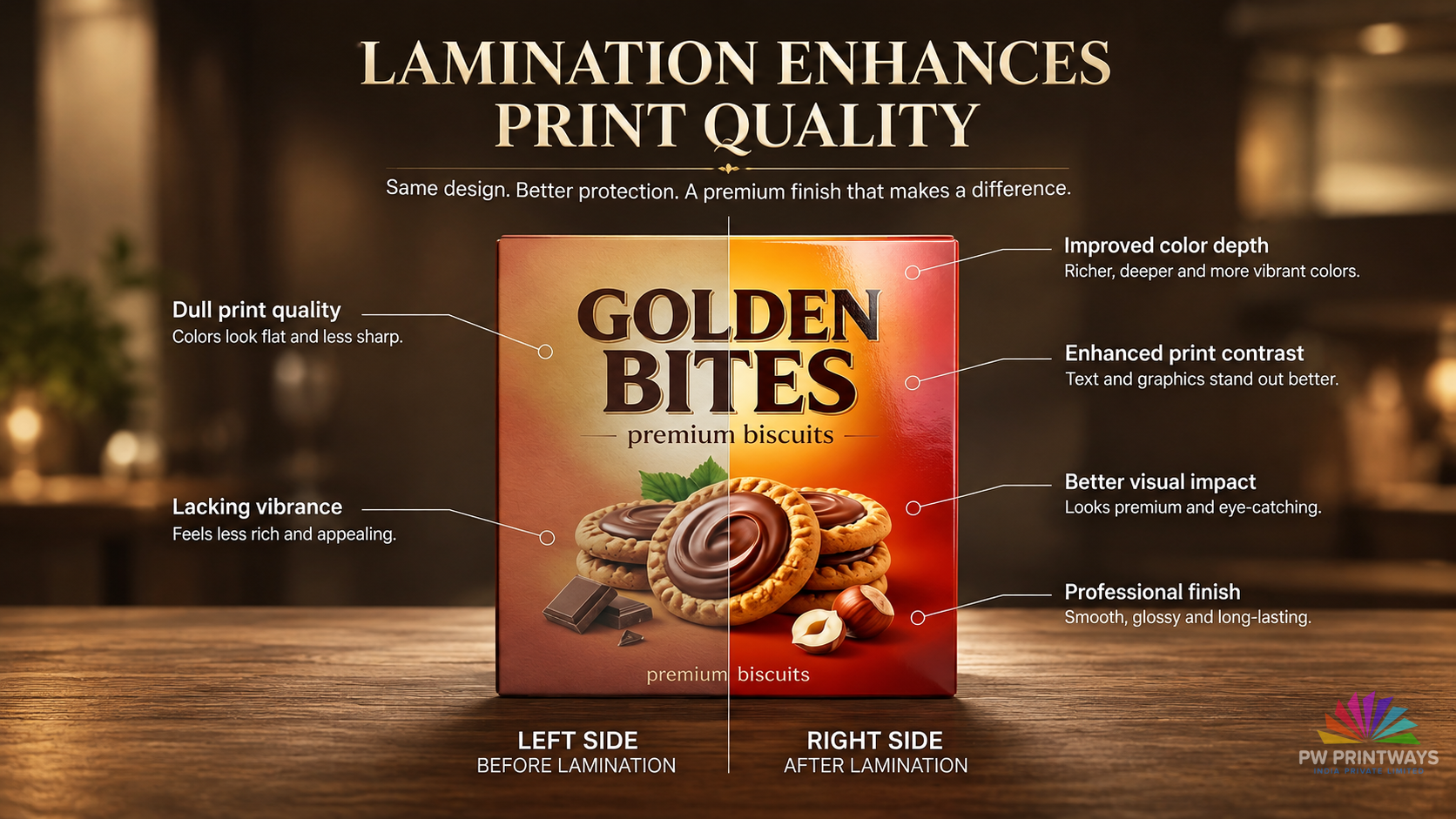
The short answer
Lamination can extend the useful life of the printed surface—not every part of the box.
Film lamination bonds a thin film layer to the printed paperboard. Depending on the film, adhesive, substrate and application, that extra layer can improve resistance to surface scuffing, rubbing and some forms of abrasion, while changing the carton’s visual and tactile finish.
The distinction matters: surface durability is not the same as structural strength. Lamination cannot compensate for unsuitable board, weak carton geometry, a poorly developed crease, weak pasting or a shipping system that does not protect the product.
One important distinction
“Adds life” means the surface may stay presentable for longer under the right conditions.
A laminated mono carton may look cleaner for longer when it faces repeated contact, shelf handling, rubbing against other packs or ordinary movement through a distribution process. How much difference it makes is application-specific and should be checked with representative samples.
Do not read “laminated” as “waterproof,” “crush-proof,” “tear-proof” or “guaranteed to last longer in every environment.” Those are different performance claims and require their own specification and testing.
01 / What the film layer does
What Is Lamination on a Printed Box?
In folding-carton production, film lamination means bonding a thin film to the printed paperboard surface. The resulting construction is no longer just print on board; it becomes a layered surface system made up of paperboard, print, adhesive and film.
Simplified construction — schematic, not to scale
Actual constructions vary by film type, adhesive, print/varnish system, board and converting requirements.
Common appearance options include gloss, matte and speciality tactile films such as soft-touch. These finishes affect the way a carton reflects light and feels in the hand, while their protective performance depends on the particular material system and application.
02 / How it can help
Five Ways Lamination Can Help a Carton Keep Its Finish
| Potential benefit | What it can mean in practice | What still matters |
|---|---|---|
| Scuff resistance | The film can help reduce visible rubbing or scuff marks on the printed surface. | Performance depends on film, print, board, contact pressure and test conditions. |
| Surface abrasion | Can offer added resistance when cartons rub against hands, adjacent packs or handling surfaces. | Severe abrasion, sharp contact or damage to cut edges may still affect the package. |
| Appearance retention | Can help keep the printed face looking clean through normal use and handling. | Colour, film, adhesive, storage and ageing behaviour still need consideration. |
| Tactile presentation | Matte, gloss and speciality films can create a deliberate hand-feel and visual effect. | A premium feel does not automatically mean the carton is stronger. |
| Some moisture exposure | The film may reduce direct contact between the printed face and certain brief or incidental moisture exposures. | Edges, seams, cut-outs, folds and exposed board remain vulnerable; this is not a waterproof-packaging claim. |
These are potential benefits, not guaranteed outcomes for every laminate or paperboard combination. Where durability matters commercially, agree the actual performance requirement and evaluate an appropriate sample or test.
03 / Where it earns its place
When Lamination Makes Sense for Mono Cartons
Lamination is most useful when the added surface protection or finish solves a real packaging problem. The decision should follow the product’s handling journey, desired appearance and manufacturing constraints—not the assumption that every premium carton needs a film layer.
Use case 01
Frequent handling
Useful to evaluate when packs are repeatedly picked up, shifted, packed or handled at retail.
Use case 02
Premium surface finish
Worth considering when the tactile or light-reflecting character of the film supports the brand presentation.
Use case 03
Dark or solid-colour artwork
The printed surface can be more visually sensitive to visible scuffs, so the actual finish can be tested against handling needs.
Use case 04
High-contact distribution
Consider film where handling and surface rubbing are a meaningful quality concern, after reviewing the full packaging system.
For a finish-by-finish comparison, read
Aqueous Coating vs Lamination Film: Cost & Durability →
04 / What it cannot do
Lamination Does Not Fix Every Packaging Failure
A film layer can improve some surface properties, but it should not be treated as a substitute for sound structural design, a suitable paperboard, good adhesion, correctly developed creases or appropriate transit packaging.
| Problem | Why lamination alone is not enough | What to review |
|---|---|---|
| Crushing or collapse | A surface film is not a replacement for board stiffness or structural support. | Board grade, dimensions, loading, carton geometry and shipper design. |
| Crease cracking | The film and board must still bend around the crease without excessive surface strain. | Film flexibility, finished caliper, grain direction, crease geometry and folding conditions. |
| Bubbles or delamination | The film must remain bonded to the printed substrate through handling and storage. | Adhesive compatibility, lamination conditions, moisture, temperature and storage. |
| Water ingress | Cut edges, seams, creases and exposed board may still absorb water or moisture. | Actual exposure, material construction, closures and any required barrier specification. |
05 / The fold is the test
Why Creasing and Folding Must Be Planned With Lamination
A laminated carton may look excellent while flat but show a white line, film fracture or surface split after folding. Research on laminated paperboard creasing and folding explains that fold quality depends on the creasing process and the subsequent folding operation. The finished surface layers must deform with the paperboard at the intended crease.
Grade, caliper, stiffness and grain relationship.
Material characteristics, thickness and bonding.
Rule/channel specification and fold geometry.
Pre-breaking, folding, pasting and erection.
The practical rule is to approve the finished laminated carton after converting—not only the printed sheet or a flat sample. Check the major folds and the actual carton geometry before authorising the full run.
Read the related troubleshooting guide:
Laminate Cracking Along the Crease Line During Folding →
06 / Moisture and storage
Does Lamination Make a Box Water-Resistant?
A laminated face may reduce direct contact between the printed surface and certain brief moisture exposures, depending on the film and bonding system. That does not mean the complete carton is waterproof. Moisture can reach paperboard through exposed edges, cut-outs, seams and other unlaminated areas; the board may also still be affected by a humid environment.
If the carton is expected to face high humidity, condensation, wet handling or extended storage, specify the actual exposure and test the complete packaging structure. Do not assume that adding film alone will protect the carton in every condition.
Storage is part of performance. Film, adhesive, paperboard, packaging geometry and the environment should be evaluated as one system.
Related failure analysis:
Bubbling & Delamination in Humid Warehouse Storage →
07 / Lamination vs coating
When Is Aqueous Coating Enough—and When Is Lamination Worth It?
Aqueous coating is a water-based liquid coating applied over a printed surface. Film lamination bonds a separate film layer to the board. Both can protect printed cartons, but they differ in material addition, appearance, tactile result, durability and converting requirements.
| Factor | Aqueous Coating | Film Lamination |
|---|---|---|
| Material | Thin water-based coating. | Separate film and bonding layer. |
| Protection | Can provide useful scuff and handling protection for many standard carton applications. | Often selected where stronger abrasion resistance or frequent-handling protection is required. |
| Appearance | Can support gloss, satin or matte results depending on the system. | Can create gloss, matte, soft-touch and other film-based surface effects. |
| Production | Can integrate efficiently into suitable print workflows. | Usually introduces an additional converting stage. |
| Best starting question | Is normal surface protection enough? | Does the added protection or tactile result justify the film layer? |
Neither option is universally better. Compare the complete construction and the requirements of the final carton, not just the finish name.
Read more:
Aqueous Coating vs Lamination Film: Cost & Durability →
and
Gloss, Matte or Velvet: Which Finish Is Right for a Mono Carton? →
08 / Premium packaging
How Lamination Supports a Premium Mono Carton
In cosmetics, skincare, wellness, electronics and selected retail categories, the carton may be handled several times before it reaches the consumer. A surface finish can contribute to how the packaging looks and feels during that journey.
A more reflective surface when visual gloss is part of the intended design.
A lower-reflection finish for a quieter visual presentation.
A tactile effect that can form part of the customer’s handling experience.
However, “premium” should not become a reason to laminate every carton. Select the finish that creates a useful presentation or performance benefit, and make sure the finished structure remains suitable for converting and handling.
09 / Material complexity
Does Lamination Affect Recyclability?
A laminated carton combines paperboard with a separate film and adhesive layer. That can make the material structure more complex than unlaminated paperboard. The practical recycling outcome depends on the film, adhesive, board construction, local collection and recycling infrastructure, and the way the material is processed.
It is therefore too simplistic to say that all laminated cartons are unrecyclable or that every alternative finish is automatically sustainable. The complete package should be evaluated in the context of the intended market and the performance needed from the carton.
Use the minimum complexity that still meets the real requirement. Avoid adding a film layer purely by default, but do not remove a needed finish without checking the performance consequences.
Related reading:
Sustainable Printing & Responsible Packaging →
10 / Colour and finish
Approve the Colour on the Finished Carton, Not Only the Printed Sheet
Lamination changes the surface through which the printed colour is seen. Gloss, matte and specialty films can alter reflection, contrast and perceived colour, so a proof approved before finishing may not fully represent the final appearance.
For colour-critical mono cartons, use the intended paperboard and finishing system for the final approval wherever practical. Keep a reference sample and compare repeat production under consistent conditions.
Related technical guide:
Why Printed Carton Colour Changes Between Batches →
11 / Pre-production control
A Practical Lamination Approval Checklist
| ✓ Confirm paperboard grade and finished caliper. | ✓ Specify the intended film and surface finish. |
| ✓ Check film-to-board bonding and surface condition. | ✓ Review major crease lines and grain orientation. |
| ✓ Fold the laminated sample in its intended direction. | ✓ Check the actual carton after pasting and erection. |
| ✓ Evaluate scuffing against the real handling conditions. | ✓ Review storage and expected distribution conditions. |
| ✓ Approve final colour and tactile appearance. | ✓ Retain a signed-off reference for repeat production. |
If the carton will face a particular abrasion, moisture or storage challenge, define that requirement before production and agree an appropriate evaluation method with the packaging supplier.
12 / Related PW Printways guides
Continue the Mono Carton Finishing Series
Cost & durability
Aqueous Coating vs Lamination Film
Visual finish
Gloss, Matte or Velvet: Which Finish Is Right?
Fold performance
Laminate Cracking Along Carton Crease Lines
Storage performance
Bubbling & Delamination in Humid Warehouse Storage
Material decisions
Sustainable Printing & Responsible Packaging
13 / Manufacturer perspective
Lamination Works Best When It Is Designed Into the Complete Carton
At PW Printways India Pvt. Ltd., finishing is considered alongside the paperboard, print coverage, carton structure, crease lines, die-cutting, folding, storage conditions and expected handling. That matters because a change to one layer can influence how the finished pack behaves during converting and use.
PW Printways manufactures custom printed mono cartons, folding cartons and printed corrugated packaging from Bawana Industrial Area, Delhi, for businesses across India. The appropriate finish depends on the product, appearance target, quantity and performance requirements—not on a blanket rule that every carton should be laminated.
14 / Final decision
How to Decide Whether Lamination Adds Real Value
Start with the failure you want to prevent or the experience you want to create. If the issue is surface scuffing or tactile presentation, lamination may be worth evaluating. If the issue is carton collapse, poor folding, weak pasting or serious moisture exposure, investigate the entire packaging construction rather than assuming that an added film layer will solve it.
Choose lamination for a defined benefit—not because “laminated” sounds more durable.
Frequently Asked Questions
Lamination & Mono Carton FAQs
How does lamination add life to a box?
Does lamination make a mono carton stronger?
Does lamination make a cardboard box waterproof?
Is lamination better than aqueous coating?
Why can laminated cartons crack at the fold?
Can lamination help prevent scratches on printed cartons?
Does lamination affect recyclability?
What should be tested before mass-producing laminated mono cartons?
Technical References
PW Printways India —
Aqueous Coating vs Lamination Film: Cost & Durability
Beex & Peerlings, International Journal of Solids and Structures —
An Experimental and Computational Study of Laminated Paperboard Creasing and Folding
PW Printways India —
Laminate Cracking Along Carton Crease Lines
PW Printways India —
Sustainable Printing & Responsible Packaging
About PW Printways India Pvt. Ltd.
PW Printways India Pvt. Ltd. manufactures custom printed mono cartons, folding cartons and printed corrugated packaging. Its published manufacturing workflow connects structural development, artwork, proofing, printing, finishing, die-cutting, folding, pasting and final quality inspection.
Lamination decisions are best evaluated as part of the complete packaging system: paperboard, printed surface, film, adhesive, crease lines, converting, storage and intended handling. This article is a technical selection guide, not a guarantee that every laminated carton will last longer in every environment.
Manufacturing location: Bawana Industrial Area, Delhi, India · Packaging projects for businesses across India.
About
·
Products
·
Industries
·
Contact
