
Mono Carton Cost Engineering / UPS / Sheet Utilisation
How Carton UPS Affects Packaging Cost
When a product is upgraded to a printed mono carton, cost is influenced by more than board GSM and printing rate. The number of carton blanks that fit efficiently on each sheet can change the material economics of the entire production run.
| QuestionWhat Is UPS? | Cost LeverSheet Utilisation | What ChangesBoard Waste & Yield | Important ResultHigher Efficiency ≠ Automatically Lower Total Cost |
Cost Summary
What Does UPS Mean in Mono Carton Manufacturing?
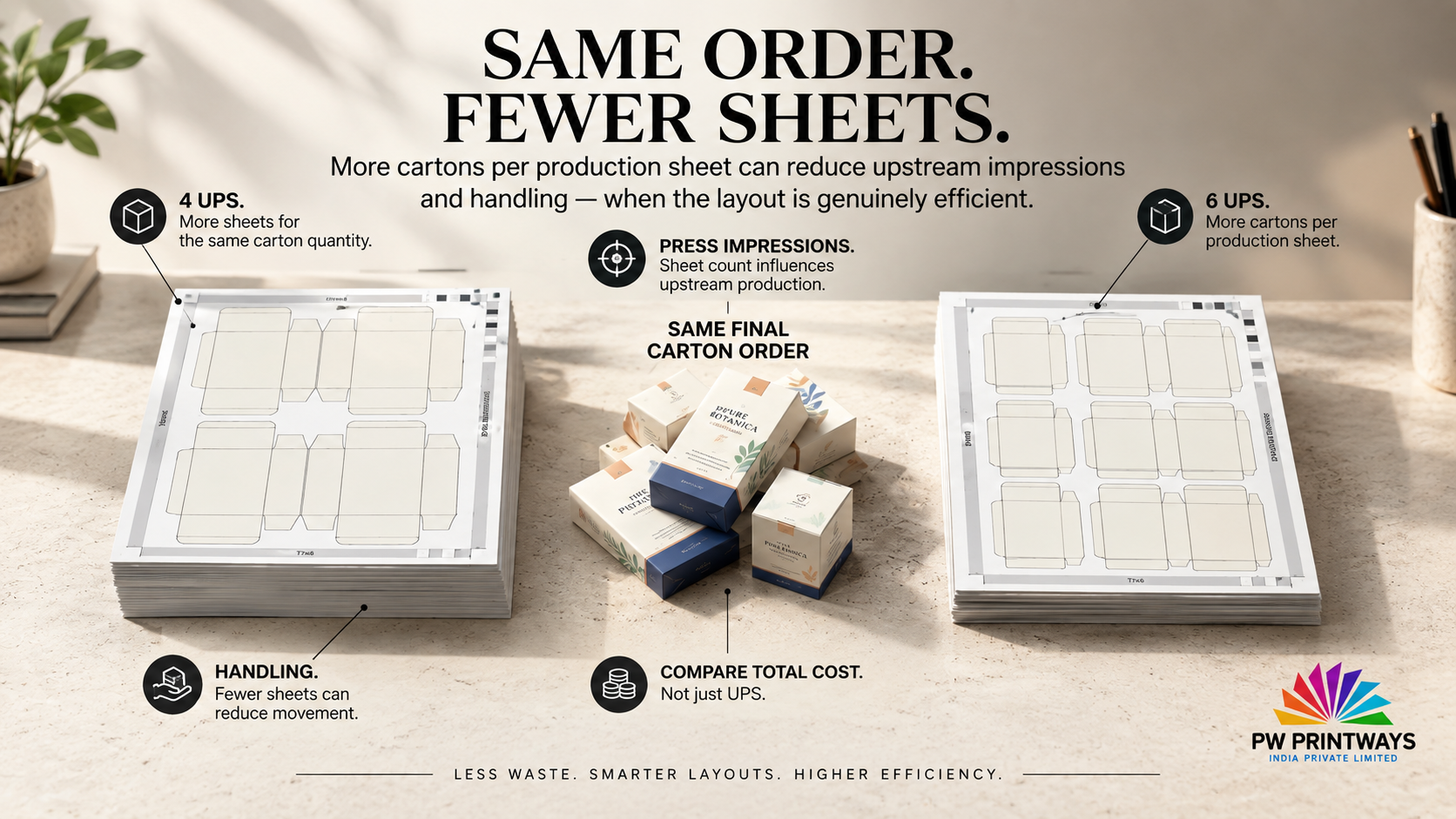
UPS, commonly used in print and packaging production, refers to the number of carton blanks arranged on one printing sheet. It is an important part of sheet planning and carton costing.
If a carton layout fits more efficiently on a usable sheet area, the same quantity of finished cartons may require fewer sheets. If the layout leaves significant unused area, material yield can be lower.
But UPS should never be judged by the number alone. A practical production layout must also respect press sheet size, gripper margins, bleed and register requirements, cutting clearances, grain direction, die layout and the actual carton structure.
The commercial objective is not simply to achieve the highest UPS. It is to achieve a production-valid layout that uses the sheet efficiently without creating new manufacturing problems.
Technical Accuracy
A Higher UPS Is Not Automatically the Cheapest Option
This distinction matters when costing a mono carton.
A layout that increases the number of blanks per sheet can improve board yield, but the final production cost still depends on the complete manufacturing plan. A theoretically tight layout may become impractical if it creates difficult cutting clearances, poor grain orientation, registration challenges or inefficient die-cutting.
The correct question is therefore: How efficiently can the carton be imposed on the available sheet while still meeting printing, converting and structural requirements?
Upgrade Stage 01
When a Brand Upgrades to Mono Cartons, Cost Should Be Designed — Not Just Quoted
Moving from a simple wrap, pouch, label or basic secondary package to a custom printed mono carton can improve product presentation and communication. It also introduces a more engineered paperboard structure.
The carton now has panels, flaps, creases, cut lines, glue areas, print coverage and finishing requirements. These elements have to be placed on a sheet before the carton can be printed and converted at production scale.
Product Dimensions
↓
Carton Dieline
↓
Sheet Layout / UPS
↓
Printing
↓
Die-Cutting & Creasing
↓
Folding & Pasting
That is why the carton should be costed as a connected manufacturing system rather than as a printed box with a fixed unit rate.
What Determines How Many Cartons Fit on a Sheet?
UPS is mainly an outcome of the relationship between the carton blank and the available production sheet. Several variables can change the practical arrangement.
01
Carton Dimensions
Panel width, height and depth strongly influence how efficiently blanks can be arranged.
02
Dieline Geometry
Flaps, glue areas, locking features and structural proportions change the blank footprint.
03
Press Sheet
Available sheet dimensions and production margins limit the usable area.
04
Orientation
The blank may be oriented in different directions depending on grain and production requirements.
Cost Stage 02
How a Carton UPS Decision Is Actually Made
01
The carton structure should be stable enough to evaluate before sheet utilisation is optimised.
02
Review the actual available sheet dimensions and required production margins.
03
Compare possible blank directions, nesting arrangements and sheet utilisation.
04
A layout must remain practical for the die-cutting and creasing operation rather than optimised only on a screen.
05
Compare blank count, usable sheet area and unavoidable waste to understand board efficiency.
06
Include printing, die tooling, finishing, pasting, production quantity and other applicable manufacturing costs.
Cost Stage 03
What Changes When the Sheet Layout Is Improved?
| Packaging Factor | Less-Efficient Layout | More-Efficient Layout |
|---|---|---|
| Blank Count / Sheet | Lower practical yield | Higher practical yield where feasible |
| Unused Board Area | Higher | Reduced |
| Sheets Required | Potentially higher | Potentially lower |
| Board Consumption | Potentially higher | Potentially lower |
| Die Layout | May be less efficient | May improve material utilisation |
| Total Carton Cost | Depends on full production setup | Can improve when other variables remain controlled |
Important:
An increase in UPS does not guarantee the same percentage reduction in total carton cost. Setup, tooling, finishing, printing, production quantity and converting requirements still influence the commercial result.
Five Cost Areas Influenced by Sheet Utilisation
COST CHANNEL 01
Paperboard Requirement
The number of usable blanks obtained from each sheet can affect how many sheets are required for the production quantity.
COST CHANNEL 02
Material Waste
More unused sheet area can mean a lower material yield, particularly when the carton is produced at high volume.
COST CHANNEL 03
Printing Efficiency
The practical sheet layout must suit the printing press and artwork, including production margins and registration requirements.
COST CHANNEL 04
Die-Cutting Efficiency
A sheet plan still has to work through cutting and creasing. Practical die layouts help control avoidable waste and production interruptions.
COST CHANNEL 05
Scale Effect
A small yield difference repeated across large quantities can become more meaningful than the same difference on a short production run.
Why a Small Dieline Change Can Improve UPS
A carton does not need to become dramatically smaller to improve sheet utilisation.
A structural review may identify unnecessary panel width, oversized flaps, inefficient proportions or other blank geometry that prevents cartons from nesting efficiently.
This is different from simply reducing GSM. The aim is to use the existing paperboard more intelligently while retaining the functional requirements of the pack.
Our Illustrative Example: Reducing Board Use Through Carton Dieline Design uses hypothetical assumptions to explain the comparison. It does not report a verified customer result.
Related illustrative reading: Illustrative Example: Reducing Board Use Through Carton Dieline Design. These examples do not report verified client outcomes.
UPS Optimisation Warning
Don’t Optimise the Sheet at the Expense of the Carton
× Cutting clearances become impractical
× Grain direction becomes unsuitable for the structure
× Registration or finishing requirements are compromised
× Folding or pasting performance becomes unreliable
× Product fit or structural strength is reduced
× Apparent material savings create rejection or rework
The more efficient layout is the one that improves yield without creating a downstream manufacturing penalty.
The Real Target: Cost per Functional Carton
Packaging buyers sometimes focus on the cheapest board rate or the highest number of blanks per sheet. Neither metric, by itself, tells the full story.
The more useful target is a carton that delivers the required product protection, presentation and production performance at an efficient overall manufacturing cost.
Effective Carton Cost
=
Board + Printing + Finishing + Die-Cutting + Pasting + Other Applicable Costs
÷
Accepted Functional Cartons Produced
UPS influences the board-and-sheet side of this equation, but the final commercial outcome depends on the entire production system.
Upgrade Stage 02
UPS Becomes More Important as Mono Carton Volumes Increase
For a low-volume trial, a small difference in sheet yield may have limited commercial impact. For a recurring high-volume SKU, the same difference repeats across every production sheet.
This is particularly relevant to industries such as FMCG, pharmaceuticals, cosmetics, food & beverage, electronics, D2C and retail products, where packaging is often produced repeatedly against approved artwork and specifications.
Scale Principle
Small Yield Difference × Large Repeat Quantity = Potentially Meaningful Material Impact
UPS and Right-Sizing Are Connected — But They Are Not the Same Thing
Right-sizing looks at the finished carton around the actual product. UPS looks at how efficiently the approved carton blank can be arranged on a production sheet.
A right-sized carton may still have poor sheet utilisation. Conversely, a highly efficient sheet layout may be built around a carton that is unnecessarily large for the product.
The strongest packaging reviews consider both levels together: product fit first, then structural efficiency, then sheet utilisation.
Related illustrative reading: Illustrative Example: Carton Right-Sizing and Shipping Cost. These examples do not report verified client outcomes.
The Sheet Layout Must Also Work With Print and Finishing
UPS should be reviewed before final production because the sheet arrangement has to accommodate the complete printed packaging workflow.
Artwork coverage, colour management and finishing can influence how the print job is planned. Your packaging team may also need to account for coating, lamination or other finishing requirements when finalising production specifications.
For example, PW Printways’ packaging guidance explains how Pantone colours can behave differently on coated and uncoated boards, while its finishing guide discusses gloss, matte and velvet options for mono cartons.
How Pantone Colours Behave on Coated vs Uncoated Board →
Gloss, Matte or Velvet: Which Finish Is Right for a Mono Carton? →
Which Packaging Projects Should Be Reviewed for UPS?
See more about the industries served by PW Printways India →
Better UPS Can Support Material-Efficiency Goals
Improving sheet utilisation can reduce avoidable paperboard waste when the production layout is genuinely more efficient.
However, higher UPS should not be described as automatically “sustainable.” Responsible packaging still requires the correct amount of board, reliable product protection, suitable finishing and consideration of the complete packaging system.
Read our Responsible Packaging & Sustainable Printing Guide →
Manufacturer Perspective
How PW Printways Looks at Carton UPS
At PW Printways India Pvt. Ltd., custom mono-carton projects can be developed around product dimensions, board specification, artwork, printing and finishing requirements.
The company’s published packaging workflow includes structural development, prepress, proofing, printing, finishing and final quality inspection. That makes sheet utilisation part of a broader manufacturing discussion rather than a standalone costing exercise.
A practical UPS review may consider:
- Actual carton blank dimensions
- Approved dieline and structure
- Board grade and caliper
- Available press sheet dimensions
- Production margins and register requirements
- Die-cutting and creasing requirements
- Required quantity and repeat frequency
- Printing, coating and finishing specification
The objective is not merely to fit more blanks on a sheet. It is to achieve repeatable manufacturing efficiency without compromising the carton itself.
Explore Our Manufacturing Process →
Custom Mono Cartons Designed Around Production Reality
PW Printways manufactures custom mono cartons and folding-paperboard packaging for pharmaceuticals, FMCG, cosmetics, electronics, food, retail and other product categories.
A carton costing exercise can be more useful when structure, board, UPS, printing, finishing and final production quantity are reviewed together.
Explore PW Printways Packaging Products →
PAN-India Packaging Manufacturing
UPS and Mono Carton Cost Planning for Businesses Across India
PW Printways India manufactures custom printed packaging from Bawana, Delhi and supports packaging requirements for businesses across India.
For buyers in Mumbai, Pune, Ahmedabad, Surat, Bengaluru, Hyderabad, Chennai, Kolkata, Jaipur, Chandigarh, Lucknow, Indore, Kochi and other markets, the practical costing discussion can be built around the actual product, board, sheet layout, quantity, printing and delivery requirement rather than a generic per-carton assumption.
International and export-oriented enquiries can also be discussed according to the product configuration and production specification.
UPS Review Brief
What Should You Share Before Reviewing Carton UPS?
| Actual Product | Bottle, jar, tube, unit or primary container |
| Product Dimensions | Accurate packed product L × W × H |
| Existing Carton | Current sample and dieline if available |
| Board Specification | Board grade, GSM / caliper where known |
| Printing Requirement | Colours, artwork, coverage and process |
| Finishing | Coating, lamination or specialty requirements |
| Quantity | Production quantity and repeat frequency |
| Target Cost | Budget direction or current carton cost if available |
Related Packaging Insights
Related illustrative reading: Illustrative Example: Reducing Board Use Through Carton Dieline Design. These examples do not report verified client outcomes.
Related illustrative reading: Illustrative Example: Carton Right-Sizing and Shipping Cost. These examples do not report verified client outcomes.
COLOUR MANAGEMENT
How Pantone Colours Behave on Coated vs Uncoated Board →
SURFACE ENGINEERING
Gloss, Matte or Velvet: Choosing a Mono Carton Finish →
RESPONSIBLE PACKAGING
Responsible Packaging & Sustainable Printing →
PACKAGING PRODUCTS
Explore Mono Cartons & Printed Packaging →
INDUSTRIES
Packaging Solutions by Industry →
Mono Carton Cost Engineering
Could Your Carton Use the Sheet More Efficiently?
Share your existing carton or dieline, product dimensions, board specification, quantity and printing requirement with the PW Printways India team to discuss sheet utilisation and carton costing.
Frequently Asked Questions
Mono Carton UPS & Packaging Cost FAQs
What does UPS mean in packaging?
UPS generally refers to the number of carton blanks arranged on one production sheet. It is used when planning sheet utilisation and estimating how many finished blanks can be obtained from a sheet.
Does higher UPS always reduce mono carton cost?
No. A higher UPS can improve material utilisation, but the layout must still satisfy press, printing, die-cutting, creasing, grain direction, finishing and structural requirements. Total carton cost also includes other production factors.
How does UPS affect paperboard consumption?
When more usable carton blanks can be produced from each sheet, fewer sheets may be required for the same finished quantity. The actual effect depends on the production layout and unavoidable waste.
Can changing the carton dieline improve UPS?
Yes. Structural changes can sometimes improve blank proportions and sheet nesting. Any change should still be checked for product fit, strength, cutting, creasing, folding and pasting performance.
Is UPS the same as sheet utilisation?
Not exactly. UPS is the number of blanks arranged on a sheet, while sheet utilisation considers how effectively the usable sheet area is occupied and how much unavoidable waste remains.
Can higher UPS create production problems?
It can if the layout ignores production clearances, cutting accuracy, grain direction, registration, finishing or other requirements. The practical layout is more important than the UPS number alone.
When should a brand review its carton UPS?
Reviewing UPS can be useful when launching a new mono carton, changing carton dimensions, switching board, increasing production volume, redesigning a dieline or investigating material cost and waste.
Does UPS affect only material cost?
No. Sheet layout can also interact with printing planning, die-cutting efficiency and production setup. However, UPS should not be treated as a direct measure of total manufacturing cost.
Can UPS optimisation support responsible packaging?
It can support material-efficiency efforts by reducing avoidable sheet waste. Responsible packaging still requires the complete package to be evaluated for material quantity, product protection, production and end-of-life considerations.
Does PW Printways manufacture custom mono cartons in India?
PW Printways India manufactures custom printed mono cartons and folding cartons from its Bawana, Delhi manufacturing location and supports packaging requirements for businesses across India.
Can PW Printways discuss carton sheet utilisation for an existing pack?
Yes. An existing carton sample or dieline, product dimensions, board specification, quantity and printing requirements provide a useful starting point for a packaging-cost discussion.
About PW Printways India Pvt. Ltd.
PW Printways India is a custom printed packaging manufacturer specialising in mono cartons, folding cartons and printed corrugated packaging. Its published workflow covers structural development, prepress, proofing, printing, finishing and final quality inspection.
Packaging projects can be developed around product dimensions, material specifications, artwork, printing, finishing and required production quantities.
Manufacturing Location:
K-30, Sector-5, DSIIDC Bawana Industrial Area,
Delhi – 110039, India
Market Reach:
PAN India • International / export-oriented enquiries
About / Products / Industries / Contact
Technical note: UPS and sheet utilisation are production-planning concepts. Actual yield depends on the approved carton structure, available sheet, production tolerances, board characteristics, grain direction, printing requirements, die-cutting layout and manufacturing conditions. Commercial savings should therefore be validated using the actual production specification rather than a UPS number alone.
