
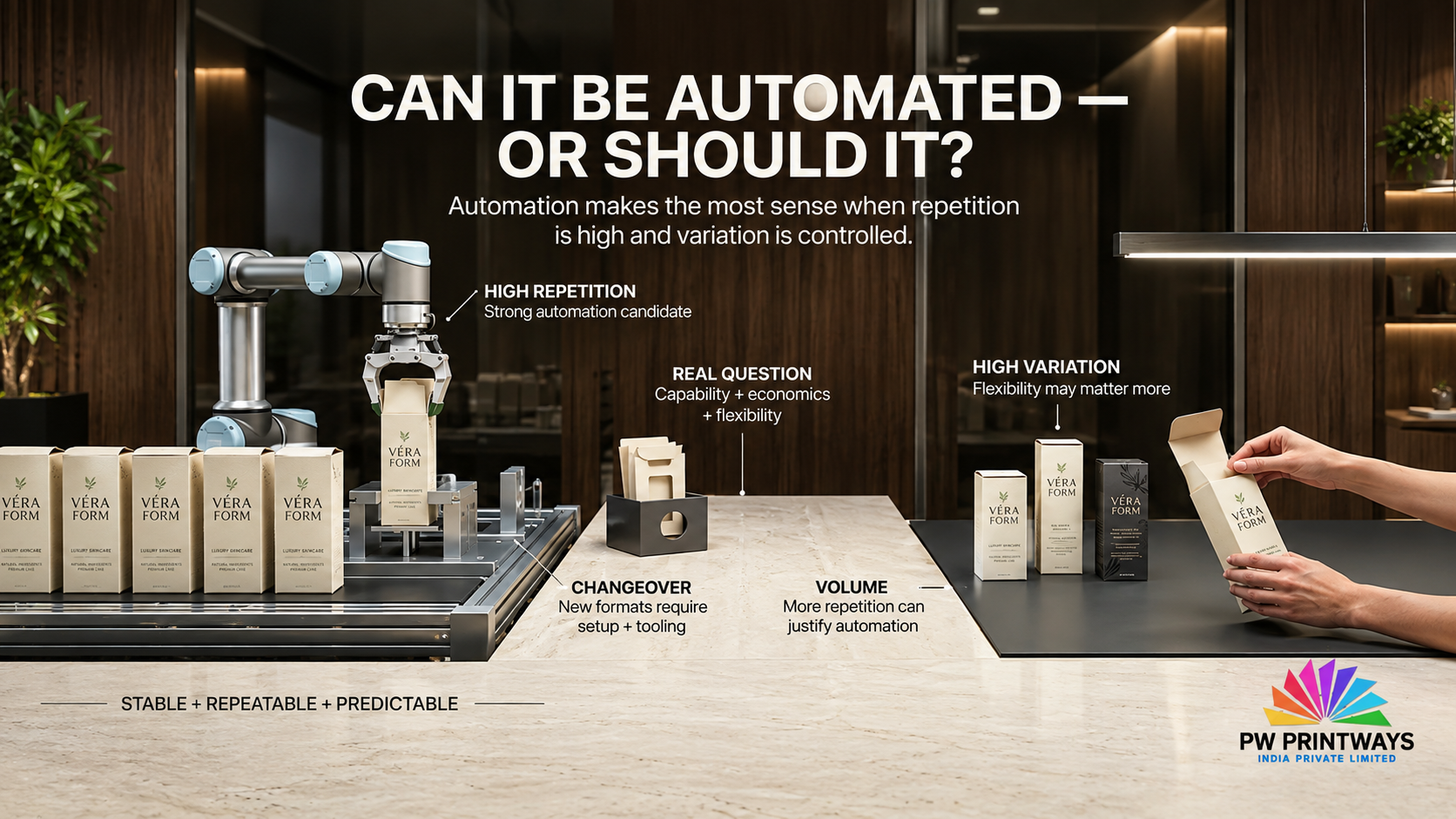
Future of Carton Manufacturing / Automation / Hand-Finishing
Will Robotics Ever Fully Replace Hand-Finishing for Complex Cartons?
Automation is moving deeper into folding, gluing, inspection and packing. But complex cartons raise a harder question: can a machine adapt when the package itself keeps changing?
PW Packaging Engineering View · Mono Cartons & Folding Cartons · India
The short answer
Robotics can replace more repetitive hand work. It does not automatically replace people.
Robotic carton-folding research shows that complex structures can be automated under engineered conditions. Commercial converting systems already automate major folding and gluing stages. The harder issue is economic and operational adaptability across different structures, materials, volumes and exceptions.
The practical question
Can the system repeat the job reliably at the required volume, changeover time and cost?
01 / Start with the carton
Why Complex Cartons Create a Different Automation Problem
A standard carton can follow a predictable sequence. A complex carton may introduce unusual folds, special openings, interacting panels or a folding sequence that is sensitive to the board and crease geometry.
That changes the automation problem. The machine is no longer performing one fixed motion repeatedly; it must deal with geometry, positioning, tooling, material behaviour and sequence control. Research into robotic carton folding has therefore focused on reconfigurable systems capable of handling different structures rather than one permanently fixed format.
| A Stable Geometry Repeatable structure and predictable folding sequence. |
B Controlled Variation Several known carton formats with planned setups. |
C Complex Structures Multiple folds, unusual movement or interacting panels. |
D Custom / Variable Work Low volumes, prototypes, frequent change and exceptions. |
02 / Where automation is strongest
What Robots Can Already Do — and What Still Gets Difficult
| Automation works well when… | Human flexibility matters when… |
|---|---|
| The carton structure repeats at high volume. | Carton styles change frequently or volumes are low. |
| The folding and gluing sequence is stable. | The job involves unusual sequences or new structures. |
| Inputs and tolerances are well controlled. | Operators need to identify and manage exceptions. |
| Throughput and repeatability justify the system. | Setup, programming and changeover would consume too much capacity. |
This is why “robotic” does not automatically mean “fully autonomous.” Automation can be highly effective inside a controlled process while still relying on people for development, setup, troubleshooting, inspection and change.
03 / The hand-finishing question
Hand-Finishing Is Not Just “Manual Folding”
Hand-finishing can include more than physically folding a carton. Operators may be assembling, positioning, checking, correcting, sorting or handling a construction that the automated line was not built around.
The better question is not “Can a robot fold this carton?”
It is:
“Can the system fold it reliably, repeatedly and economically under real production conditions?”
04 / Inside the production line
Where Automation Fits Into a Modern Mono-Carton Workflow
| 01 Structural Development |
02 Prepress & Artwork |
03 Printing |
04 Die-Cutting & Creasing |
05 Folding & Gluing |
06 Inspection & Packing |
Modern folding-carton systems can automate substantial parts of folding and gluing, while downstream packaging automation can extend into inspection, packing and handling. The strongest manufacturing model is usually not “remove people everywhere,” but “automate the predictable stages and keep flexibility where it adds value.”
That same principle is relevant when a brand upgrades from a simpler package to a printed mono carton. A complex structure should be designed with its actual manufacturing route in mind from the beginning.
05 / The economics
A Robot Can Be Technically Possible and Still Be the Wrong Business Decision
Automation has to be evaluated as a production investment, not as a technology demonstration. The relevant question is whether the system creates enough value after considering capital cost, programming, tooling, changeover, maintenance, downtime and actual production volume.
| Decision Factor | Automation becomes easier to justify when… | Flexible work may remain practical when… |
|---|---|---|
| Production Volume | Large recurring runs repeat the same sequence. | Volumes are low or irregular. |
| Carton Variety | A small family of structures dominates production. | Many custom structures change frequently. |
| Changeover | Setup is predictable and repeatable. | Frequent setups consume too much capacity. |
| Quality | Variation can be measured and controlled. | Inspection and correction rely heavily on judgement. |
06 / Upgrading to mono cartons
The Automation Question Should Start When the Mono Carton Is Designed
When a brand upgrades to mono cartons, it may introduce more structural and finishing choices: tuck-end configurations, windows, inserts, multiple SKU variants and premium finishes. Each additional feature can change how the carton behaves during converting and finishing.
That is why packaging design should consider the production route early. A carton that is visually impressive but difficult to manufacture repeatedly can create unnecessary setup, finishing or inspection work.
| Design for repeatability Use a structure and specification that can be reproduced consistently. |
Design for changeover Understand how many sizes, SKUs and structures the line must handle. |
Design for inspection Leave a clear path for quality checks and exception handling. |
Related illustrative reading: Illustrative Example: Reducing Board Use Through Carton Dieline Design. These examples do not report verified client outcomes.
For the evolution of folding-carton manufacturing, read
1879 Changed the Folding Carton — What Has Changed Since?
.
07 / Human + machine
The More Realistic Future: Machines Working With Skilled People
Robotics does not have to mean a factory without skilled operators. A more practical model is a production system where machines handle repeatable movements and people handle the parts that require adaptation, judgement and decisions.
| Machines Speed + Repeatability |
People Judgement + Adaptation |
System Integration + Control |
The result can be a manufacturing environment where high-volume repeat orders use more automation, while prototypes, special structures and exceptions retain a flexible human-led path.
08 / Practical roadmap
What Should a Carton Manufacturer Automate First?
| 01 | Map repeat work. Identify carton structures and tasks that recur often enough to justify investment. |
| 02 | Standardise inputs. Stable board, artwork, dielines and tolerances make automation easier. |
| 03 | Automate predictable stages. Repetitive folding, gluing, counting, inspection or packing can be logical starting points. |
| 04 | Measure changeover. Account for the real setup time, not only theoretical machine speed. |
| 05 | Keep an exception route. New structures, defects and unusual jobs still need a controlled path. |
| 06 | Validate before scaling. Test the real carton, board and production conditions before expanding automation. |
Packaging engineering library
Related PW Printways Insights
| Manufacturing Evolution 1879 Changed the Folding Carton — What Has Changed Since? |
Structural Efficiency Illustrative Example: Reducing Board Use Through Carton Dieline Design |
| Converting Quality Laminate Cracking Along the Score / Crease Line |
Products Explore Custom Mono Cartons & Printed Packaging |
Technical references
Research Behind the Automation Discussion
The automation discussion is informed by published research into robotic folding of complex carton structures and more recent work on automated folding-sequence planning.
Automatic Folding of Cartons Using a Reconfigurable Robotic System →
A Packaging Robot for Complex Cartons →
A Reconfigurable Robotic Folding System for the Confectionery Industry →
Automating Box Folding: Sequence Extraction and Ranking Methodologies →
PAN-India Packaging Manufacturing
Automation Thinking for Mono Cartons Across India
PW Printways India Pvt. Ltd. manufactures custom printed packaging from Bawana, Delhi and supports packaging requirements for businesses across India.
For brands considering new mono-carton structures or higher production volumes, the discussion can begin with product dimensions, board, structure, artwork, quantity, packing method and the desired level of production repeatability.
Mono Carton Development
Planning a New Mono Carton or a Complex Carton Upgrade?
Start with the actual product, structure and production requirement. Understanding the carton first makes it easier to decide which stages should be automated and where flexibility is still valuable.
Send Your Packaging Requirement →
+91-98993-80302 [email protected]
Frequently Asked Questions
Robotics & Hand-Finishing FAQs
Can robots fold complex cartons?
Will robotics completely eliminate hand-finishing?
Why are complex cartons harder to automate?
Is automated folding always cheaper than hand-finishing?
What should a brand consider when upgrading to mono cartons?
Does automation mean fewer quality checks?
About PW Printways India Pvt. Ltd.
PW Printways India Pvt. Ltd. is a custom printed packaging manufacturer specialising in mono cartons, folding cartons and printed corrugated packaging. Its published manufacturing information covers structural development, prepress, proofing, printing, finishing and final quality inspection.
This article is an engineering and industry perspective. It does not claim that robotics will replace all hand-finishing, nor does it predict the performance of a particular machine. Automation suitability should be evaluated on the actual carton, board, production volume and process conditions.
Manufacturing Location:
K-30, Sector-5, DSIIDC Bawana Industrial Area, Delhi – 110039, India
Market Reach:
PAN India • International / export-oriented enquiries
/
Products
/
Contact
